My allergies have been incredible this year, and by that I mean that they have been worse than they have ever been. (Please, please, please do not suggest medical advice here. Much appreciated.) I see an allergy specialist who gives me 2 shots, 2-3 times a week to help with my symptoms. They have helped a lot; however, Juniper Ash (Cedar Fever!) here in Austin is 6 times worse than average this year, and boy oh boy, do I feel it. She suggested that I wear a face mask when I go outside to help reduce the amount of pollen that is going into my lungs and sinuses. After going to a few different stores to purchase some, I found that many other Austinites had already bought them out. No worries, right? I know how to sew. I will just make one. When I finished, I had many requests for a tutorial, so here you go:
Materials needed:
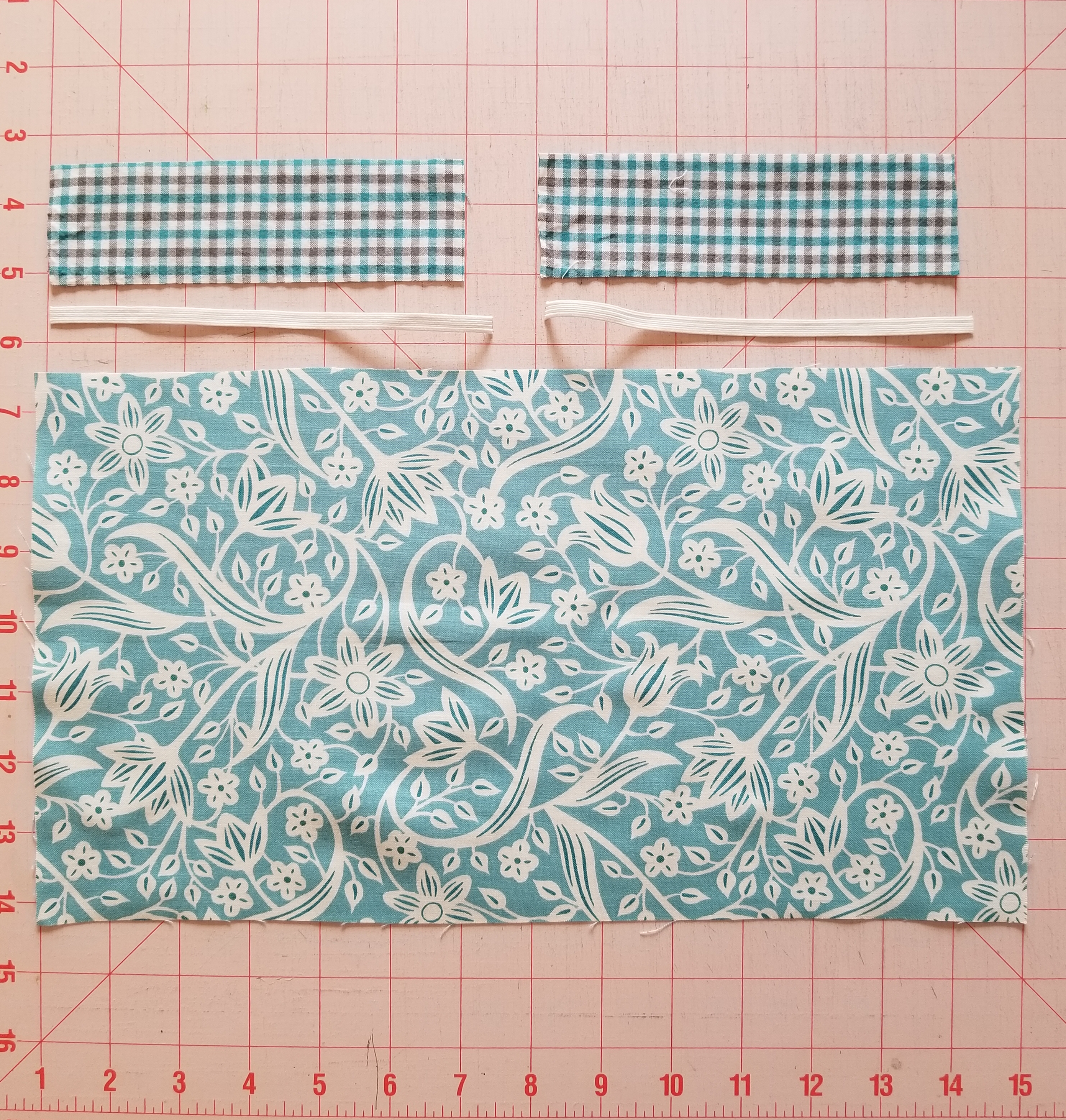
- 1 piece of fabric measuring 8” x 14”. Until you get familiar with this tutorial, I would suggest a non-directional print. One that has a scattered image printed on the surface such as the one shown.
- 2 strips of fabric measuring 1.75” (1 3/4”) x 6”. This will be the accent edge piece. It can be the same fabric as the main piece or a small-scale print or solid.
- Two pieces of 1/4” width elastic. These will be about 6 1/2” long.
- Ruler
- Fabric marking tool.
- Pins
- Scissors
- Sewing machine, threaded.
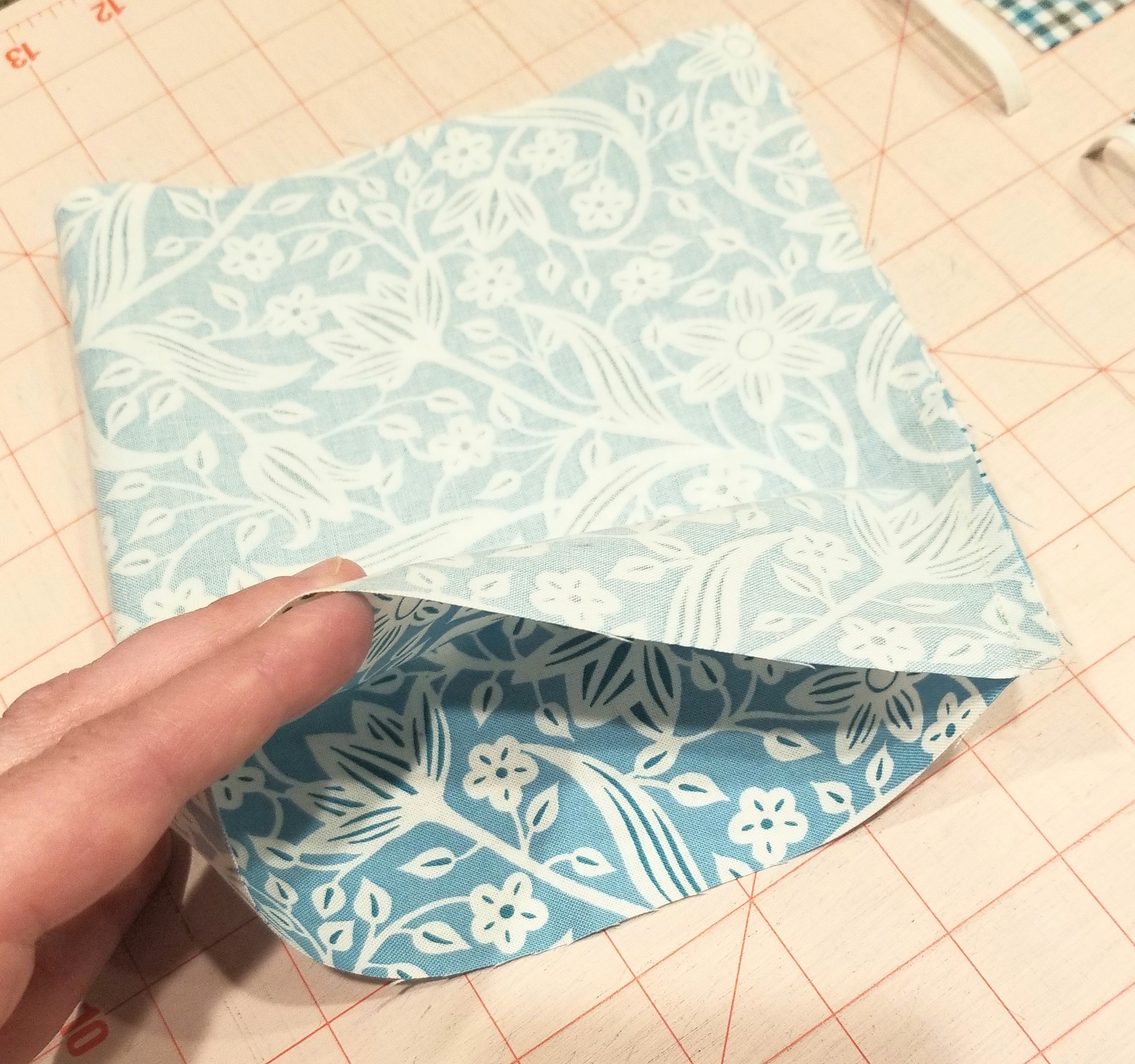
Fold the main piece of fabric in half, right sides together. Sew along the 8 inch width edge, using a 1/4 inch seam allowance.
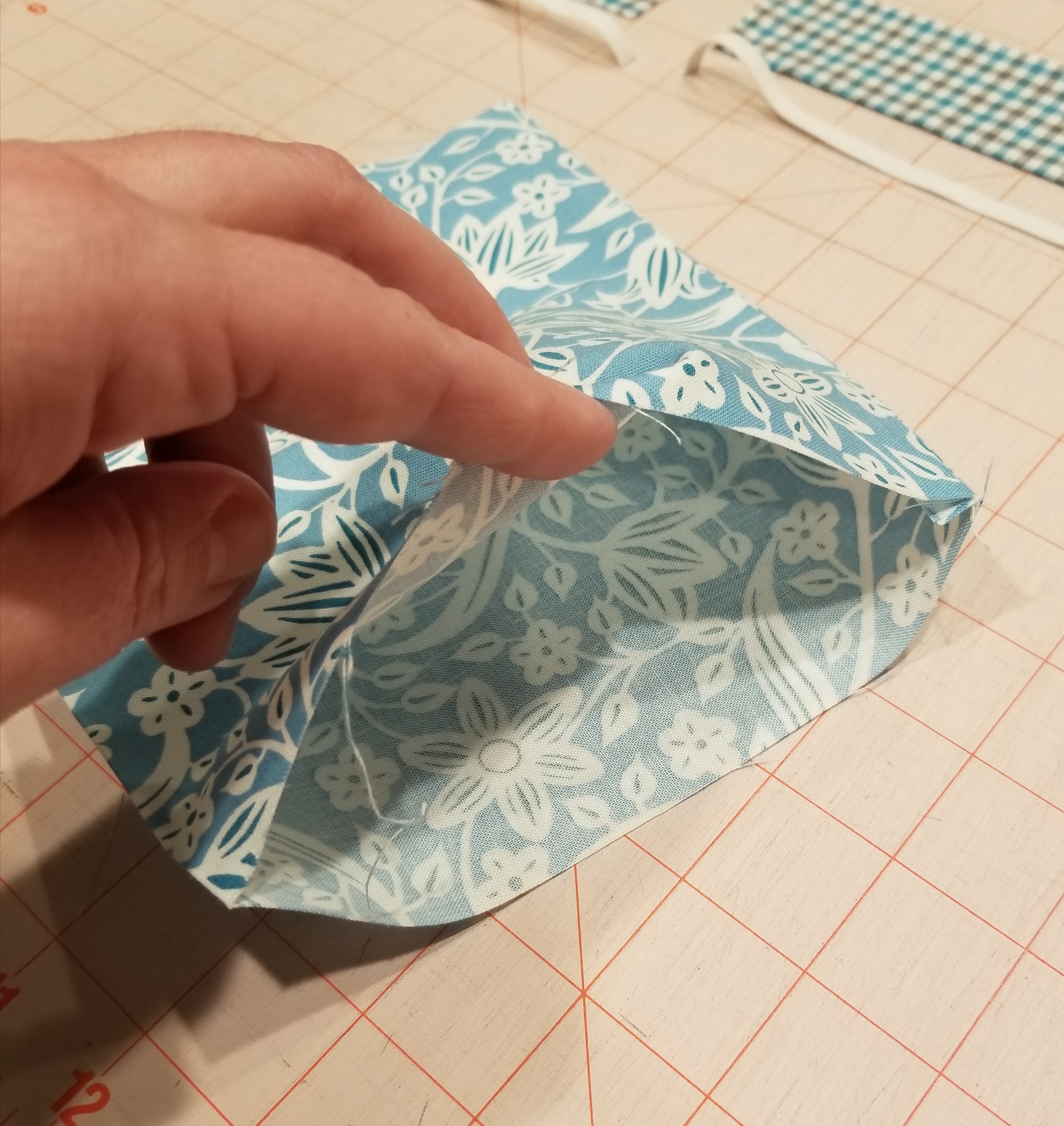
Turn this tube shape inside out, so that the right side of the fabric is now on the outside. Press this flat, keeping the seam to one end of the flattened tube.
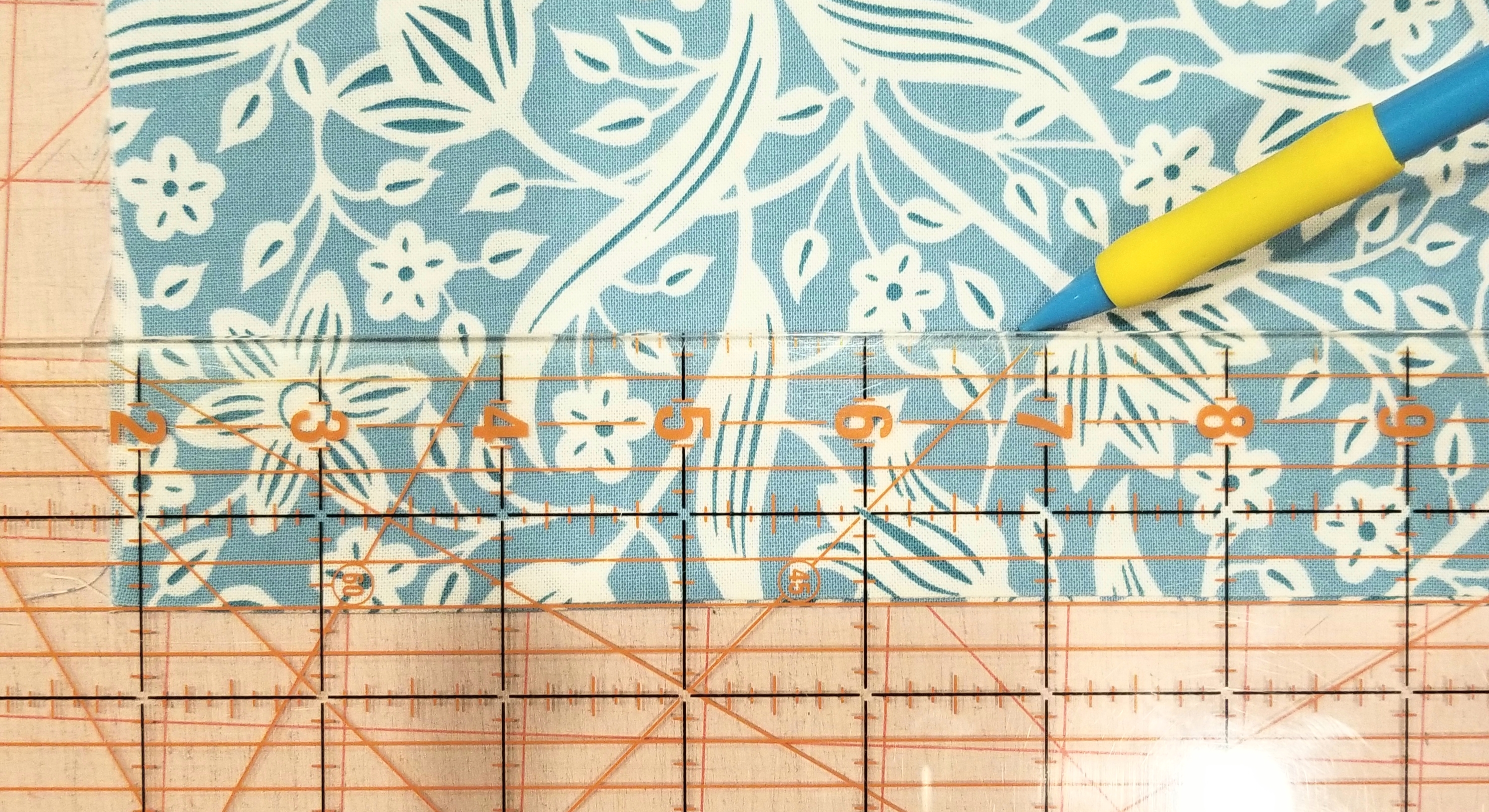
Place the tube of fabric so that the raw edges are on each side and the seam edge is at the bottom. Using a ruler, measure and mark a line 1 1/2 inches from the bottom edge. Make another line 1 inch above this line, or 2 1/2 inches from the seam edge. Don’t use a pencil as you see in the picture, use a fabric pen, or fabric chalk. I used a pencil for illustration purposes.
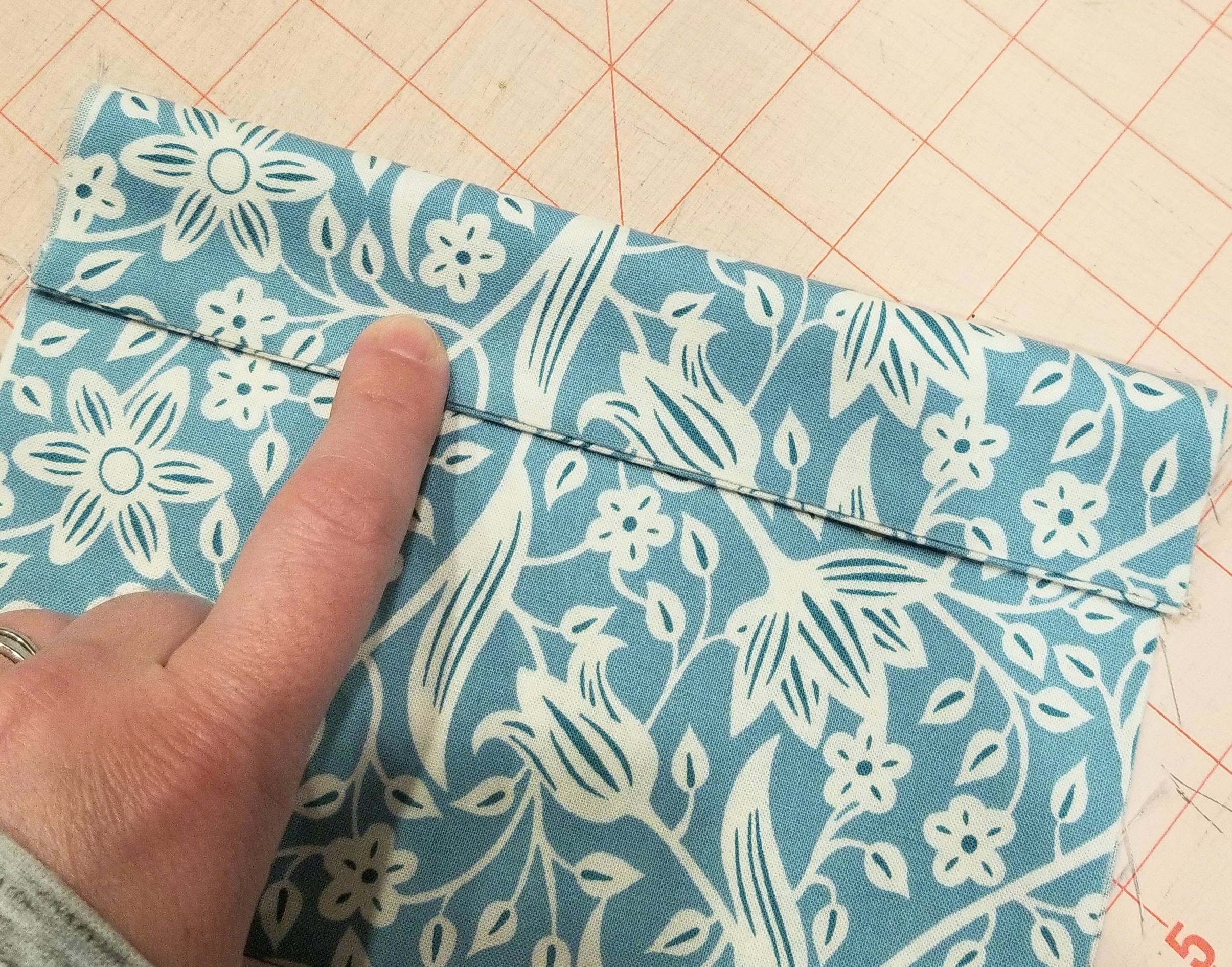
Fold the seam edge up (or down in this picture, as I turned it upside down…sorry) making the crease on the first line that you just marked. You should have 1 1/2 inch edge here.
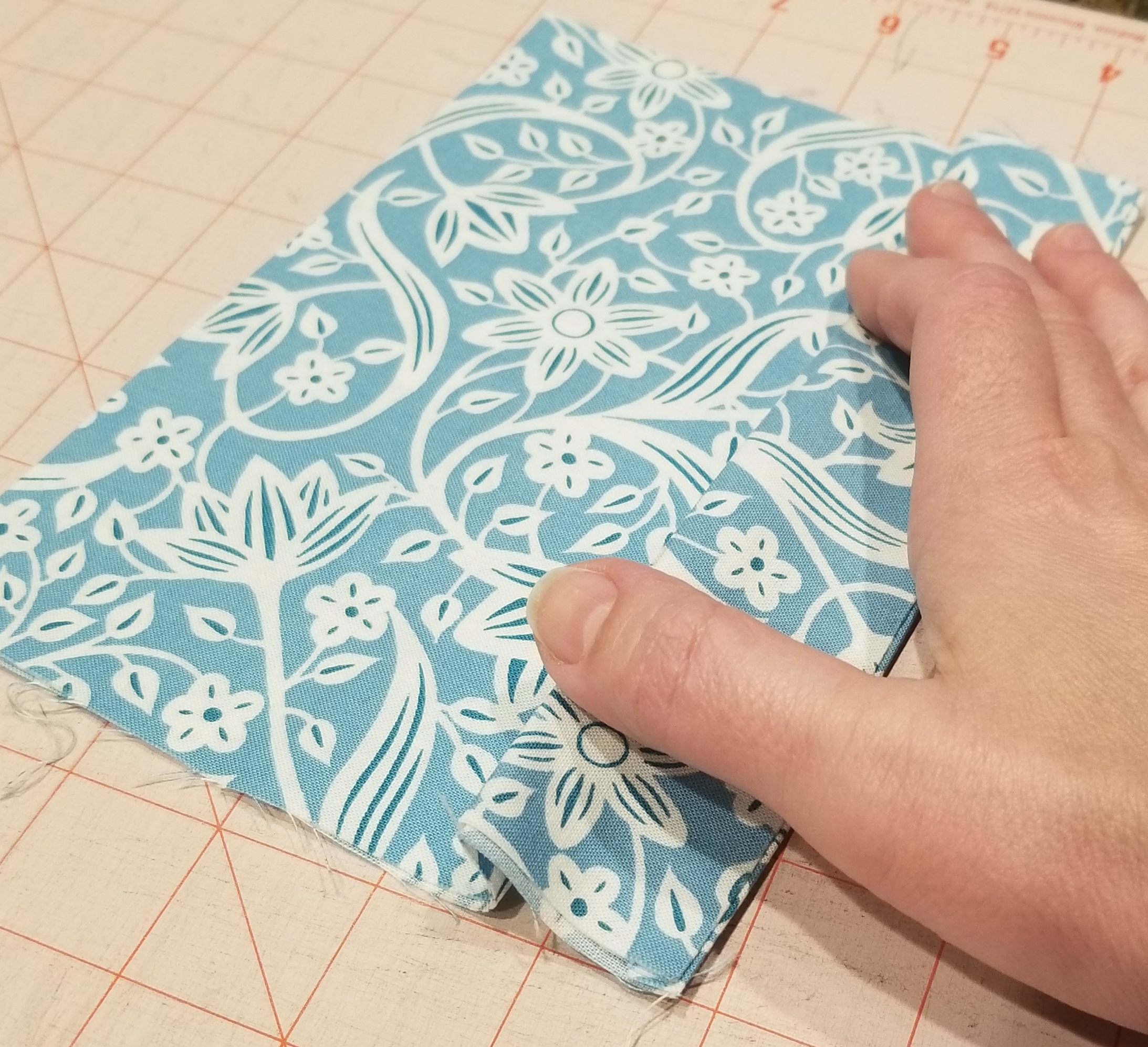
Flip the tube piece over. Match the crease edge to the second line that you made earlier. Press. The pleat that you just created will be 1/2 inch deep. Pin the pleat down on each raw edge end.
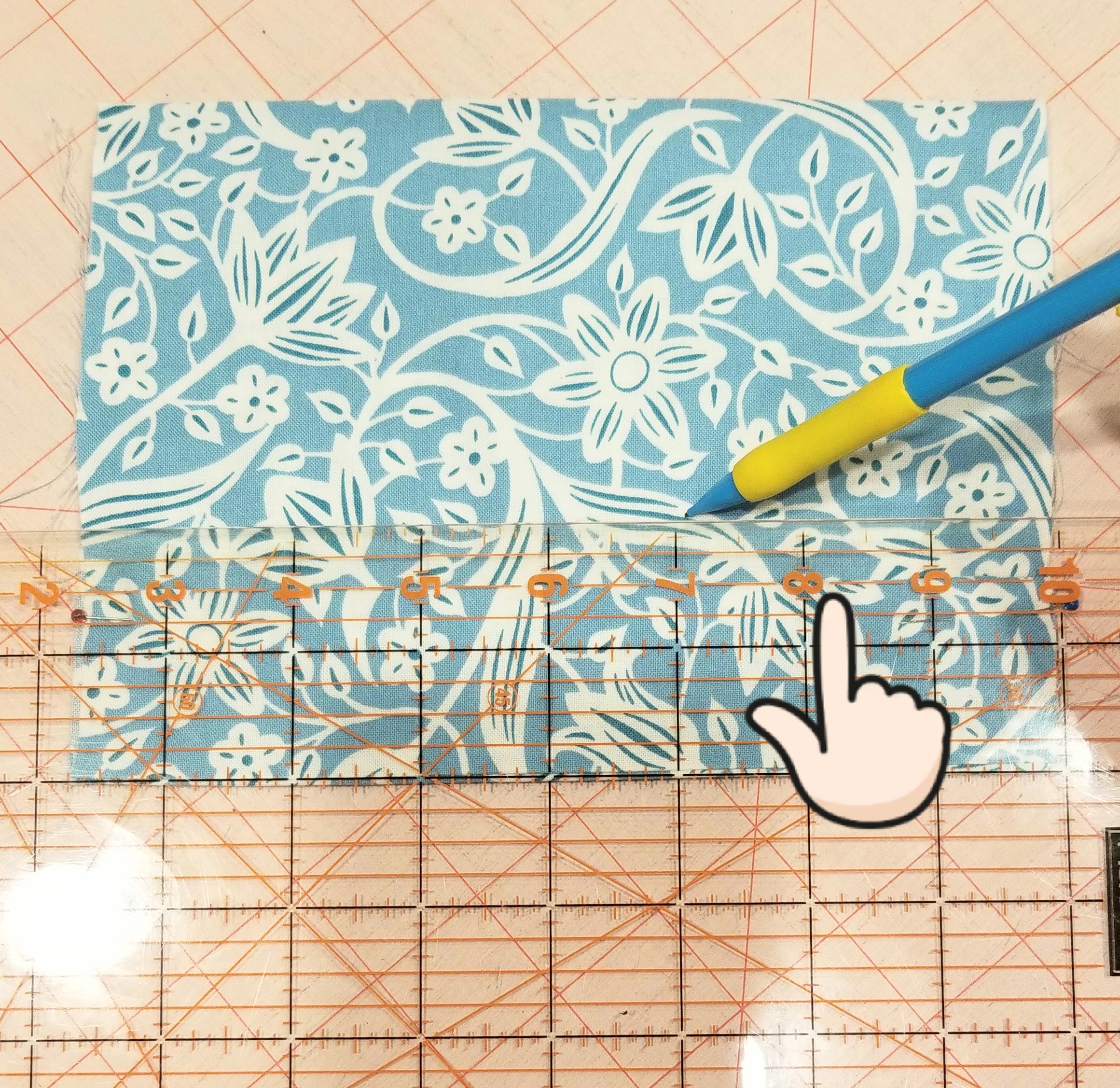
Now you will mark the lines for the second pleat. Mark a line measuring 1/2” from the top crease of the last pleat, (or 2″ from the bottom seam edge). It was difficult to see the top of the crease in this picture, so look at the finger indicator above.
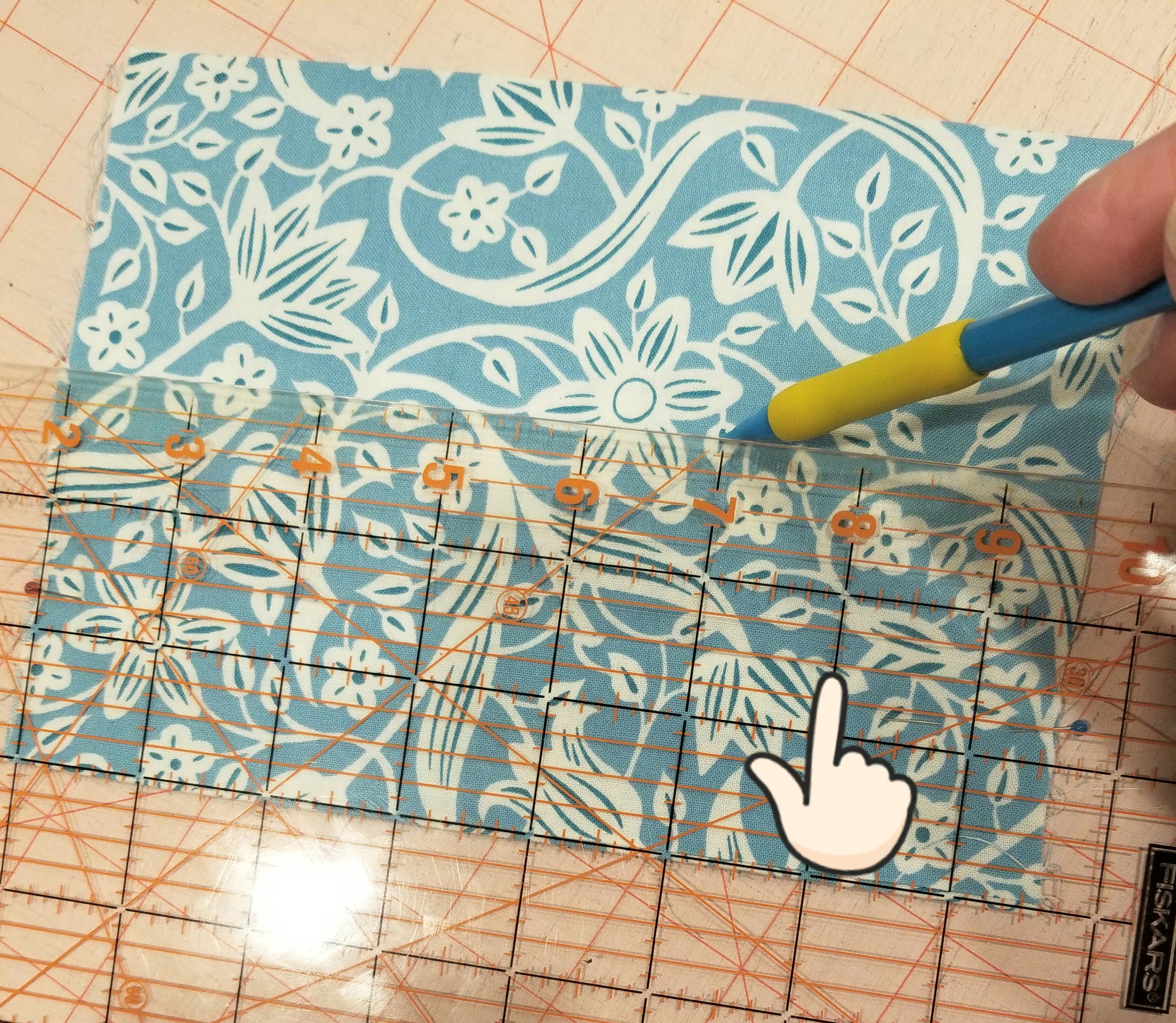
Now mark another line one inch above the last line that you made (or 3 inches above the seam edge). Using these lines as your guide, repeat the steps that you followed to make the first pleat.
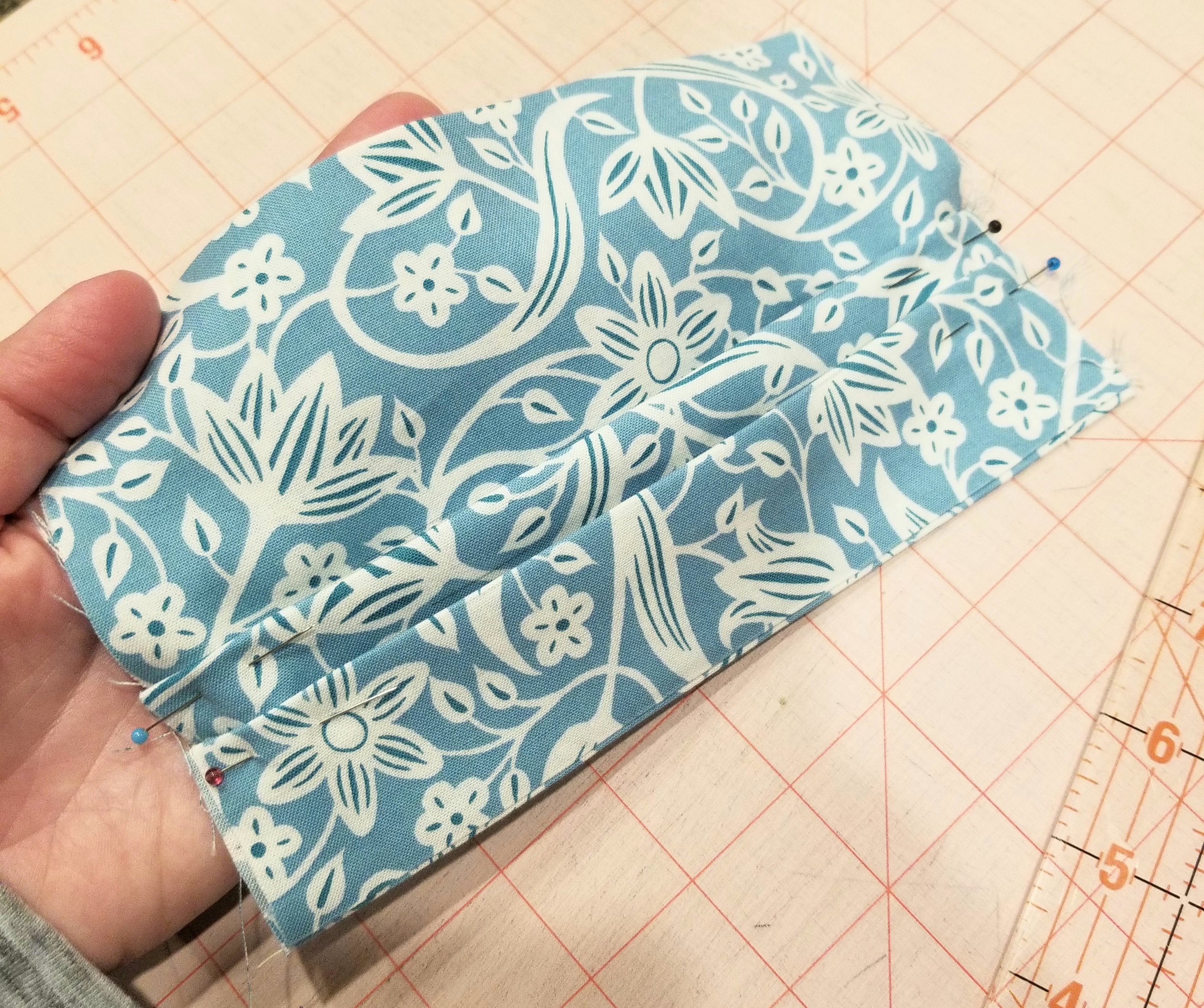
You should now have two pleats, each one being 1/2 inch deep. Repeat the steps you used to make the second pleat, so that you end up with three pleats total. Press.
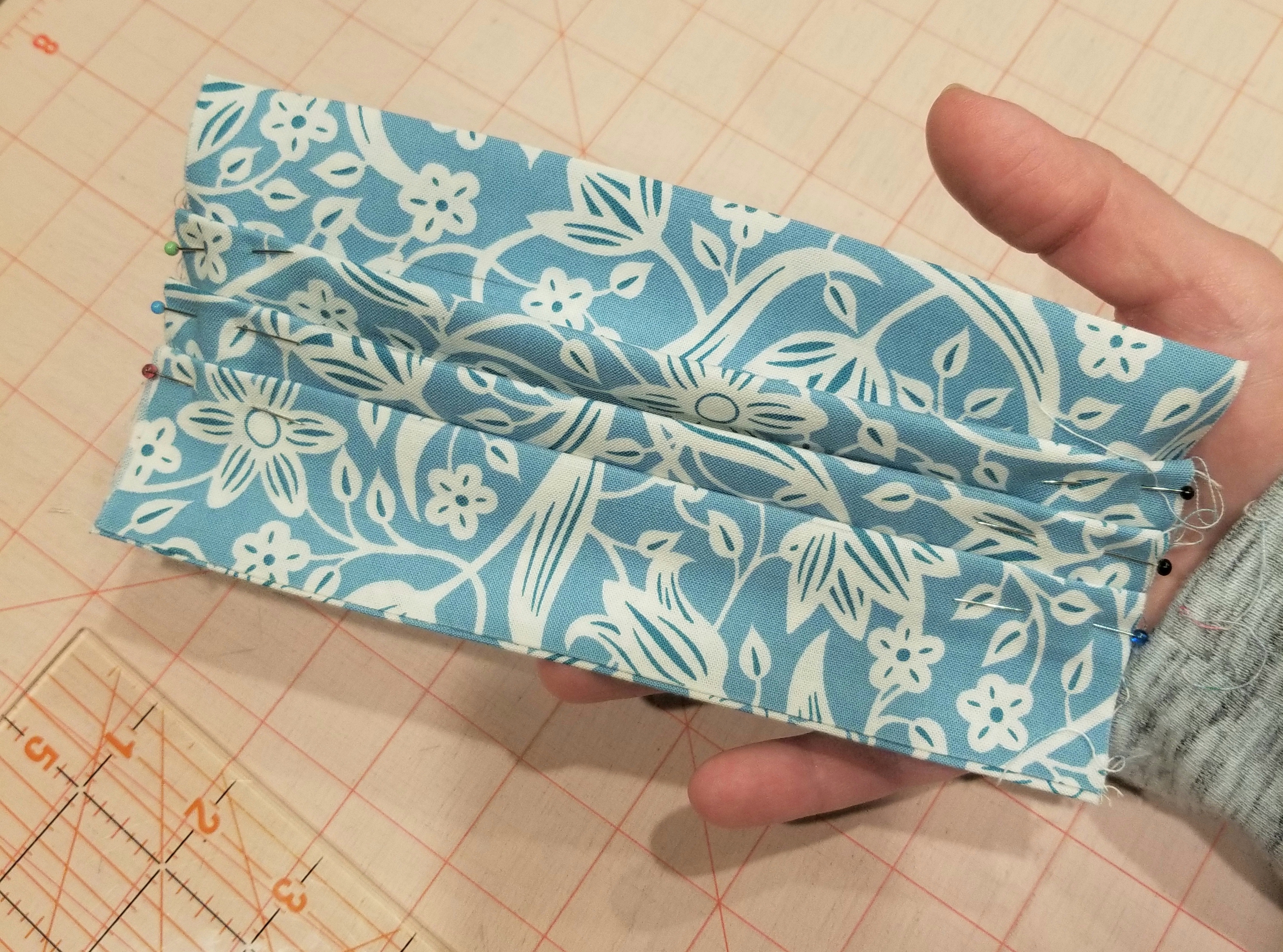
This is what your main piece should look like at this point.
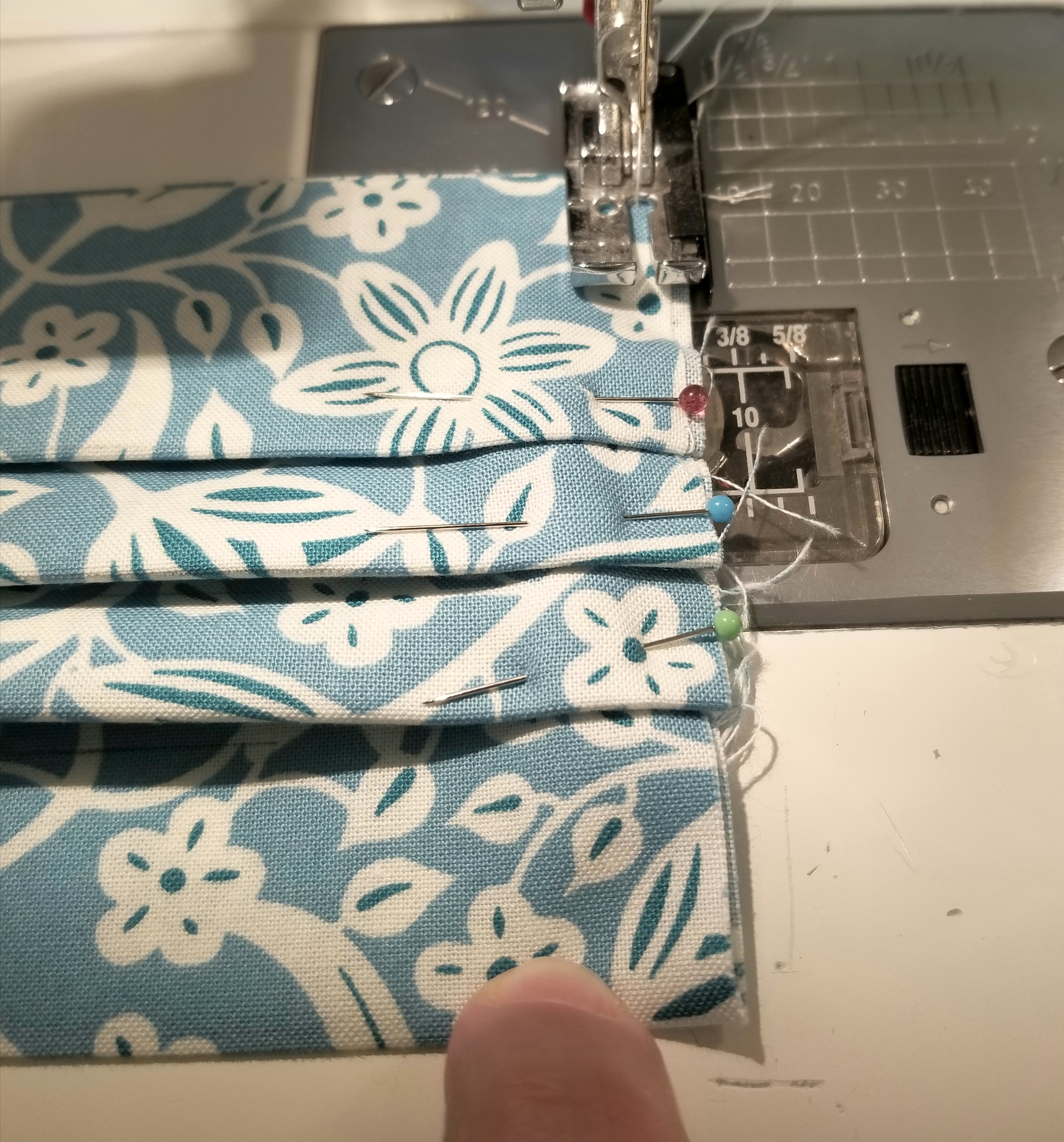
Using a 1/8” seam allowance, baste stitch the raw edges.
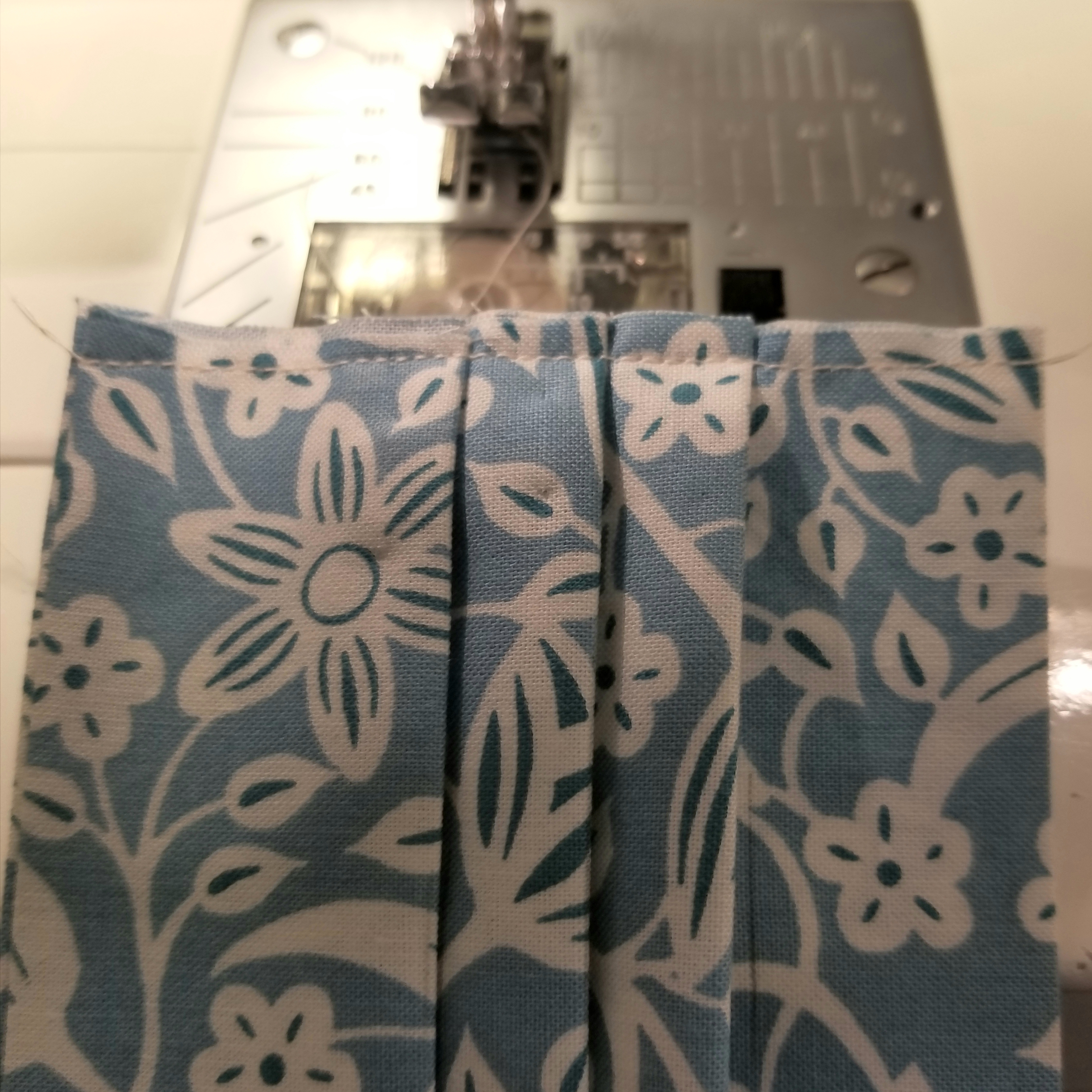
Repeat this step so that both raw edges are basted as shown in the picture above.
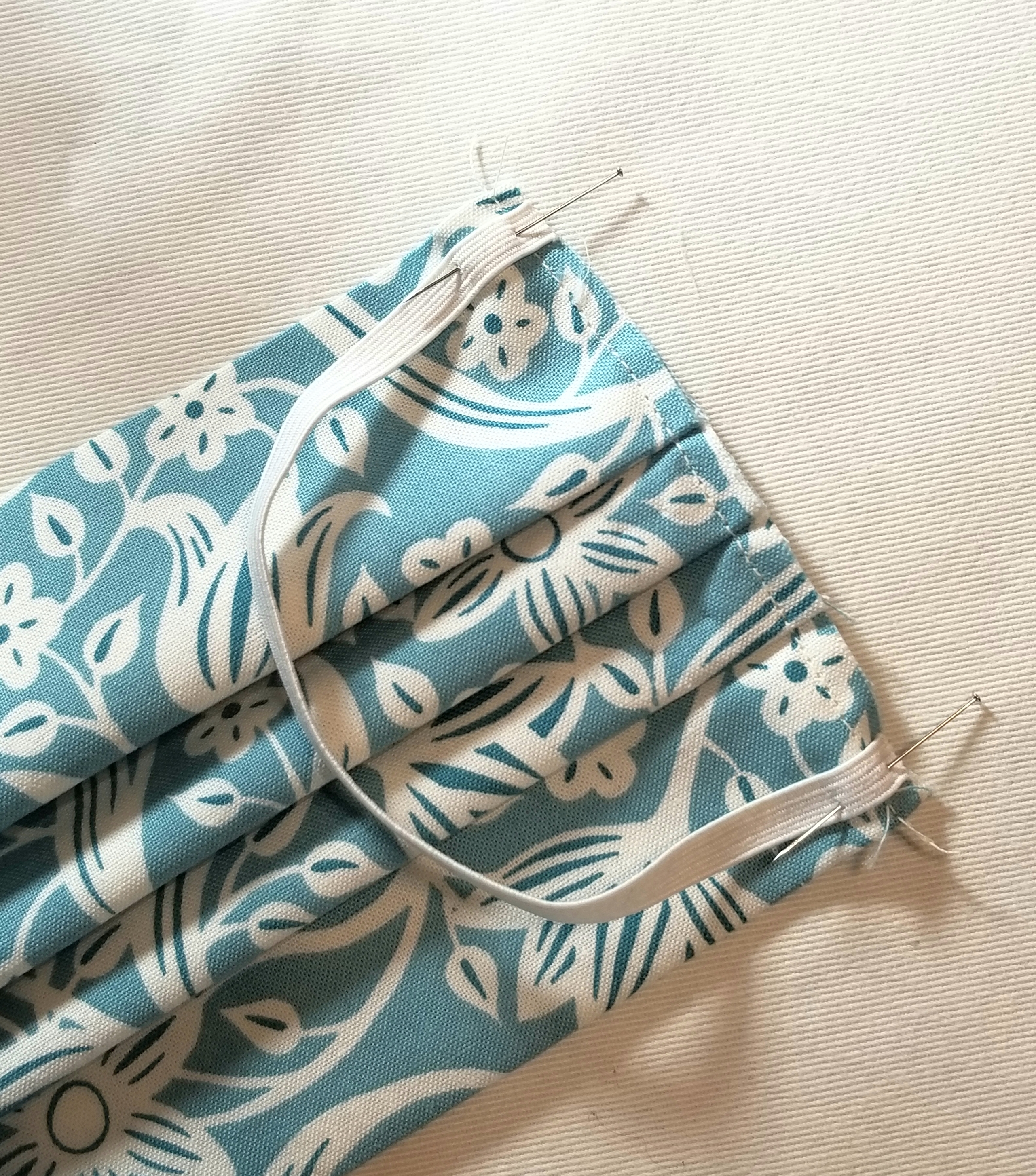
Pin one elastic piece to the raw edge, making sure not to twist it before baste stitching it to the edge at both ends. I placed mine 1/8” from the top and bottom edge of the main pleated piece. Baste elastic in place 1/8” inch from raw edge. Repeat, to attach remaining elastic piece to the other raw edge.
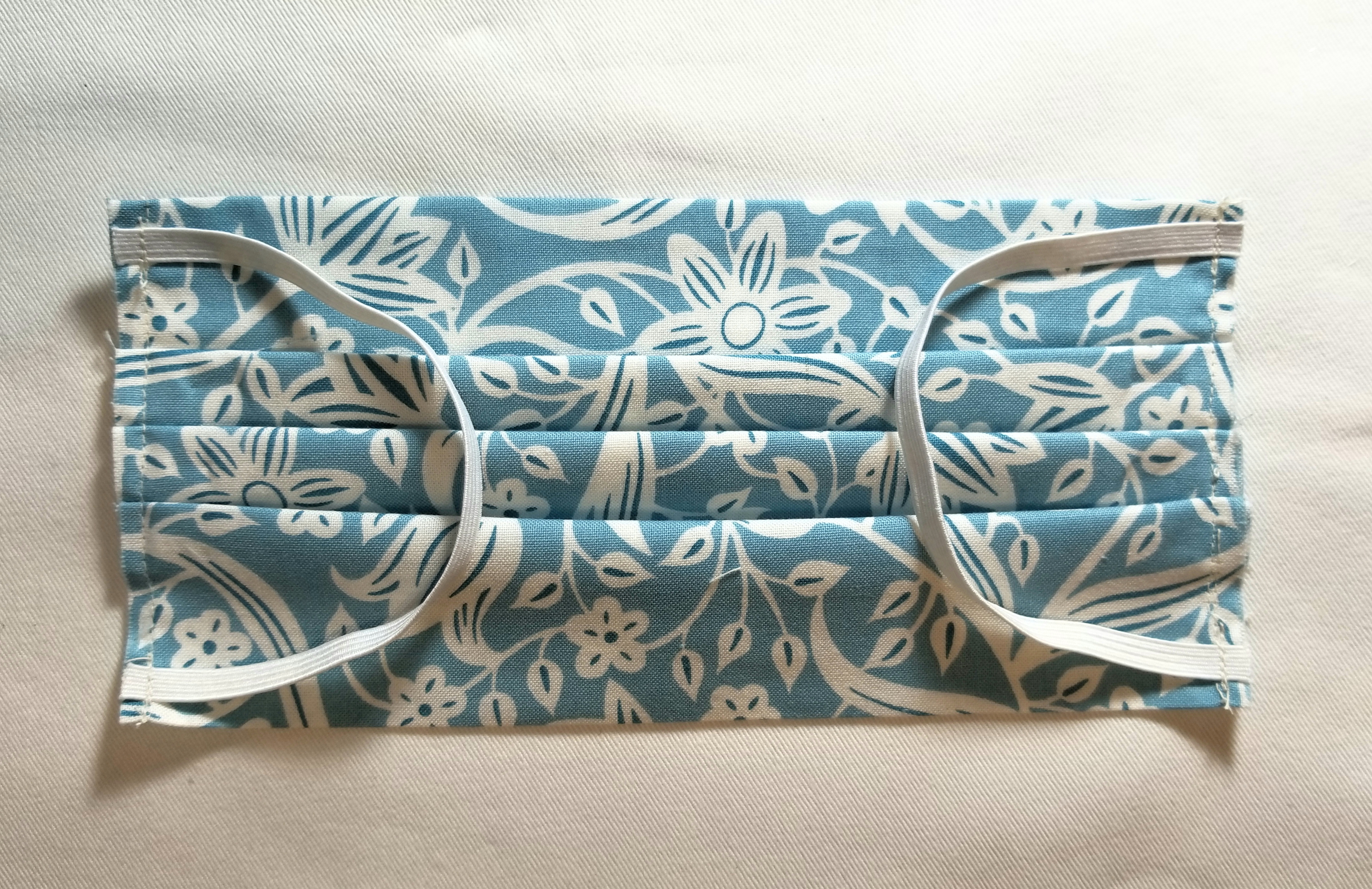
Your pleated piece should now resemble the picture above.
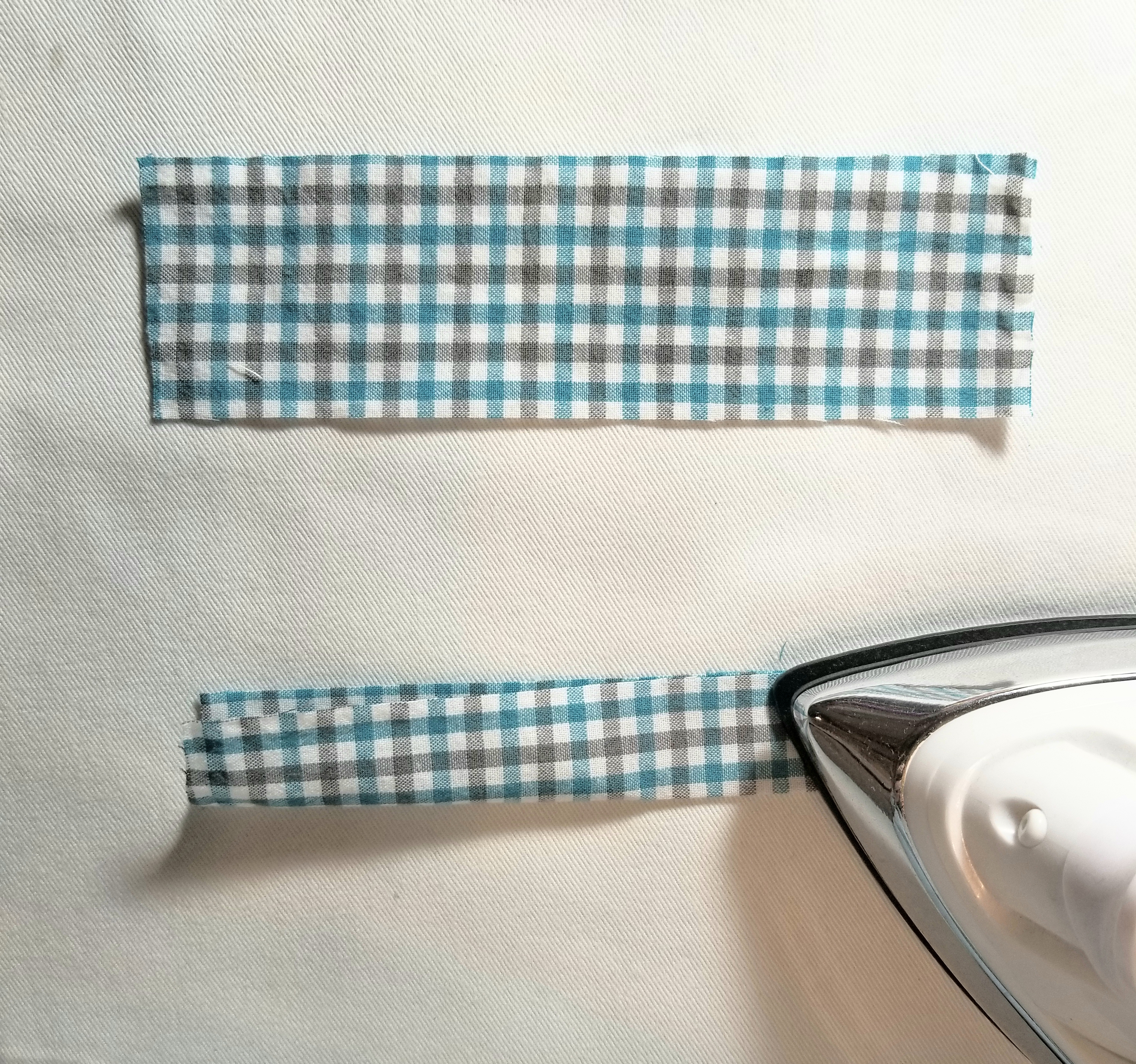
Fold each accent strip of fabric lengthwise in half, matching raw edges, as shown in the picture above. Press.
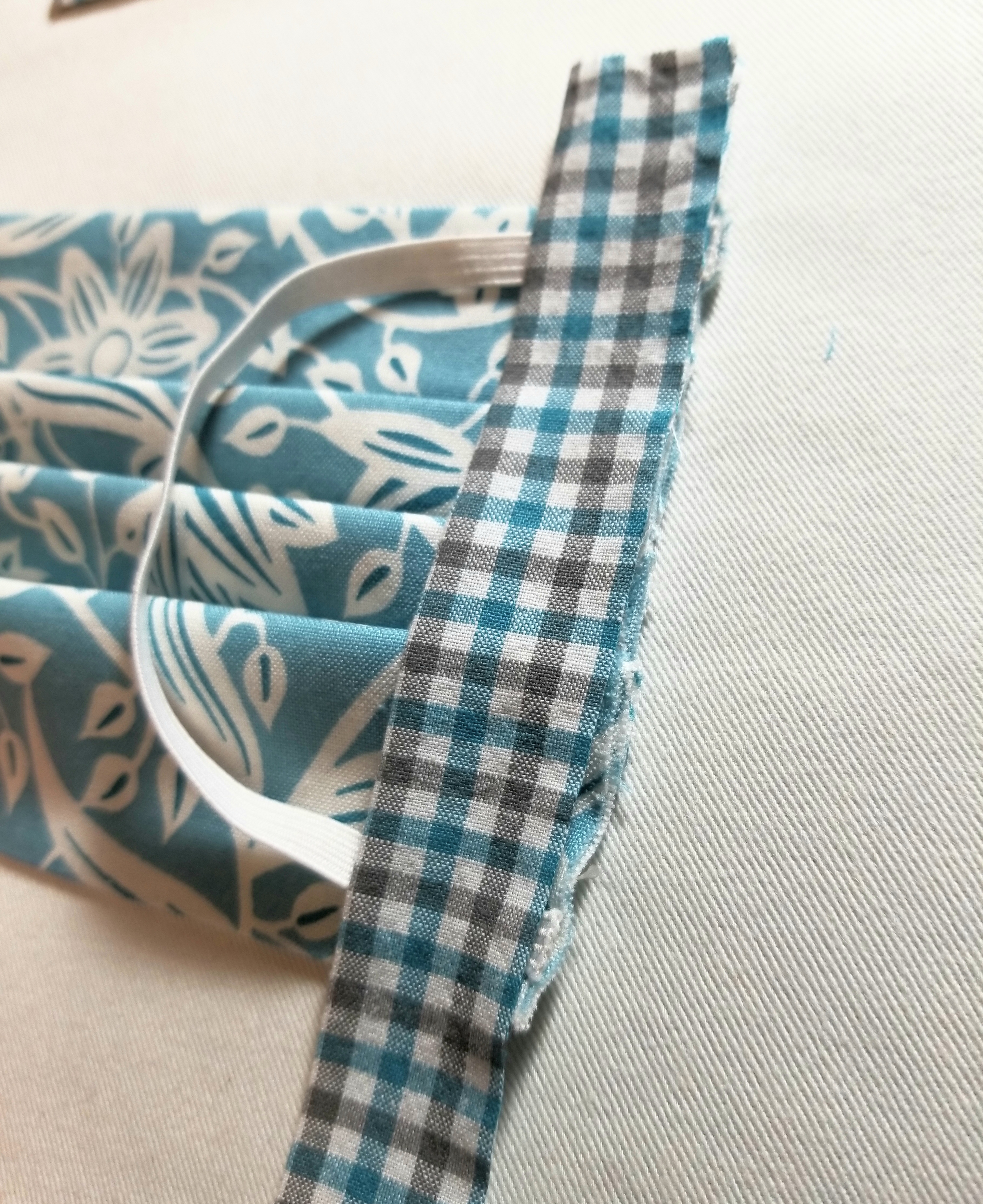
Place the strip on top of the elastic. Make sure the raw edge is facing outward, and the creased edge is facing the main body of the pleated piece. It will be a little longer on the top and bottom and that is okay, as we are going to fold some of that to the back.
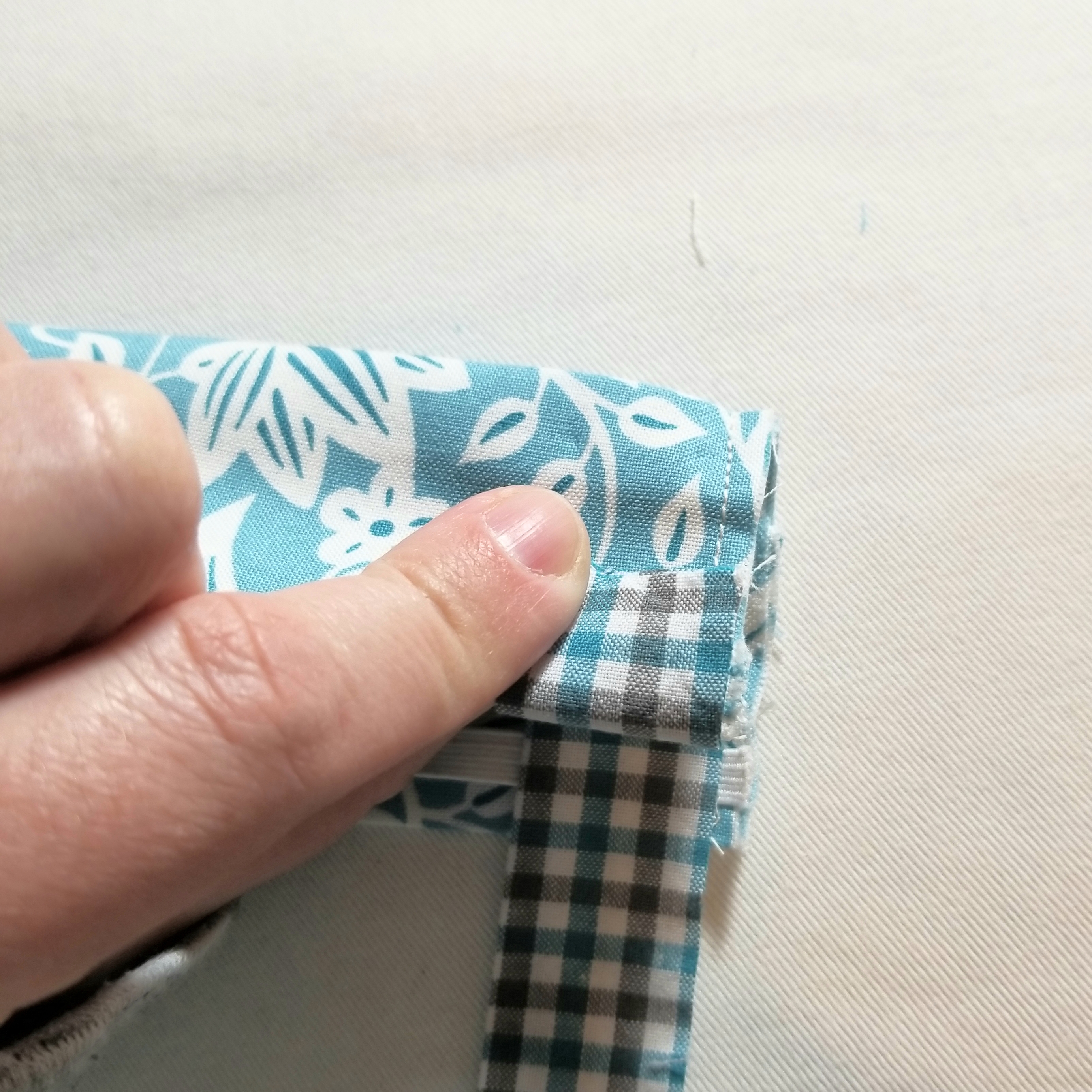
Tuck about 1/2” of the top edge to the back as shown in the picture above.
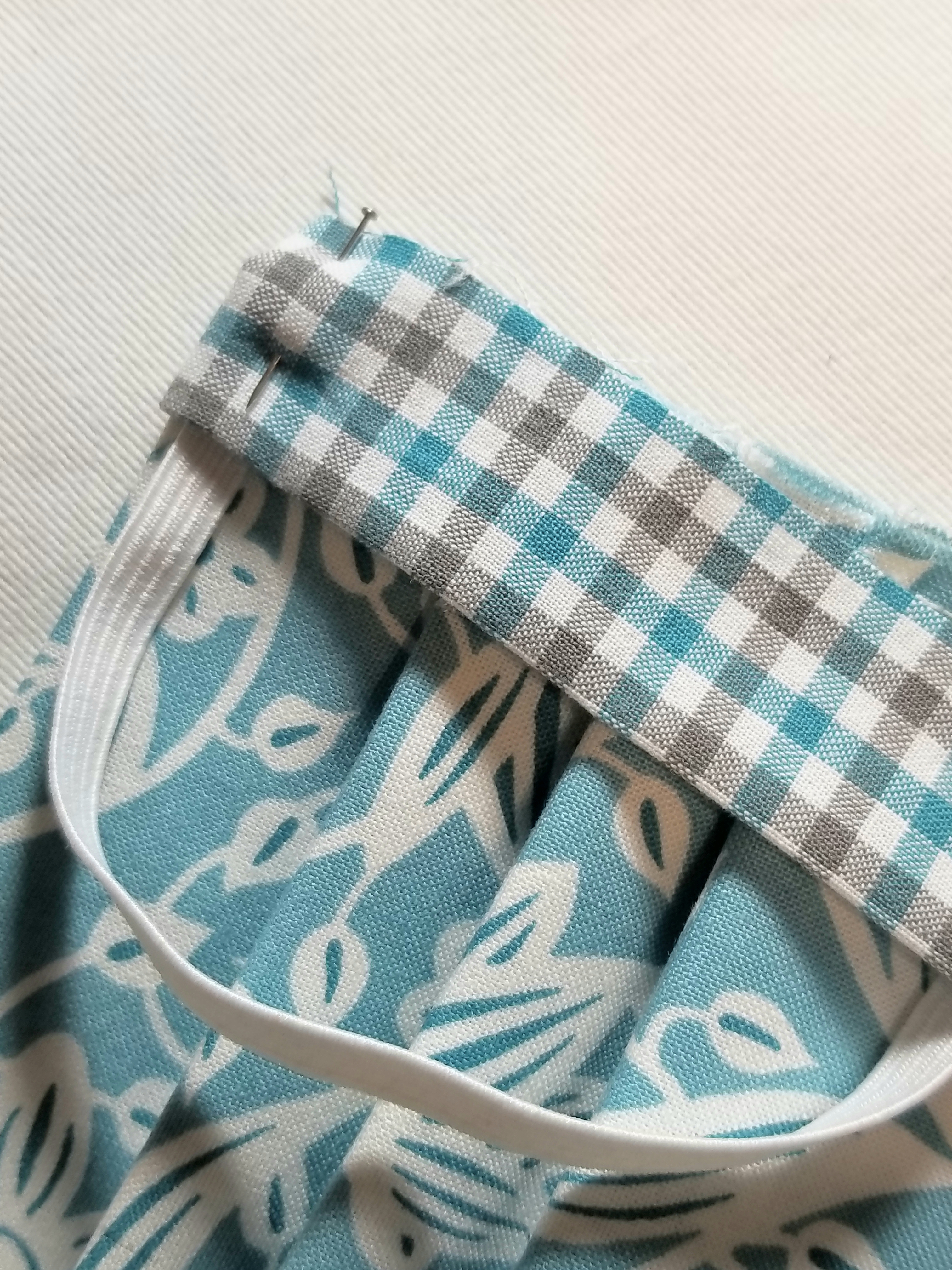
Pin all layers in place.
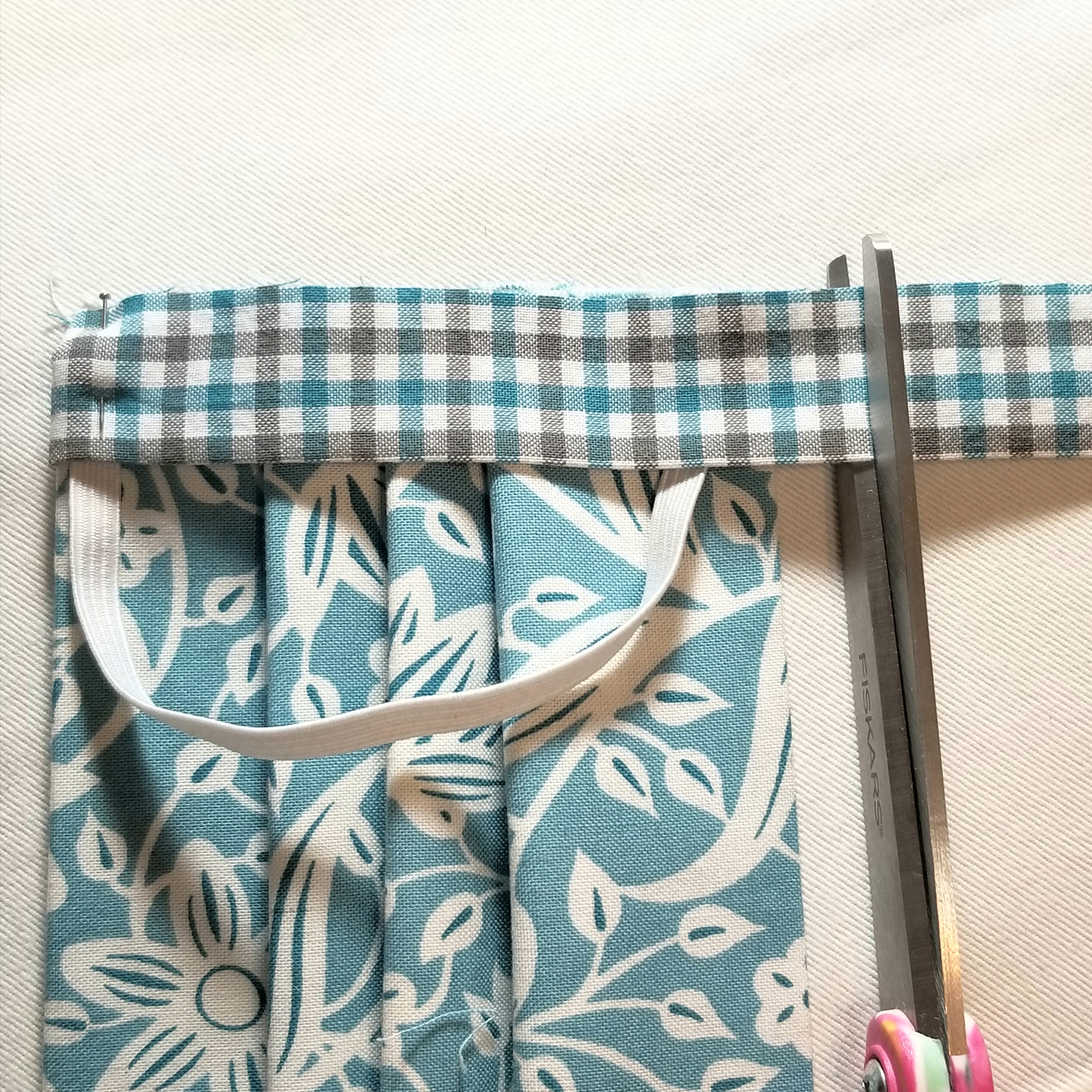
Trim the other end of the accent strip, so that it is about 1/2” longer than the bottom edge of the main pleated piece.
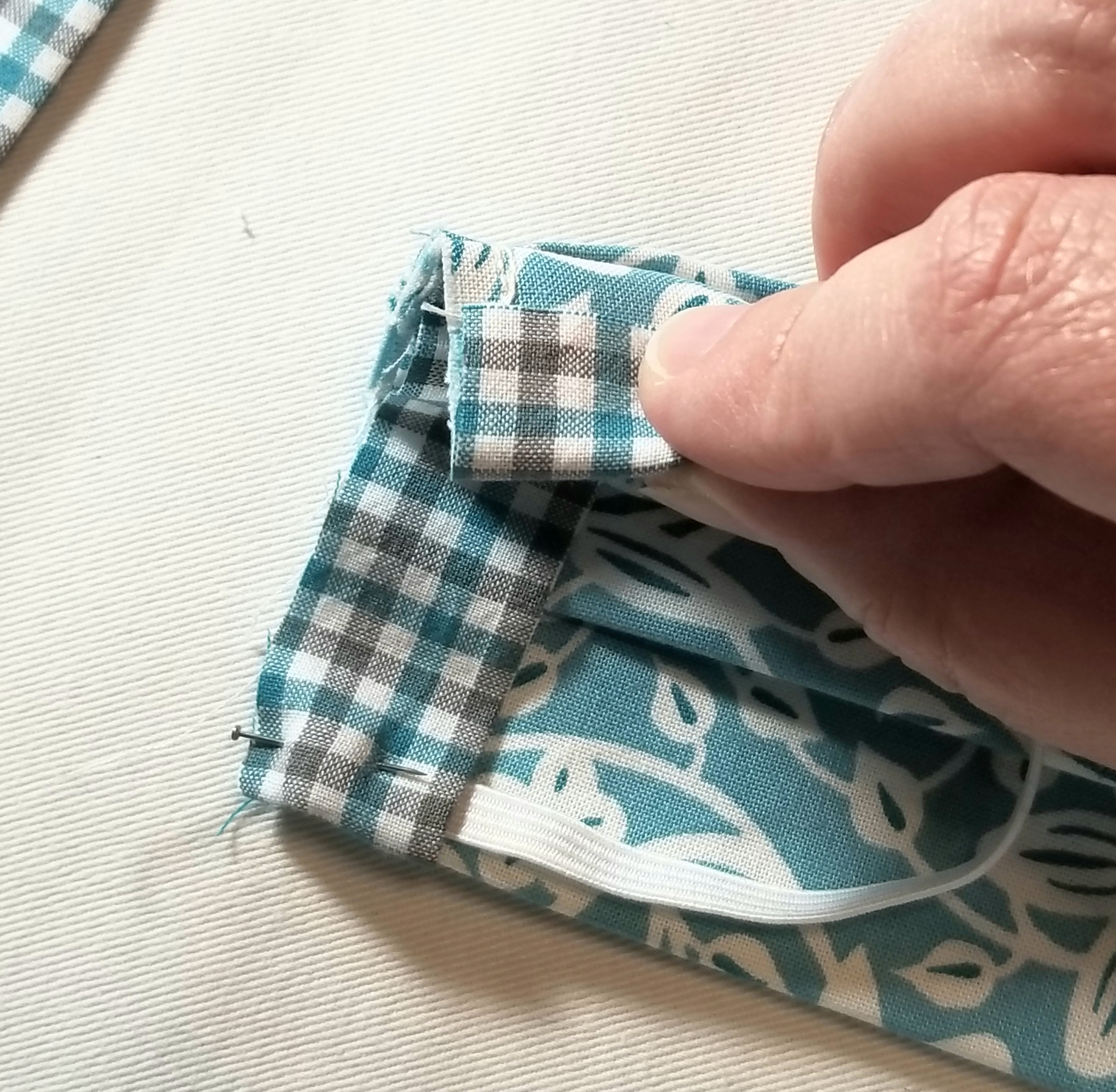
Fold the bottom edge of the accent fabric strip to the back, just as you did with the top edge.
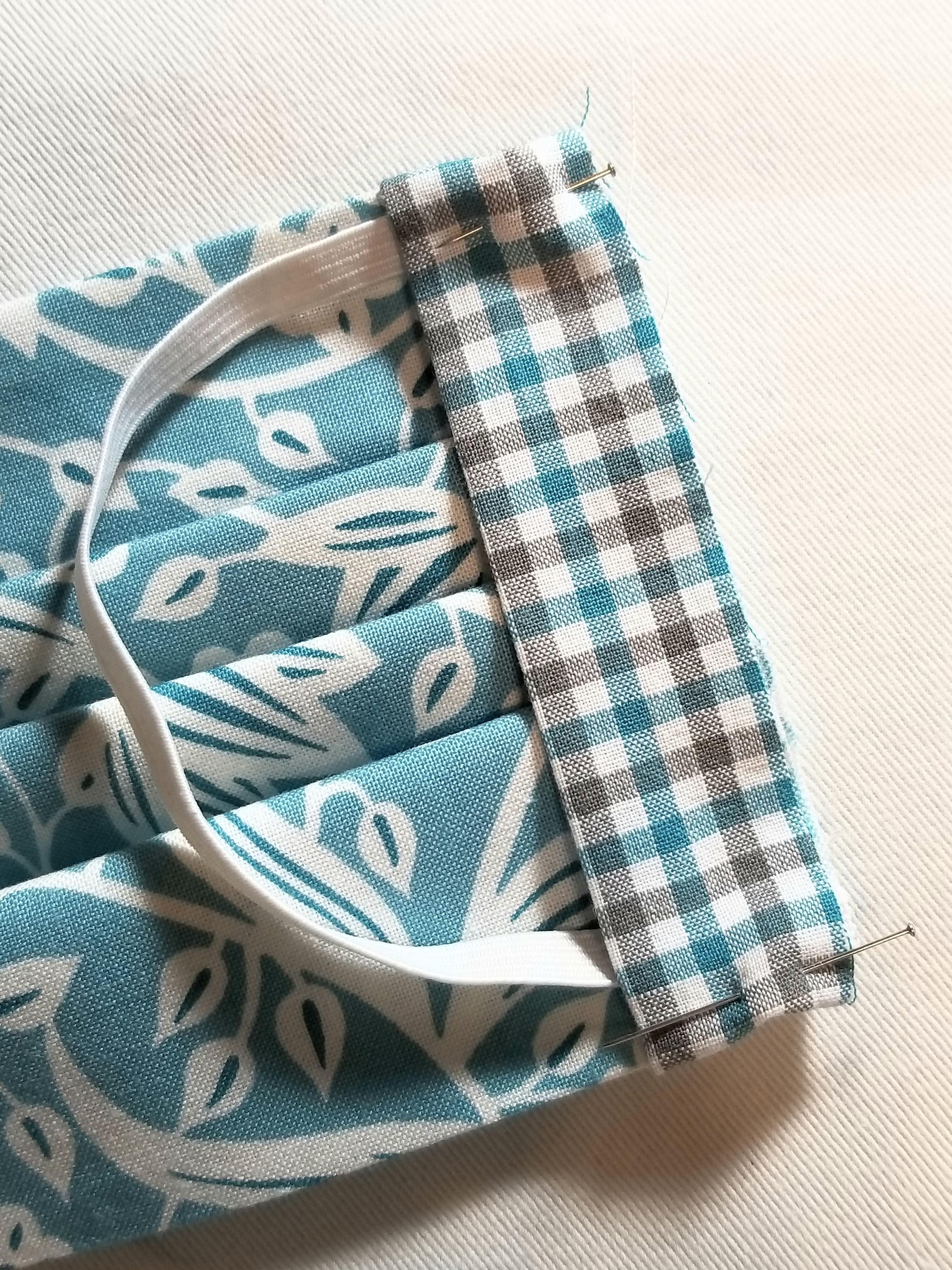
Pin both ends in place.
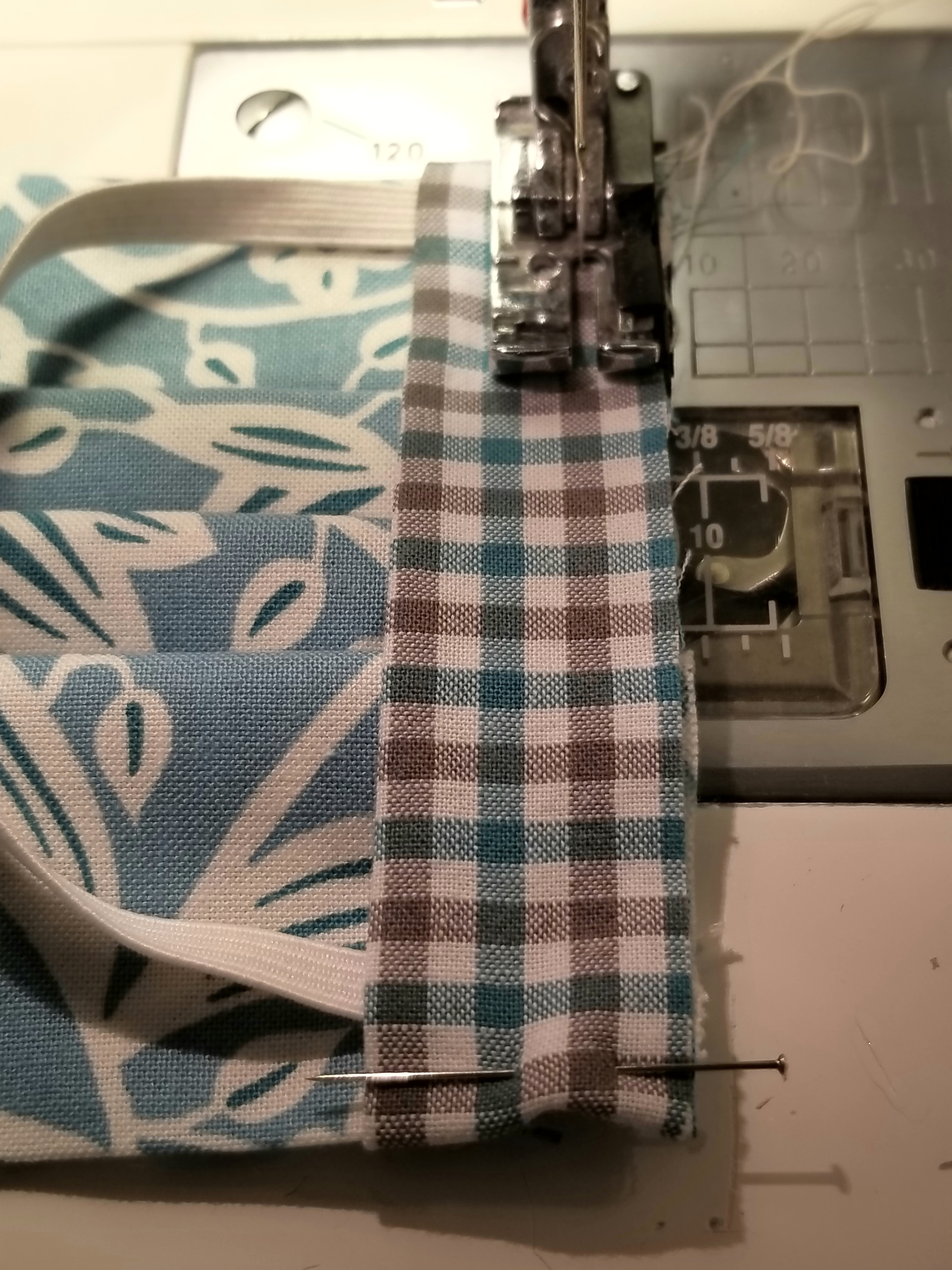
Using a 1/4 inch seam allowance, stitch the length of the entire edge, making sure to back stitch at the beginning and end.
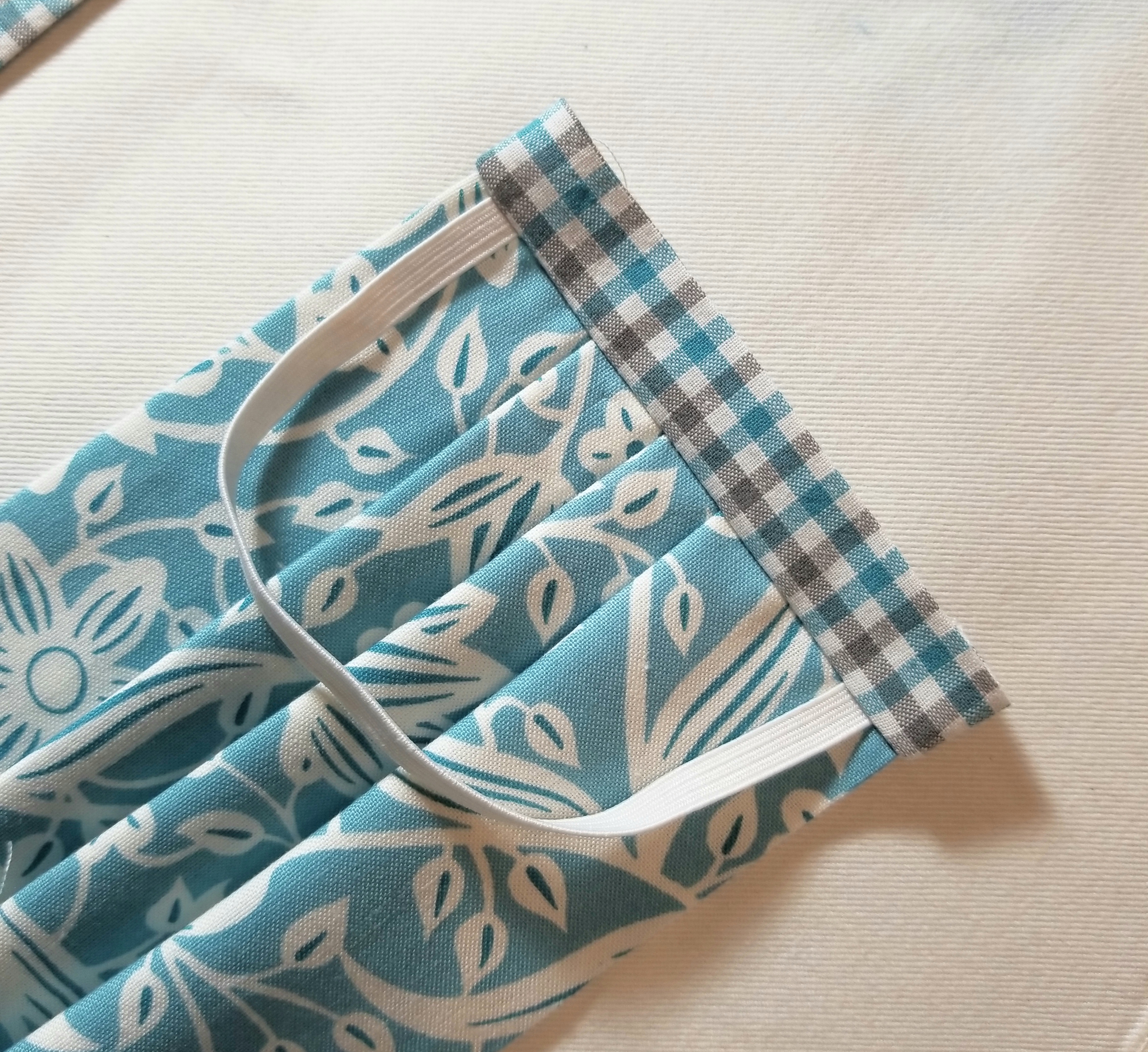
Open the the accent fabric strip seam by flipping it outward away from the main pleated piece, then press.
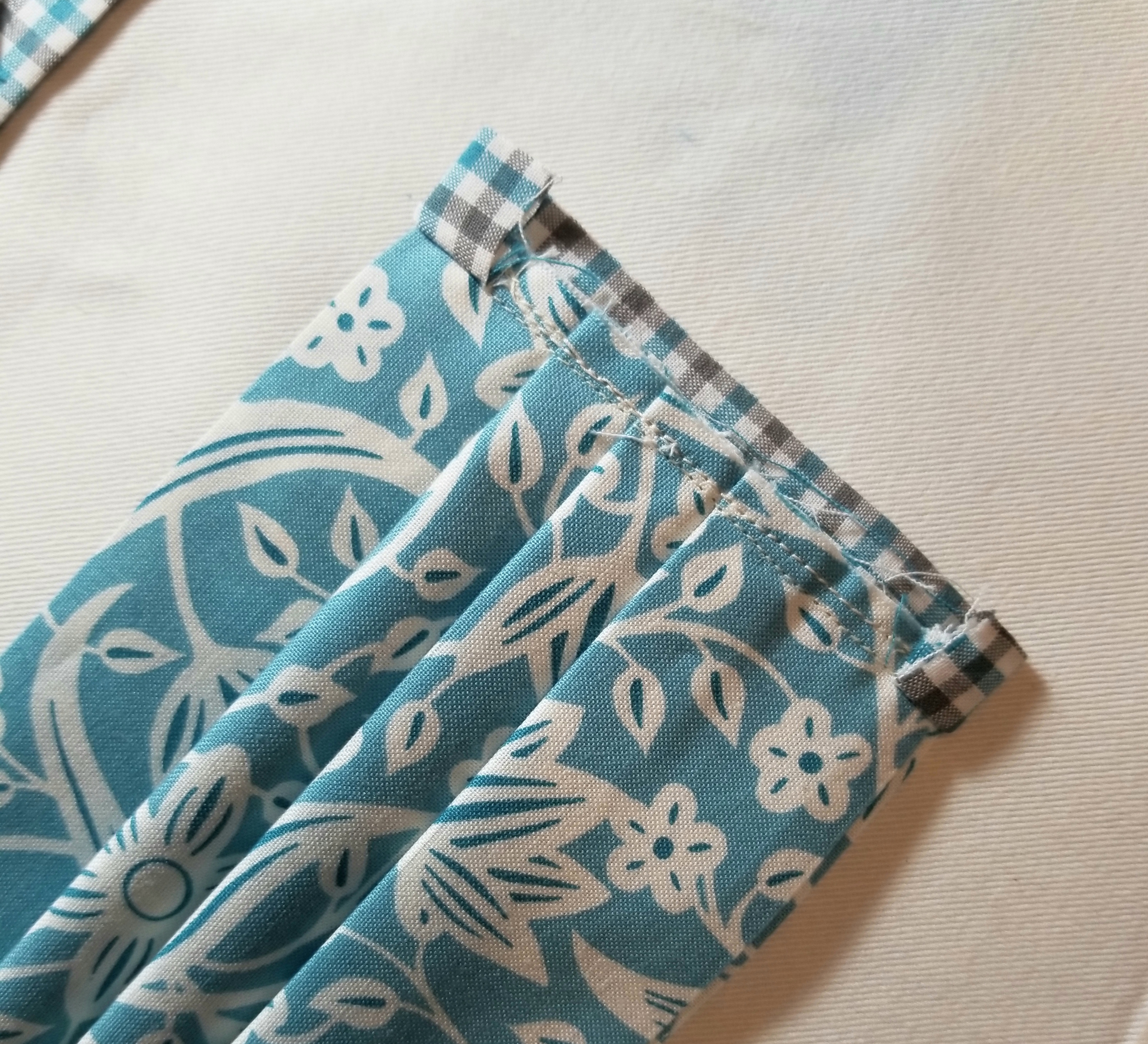
This is what the mask should look like if you flip it over.
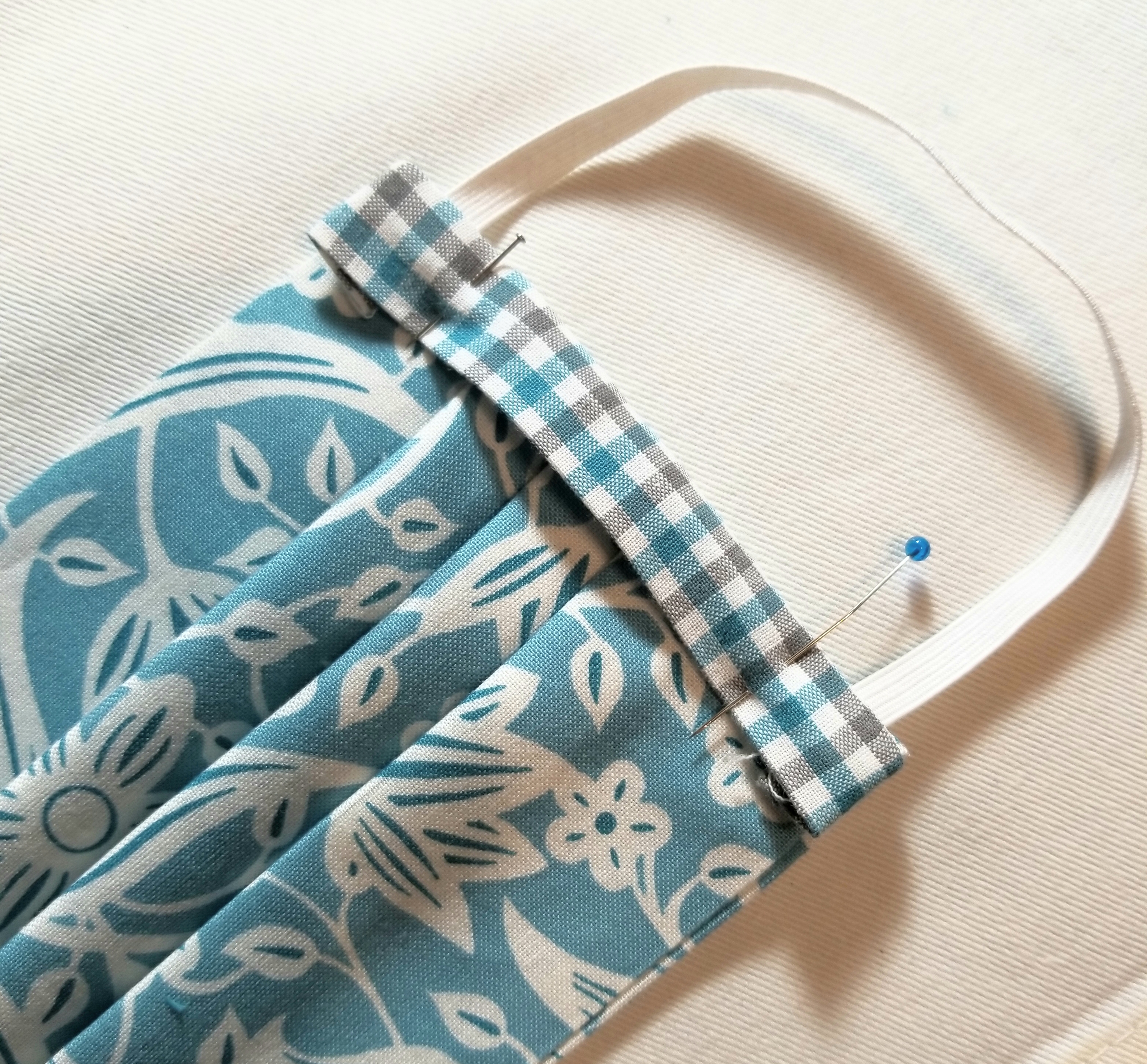
fold the ENTIRE accent piece down toward the main pleated piece, encasing the raw seam. You will now see the accent piece on this side, but not at all on the flip side. Press. Pin edge down.
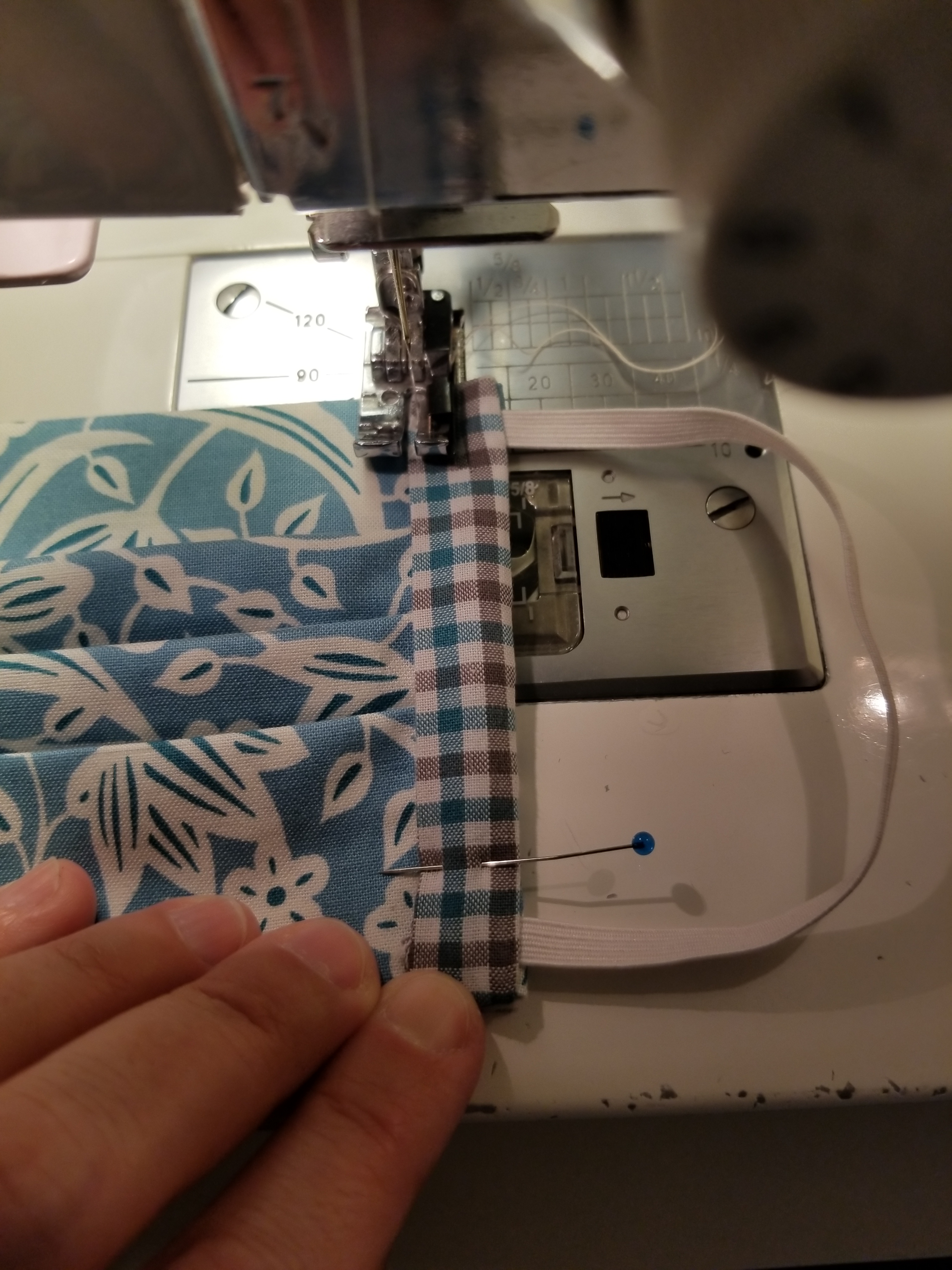
If you are a good sewist, you will change out your presser foot to a straight stitch foot. If you are lazy, like me, you will keep that 1/4″ presser foot on your machine and struggle your way through this next step. 😀 Stitch this accent strip down to the main body of the mask, sewing along the edge, making sure to back stitch at the beginning and end.
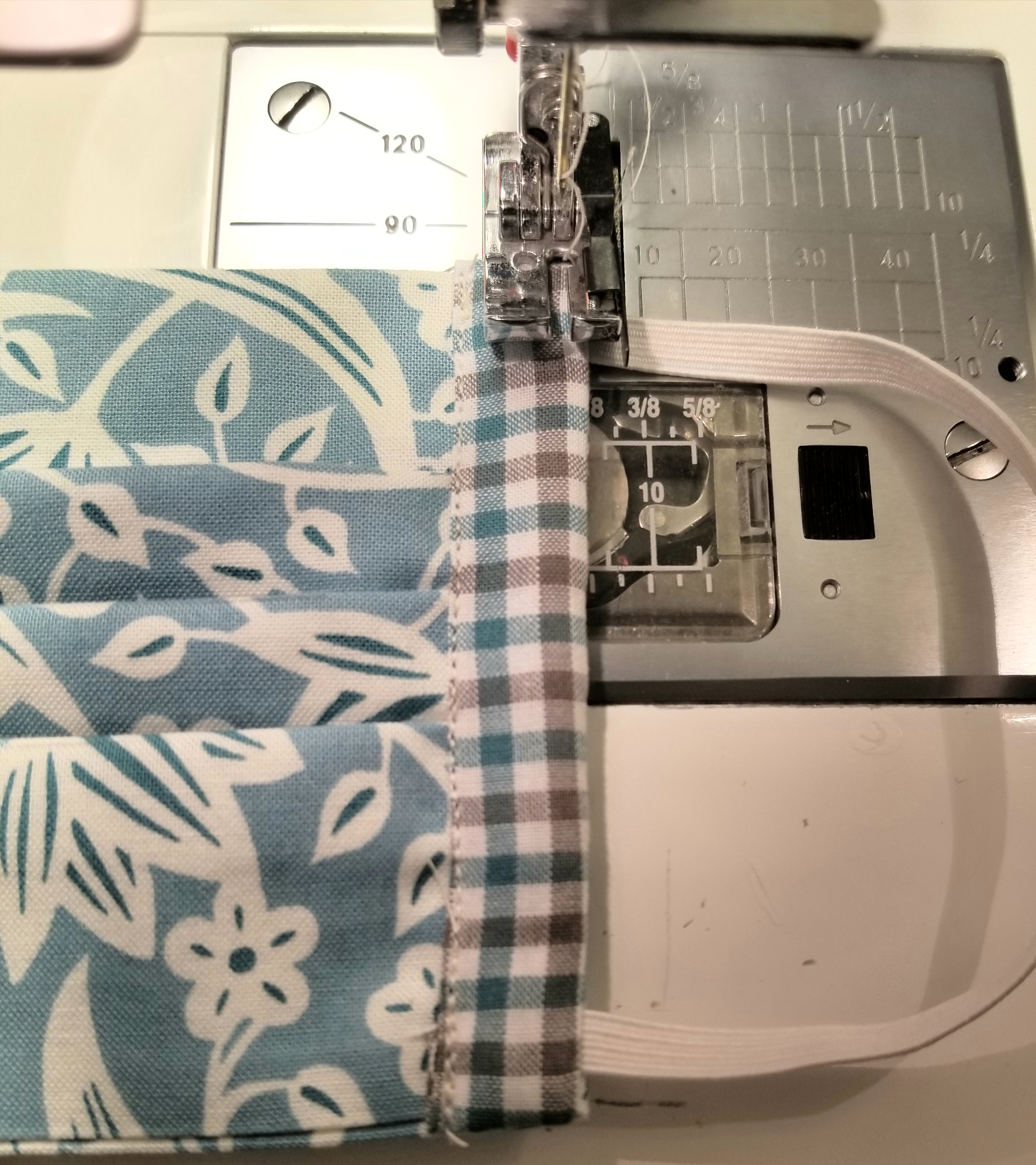
This step isn’t necessary. It just gives it a nice finished look, and helps to give that elastic a little extra stability. Stitch down the edge of the mask close to the elastic side.
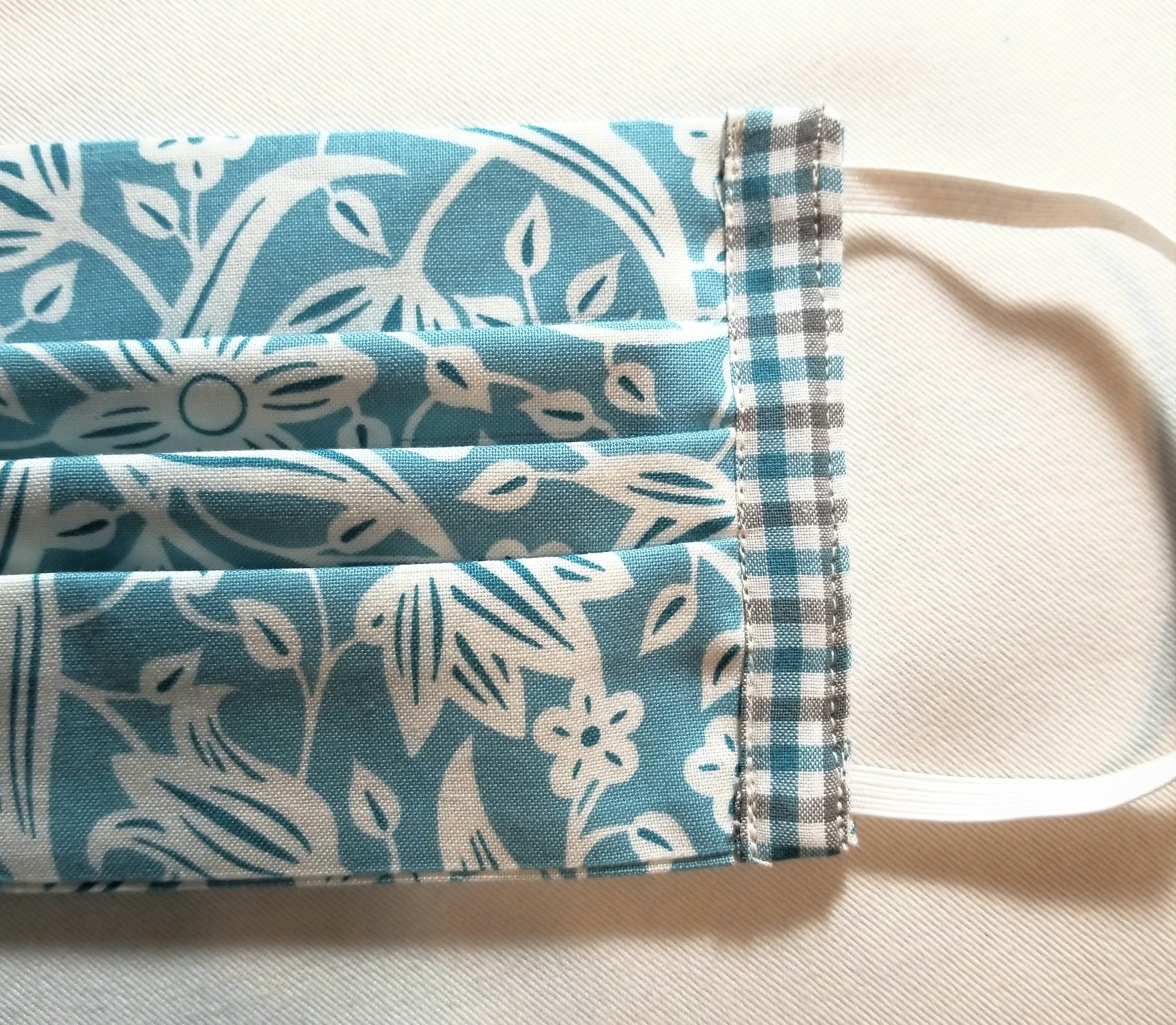
The front of your mask should now resemble the above picture.
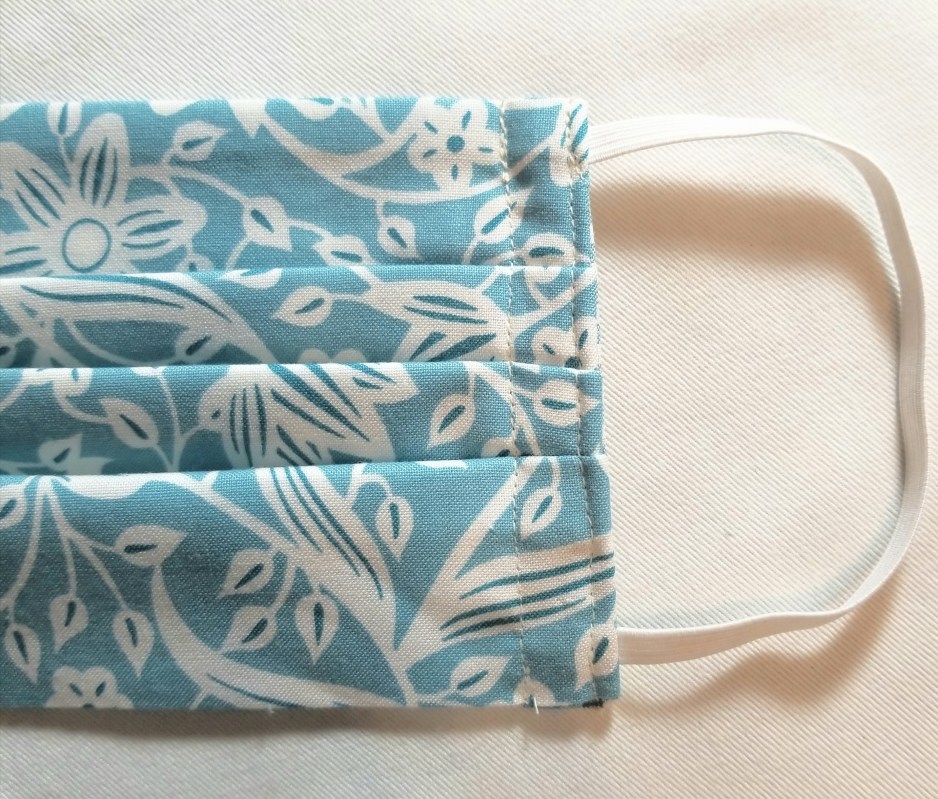
The back of your mask should look like this. Following the previous steps, attach the remaining accent fabric piece to the other end of the mask.
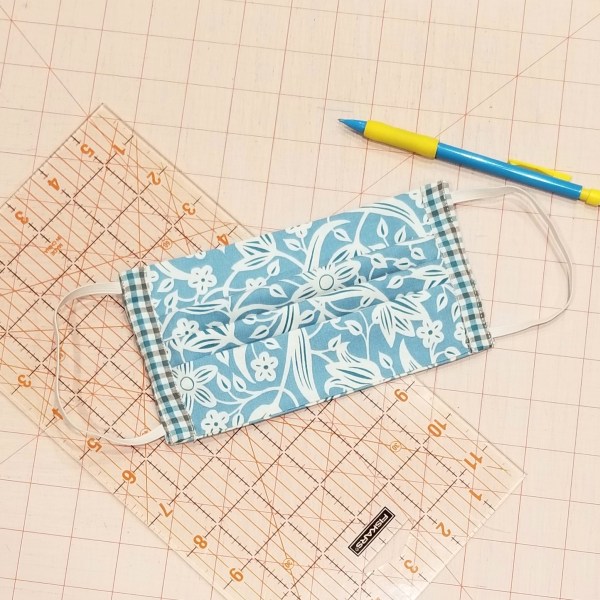
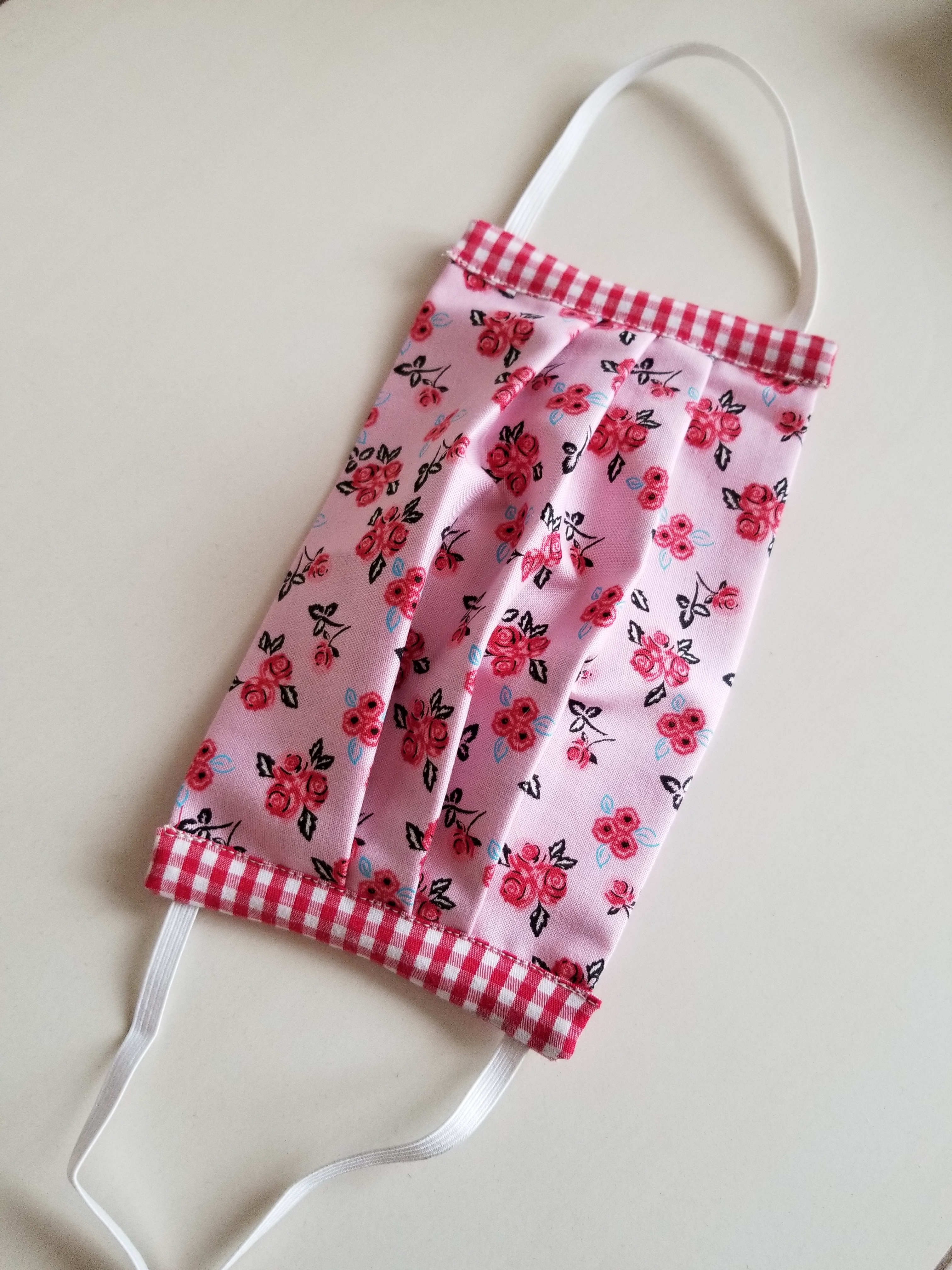
You should now have a reusable, washable mask that measures approximately 4″ x 7″ (unopened).
It took a few hours to put this free tutorial together for you. For this reason, I am greatly appreciative for any mentions that you can give me if you should use this tutorial. If you post a picture on social media, you can use the hashtag: #buttoncountermask. Feel free to share this page, and please tag me in your pictures so that I can see your beautiful creations. Last, I appreciate constructive criticism, so if you notice something that doesn’t look right, or does not make sense, bring it to my attention. I am happy to clarify any steps where you may have questions.
Enjoy!
P.S. Obviously, the elastic length can be adjusted to your facial measurements.
EDIT (March 24 2020): Because this tutorial has recently been used on a large scale, I will be adding a few things here as frequently asked and answered questions, suggestions, and reminders.
- This tutorial was happily shared by me over a year ago. This is not a new tutorial created in light of the current virus pandemic. I am not in charge, nor affiliated with any organization or entity requesting masks to be made. There are multiple organizations that are using this tutorial for their requests. If you have any question regarding what their requirements are, you really, really, really need to ask them. Please understand that I cannot and will not tell you what you should use, or how you should make your mask different from my tutorial.
- Keep in mind also that there are multiple entities that are using this tutorial for their requests. One entity may have completely different requests regarding features than another entity. (for example one organization is requesting a 4 layer mask, while another is fine with the two layer, as their thoughts are that they can be doubled up or used as a cover or liner to another kind of mask.) So, there is no correct or incorrect mask. Who are you making your mask for? Those are the people to whom you direct your questions.
- CHILD OR BABY MASK: After much thought, I have decided that it is in my best interest to NOT supply a mask tutorial for anyone other than an adult. One of my reasons for this is that I feel that a mask could pose as a choking hazard, and I do not want to have any part of that scenario. My suggestion is that you really should ask each individual child’s doctor or provider what their guidelines are, and go from there.
- I will not be held responsible for any mask misuse or malfunction.
- ELASTIC OR TIES? The main reason why my tutorial uses elastic is so I don’t have to tie it behind my head and mess up my hair. That’s it. So, if you are making the tutorial, and you don’t like the elastic, or if the person who you are making your mask for, requests ties; by all means put ties in yours. My pattern is very easily adapted to your preferences. There are organizations specifically asking for elastic, and some that are asking for ties only.
- ELASTIC LENGTH: I have read that a few of you recommend longer elastic; however, mine ended up being slightly loose. Therefore, I will not alter my pattern. I have stated in the tutorial that elastic length will need to vary due to the fact that human heads are not uniform (Thank goodness).
- I don’t have a PDF or printable version of my tutorial. If I decide to do that, I will; but it will be in my own time. I have received many hateful comments (that I deleted) demanding that I provide this. I need to remind those few sour apples that I am under zero obligation to do so. If my absolutely free visual tutorial isn’t to your liking, I invite you to go find one that makes you happy. If you are a person who often finds themselves using the words ”I need you to…”, you might fall into this category.
- I am completely honored that many of you are using my tutorial, or even certain aspects of it to help people in need. Even if you are using a completely different tutorial or pattern and just stopped by to check this one out, I applaud you for being a maker during this time. I cannot express enough how happy it makes me feel to see so many humans getting together to do something for the greater good. Please continue being that human. Those are the best ones.
I am signing off now to take care of my family, who needs me now more than ever. Thank you all for your kindness and understanding. God Bless.


Pingback: Project 34 :: Handmade Face Masks – craft hope
what is the finished size of the mask:Not including the elastic, but including the contrast.
Length
Width at edge and in the middle
Mary, it is about 7” inches wide (after the mask is washed for shrinkage) and about 4” tall (without being opened accordion style)
Can you provide a pdf file. Easier for me to print?
My daughter and I are going to spend tomorrow using up the fabric stash. We don’t have elastic, but plan to make ties. Any suggestions on the length each tie should be?
Rebecca, gosh, I would just go by what the disposable one use for length, which is about a foot or so (?). That’s just what I would use though. Good luck, I hope that works out.
Thanks for all that you are doing. Could I get a pdf please to morencole@gmail.com please. The hospital mask use 14 inch pieces of elastic on their masks. Another idea for a tight seal is double stick tape at the top just to get that tight seal when you need it.
I’m having a hard time telling which is the front and back from your directions. Are you to sew the the elastic and edges on the front or back initially.
Thanksn
Csue, Technically there is no front or back as it is reversible, but if you call the accent fabric side the front, then I can answer your question…you sew it to the back initially, then it gets completely flipped to the front and then sewn down so that the entire accent strip only shows on the ‘front’ side. I hope this helps you. Thank you for your question.
Thanks that is what I thought it looked like. Thanks for the pattern. Will try making some for my older stay at home friends!
Ms Button Counter you have hit the big time-Rachael Maddow mentioned your website on her show tonight so hurray, now all of us quilters/sewists can help in some small way making much needed masks.
Nancy, I am so honored that I am able to help in my small time way. Thank you for being a maker.
I made my first one tonight. It’s not perfect but it is pretty.
Cathy, Congratulations. Yes! you should have seen my first one! It was a hot mess altogether. Enjoy the process.
Pingback: Make Some PPE | MakePPE
I have downloaded the pattern and plan to make some if I can get material on-line. My husband is on hospice so I can’t just go shopping now. my state doesn’t currently have a crisis, but I fear they soon will due to the lack of federal response to this virus.
God bless you for what you are doing. ,j
Hi there,
Thank you for providing this pattern! I am going to sew for our local hospitals. But, I’m a little confused about the last few steps with the accent fabric. The directions show the elastic and the accent fabric but then it says “this is what it looks like when you turn it over” and there is no elastic. Is it just not showing? Thanks again!
The elastic is there, it is just on the other side. It isn’t going to stick out until you do the next step of flipping the accent piece to the other side to be stitched down. I hope that helps you.
I can not sew but thanks to all who do and are helping. You have no idea how much first responders and medical personnel appreciate your help.
Thank you! What type of fabric do you recommend?
I wanted something meaningful to do to help during this pandemic… I will start making masks tomorrow. Thank you for the pattern.
my daughter is making them for free and has been told to have the folds go down on the masks –
Excellent pattern! I haven’t tried it yet but was thinking if it could be made more impervious by adding some batting or a piece of thin plastic. Or would that make it too think and cause moisture buildup? maybe just a third piece of fabric inbetween would be better.
How do I turn off the notify by email? Thanks!
I just heard about your tutorial on @maddow and want to thank you for encouraging us to be part of the effort! Next step: get my materials together!
Pingback: DIY Fabric Face Mask Tutorials | OMG! Heart
Pingback: 9 DIY Fabric Face Mask Tutorials | OMG! Heart
Pingback: 5 DIY Face Mask Tutorials using fabric – homemade masks | Thegoplus official site
I haven’t tried the pattern yet but I’m wondering if there is a way to make the elastic go around the head instead of I guess around the ears? I’m guess I g that’s how it’s fastened on? Thanks so much!! You did a super job of demonstrating this mask!! Have a wonderful day and God bless you in your efforts!!🙏🏼🙏🏼🙏🏼
As usual, I’m not the early bird on this but do you think I could use 3/8″ elastic rather than the 1/4″? I have that in my stash and can start sewing these today without a trip out or trying to order some.
Awesome tutorial!
If you put a small knot in the end of each side of your elastic before sewing, will make elastic more secure in the mask
Thank you for your generous heart. Here in the UK, we are not at the shortage level that you have in the US, but I am looking at practising sowing this mask in case we ever need it in UK. It is this type of generosity and care for others that make this world a better place and make neighbours become really good friend. Thank you.
Pingback: Helping – One Urbana
Our quilt guild has over 300 members. We will spread the word and the tutorial!.
I was told that there should be a protective liner in the middle of the fabric, what type of fabric does that need to be and where do I find such fabric? I have a sewing business for 40 years and be willing to help make a huge supply of masks.
Did you come up with a kids size face mask pattern yet? These are great and easy to follow directions. thank you
Hi everyone. My daughter is an ER nurse in an emergency room in Seattle. She texted me yesterday to ask me to make some masks. Sewing is something we can all do to help. Would you please help make some masks for our amazing health care workers? Thank you! : )
For those that asked what material to use – this is from my local hospital request: *use cotton muslin fabric with a tighter weave/higher thread count
Great tutorial! I’m going to make these for my sister. How many yards would I need if I wanted to make 30?
Thank you for this tutorial! I heard about it from Rachel Maddow, her most recent episode March 20. You can listen to the podcast.
Our local quilt shop shared your face mask tutorial, and I in turn shared it with the members of my quilt guild. Thank you so much!
I would think cut sections of HEPA bags for vacuum cleaners could be inserted between the outer layers of the mask if designed to have an opening. You could insert the HEPA filter piece that would cover over the mouth breathing section to form a better barrier. When mask is done and needs to be washed, remove the HEPA piece first. ?????
Nona, I like your idea about the HEPA bags. Could you describe how you would insert it in the mask described on buttoncounter.com. I want to make sure I get it right. Thank you so much. Pam Bugge
I need size and pleat measurement for a five year old for the face mask
It could be done. The question is whether people might have trouble breathing through the extra layer.
Could you please put the PDF for all of us to have? Thank you! These would be great to make from scraps of fabric you have and give them to all who may need them.
That is my plan exactly! I found some on amazon, hoping they’ll be delivered on time.
I saw a report that should a chart saying a vac bag was very bad about letting mask be breathable – so they said please dont add. Although, you can make masks with a pocket or opening to place a removable filter. They gave several options for that.
DO NOT USE HVAC OR HEPA FILTER !!!!!! These items often have glass
fibers or plastic fibers that could cause swelling of your lungs…
think asbestos!
I’ve also heard tear & stick stabilizer works as a filter…..and coffee filters.
Additionally, if these are being made for hospitals, know that they will be washed and/or boiled. This is why many entities are asking for cotton only.
Thank you so much! I’m in lockdown in a retirement so this will give me and others something to do. Have plenty of material, just need to find elastic.
You are absolutely Awesome, I’m praying I can get my mond wrapped around this tutorial. I’m not a sewer, but I do have a sewing machine, and I’ve been asking my grandchildren to invent that next facial mask. Just noticed on MSNBC news your website. I’m thinking again to wrap my mind around this thought for me to try making a facial mask, and prayerfully, I do well to make a supply. Again thank you appreciation to help people in need for this item!
Detra Whitehead
Yes I apologize for the typo. I pray to wrap my mind around this tutorial
Thank you
Detra Whitehead
This is a wonderful tutorial! Thank you for taking time to create it and share it with all of us.
I’ve noticed a few people saying have mentioned turning this tutorial into a PDF and I think that would be wonderful for my mother-in-law. Will that be available here? Or can someone send it to me personally? Then I can print it for her.
Great idea !!
I can send you a pdf.
If possible, could you please send me a PDF. Thank you.
Could I get a pdf also?
To make things, easier, I uploaded the pdf to Dropbox. Here is the link:
https://www.dropbox.com/s/yhtdt8ze97oig26/Facemask%3A%20A%20picture%20tutorial.%20%7C%20Button%20Counter.pdf?dl=0
Thank you for the pdf. I am a visual person. This is a wonderful tutorial.
I made my first one today. It turned out pretty well, the next one will be better, it’s important to me for my family to have a mask, as I have a compromised immune system. Your instructions were easy to follow and very detailed with your awesome pictures. Thank you so much. You are a real MVP.
I used a piece of heat bond as a non woven barrier. I add this after I turned the tube. I also placed a piece of a twist tie to the center of the tube on the opposite side of the seam. The twist tie is so they can make it fit snuggly on their nose.
Hi Jennifer, can you post a pic of what it looks like with the tie? How did you secure the tie? I am not much of a seamstress! Thanks.
In the face masks I made I top stitched along the top edge allowing enough room for my wire between the top fold and my top stitching.
How did you attach the twist tie?
How did you attach the twist tie?
Brilliant!
Brilliant idea, Jennifer!!! Good job! So let’s all get together and do our part!!
Donate 100 masks, or whatever you can to your local hospitals!!
How did you sew in the twist tie? A nurse in our church has asked for some.
I would think you could zig zag over the twist tie, being careful not to hit it with the needle
what type of heat bond?
Can someone post a link to images/instructions for the best way to do the nose piece? Some facilities are not accepting masks that dont have a nose piece to ensure a close near airtight fit around the nose and mouth.
Hospitals are asking people not to put anything in the middle; they want us just using woven cotton, and they want everything in it to be washable, so no wires. I have also found that interfacing (is that what heat bond is?) is not breathable.
Thank you so much for this pattern. I’m an RN on a community mental health team and like everyone else we’re having trouble obtaining facemasks. Fortunately, I sew and quilt a lot so I don’t even have to go out for materials. I’m getting ready to work them up for myself and the awesome team of social workers that serve our community. I’m also sharing this post on my Facebook page.
Hi! HELP! How do I turn off receiving the comments in my email box?
What a wonderful fun pattern.I work at a health care facility where supplies are getting low ….spending my weekend masking these to fit my co-workers personality….can’t wait for the FUN Monday morning at work!
Pingback: Sewing Face Masks For Your Local Hospital and Various Medical and Public Personnel – Free Information – Brianna Lentz
Type of fabric?
Wonderful idea!
Will the shops be open? Just wondering.
THANX.
Joann Fabrics will let you order online and bring it to you curbside!
Thank you so much for this tutorial. VeryVery good pictorial and instructions.
You made an easy to follow process !!
I just wanted to let you know that I post a thread about making masks, on Facebook, last night. I woke up to over 150 (wonderful) comments, so many facilities that need them and several people who want to make them too and it still hasn’t stopped!! I’m so excited and so thankful to have your picture tutorial to pass along!!
Thank you!!
I think you could place a panty liner in them for better protection
This is great – has anyone tested whether it actually blocks the virus? I hope so – I would love to make some! We just want to be certain they are helpful and not give false security. Not trying to be a Debbie Downer – want all to be safe! 🙂
Actually, I do see where hospitals will be sterilizing these as they enter facilities, and they are better than running out and having no protection. Sorry to not have researched myself before posting the earlier comment – GO SEAMSTRESSES! What a GREAT way for us all to do something to help!!!! 🙂
I had the same question a few days ago! I was talking to a coworker whose wife is a nurse, he said she said a lot of times masks like these protect the patients more than the nurse/doctor but they’re still needed. They prevent droplet transfer from exiting the wearers mouth, as well as getting into the mouth. They aren’t proven to prevent from the virus, but they still need masks like these that are almost sold out so they don’t transfer colds, bacteria, etc to patients with lowered immune systems, as well as hopefully protecting themselves. Hope that helps!
These do NOT stop the Covid19 virus. But they are better than nothing for office workers, cleaners, maintenance folks who aren’t dealing directly with the Covid19 patients but still need some protection. And it saves the high tech for the rest.
How do you know? Then why would anyone make them? There must be some fabric that filters the virus? Have you performed any testing with the mask or research that verifies these mask don’t filter the virus?
https://www.researchgate.net/publication/258525804_Testing_the_Efficacy_of_Homemade_Masks_Would_They_Protect_in_an_Influenza_Pandemic
Check out http://www.smartairfilters.com for the research on what fabrics are best and most effective. They say that 100% cotton T-shirt fabric, cotton blend T-shirt fabric, pillowcase or other cotton materials give the best combination of effectiveness combined with breathability. I personally recommend 1/4″ cotton elastic for the ear loops, as it is soft and durable because it’s made for swimsuits and dancewear.
Try lining with vacuum cleaner bag paper. Effective screen, and better than nothing, which is what we are looking at, soon.
https://www.researchgate.net/publication/258525804_Testing_the_Efficacy_of_Homemade_Masks_Would_They_Protect_in_an_Influenza_Pandemic
I thought the same thing! Glad to use my time (and fabric) for something that will truly work, but not waste my time. Apparently the hospitals are asking for these, which are worn inside other permanent masks. Our local hospital said that they are truly useful.
Could you please tell me what type of material using is a polyester or cotton etc.
Eleanor, everything I’ve read has said to use 100% cotton.
Thank you so much for this pattern. I am going to get busy right away.
I have been making masks for the past two weeks for all HIGH RISK in my area that I can for free. I am now filling a 100 mask order for a trauma center in Sacramento. I have put a lot of money into this already with all supplies from Joanns. How can I get more supplies for free if I’m making directly for RNs near me?
Brenda, I am not sure. I am only the person who designed this pattern and created the free tutorial. I hope someone can answer your question. Thank you.
Check with your seamstress friends. Most crafters have extra fabric on hand that they might be willing to donate to a good cause. I’m moving and have pillowcases and sheets that could use a home. There might be people in your location with some to spare.
Can you use T-shirt’s, shirts, dresses that’s in your closets? Wash & iron them than cut the material needed? Will that’s work?
Maybe call your local Joann’s store & ask them
There’s a thrift store on Fulton called Assistance League, next to Carl’s Jr. They often have fabric. I am starting to make masks. I will be using Pellon 911FF to interface one side and 800 sheet for the lining. I have ordered plastic and double wire twist ties for the nost. I am washing my own fabric as we speak. I have a contact for Kaiser. I may have some fabric to give you. I’m a quilter so I’m always collecting. How do we connect?
Hi Brenda,
I am a licensed designer with Marcus Fabrics and can send you off the bolt 100% cotton fabric. Just need a ballpark amount of fabric and your address. Email me directly at nancy@nancyrinkdesigns.com.
Joann’s is now offering free materials I think – https://www.joann.com/make-to-give-response/?icn=hpzhero&ici=make-to-give-response
You might be able to get a reimbursement or more supplies for free.
Thank you for the pattern, I will be making some this week!
Check with your local quilters guild, most members have huge stashes of small pieces.
Great.. all those who sew…get busy now. We made hats scraves ,for cancer patients. Hats for new borns, a d other fun things.
Great.. all those who sew…get busy now. We made hats scraves ,for cancer patients. Hats for new borns, a d other fun things.