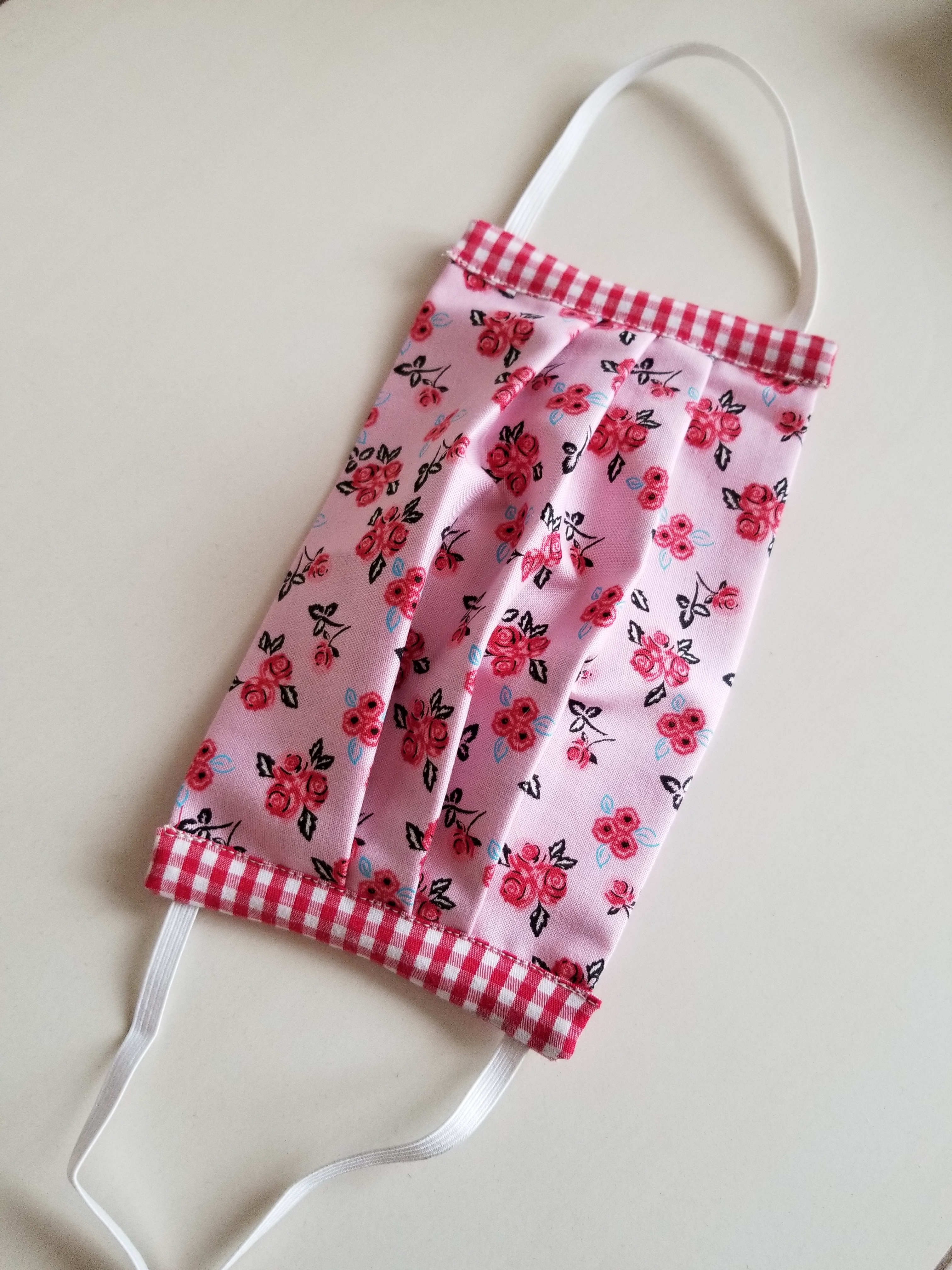
My allergies have been incredible this year, and by that I mean that they have been worse than they have ever been. (Please, please, please do not suggest medical advice here. Much appreciated.) I see an allergy specialist who gives me 2 shots, 2-3 times a week to help with my symptoms. They have helped a lot; however, Juniper Ash (Cedar Fever!) here in Austin is 6 times worse than average this year, and boy oh boy, do I feel it. She suggested that I wear a face mask when I go outside to help reduce the amount of pollen that is going into my lungs and sinuses. After going to a few different stores to purchase some, I found that many other Austinites had already bought them out. No worries, right? I know how to sew. I will just make one. When I finished, I had many requests for a tutorial, so here you go:
Materials needed:
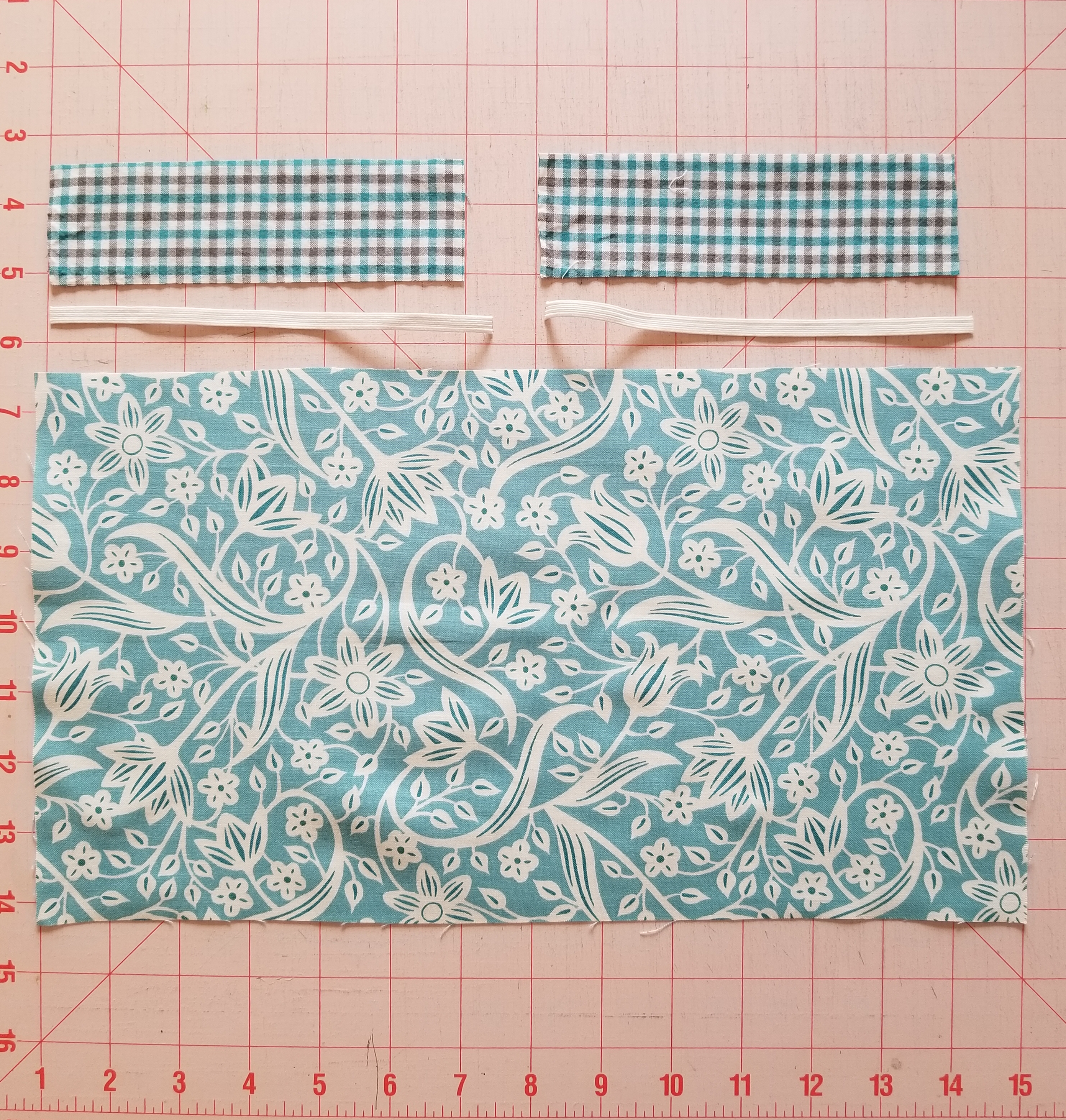
- 1 piece of fabric measuring 8” x 14”. Until you get familiar with this tutorial, I would suggest a non-directional print. One that has a scattered image printed on the surface such as the one shown.
- 2 strips of fabric measuring 1.75” (1 3/4”) x 6”. This will be the accent edge piece. It can be the same fabric as the main piece or a small-scale print or solid.
- Two pieces of 1/4” width elastic. These will be about 6 1/2” long.
- Ruler
- Fabric marking tool.
- Pins
- Scissors
- Sewing machine, threaded.
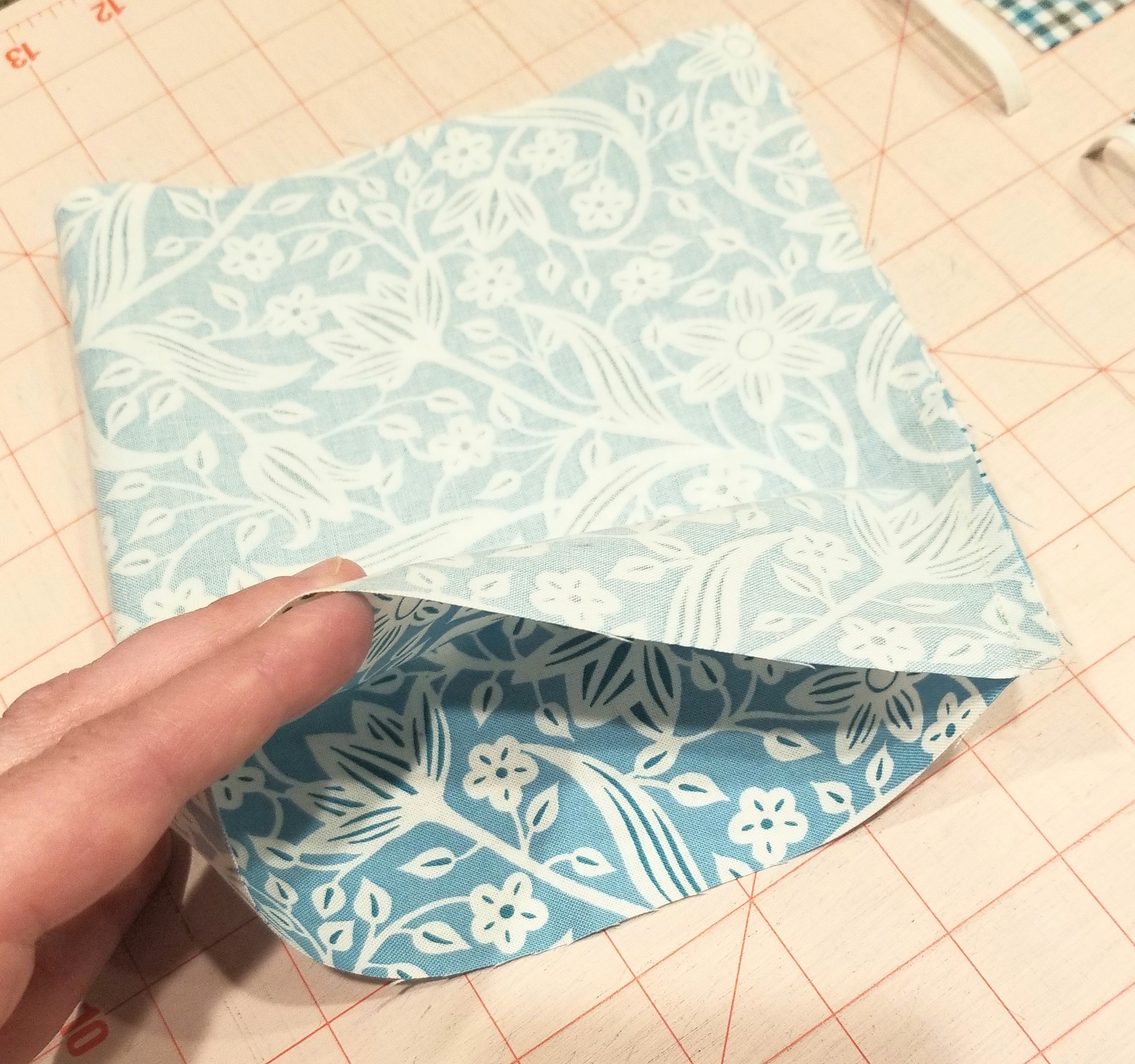
Fold the main piece of fabric in half, right sides together. Sew along the 8 inch width edge, using a 1/4 inch seam allowance.
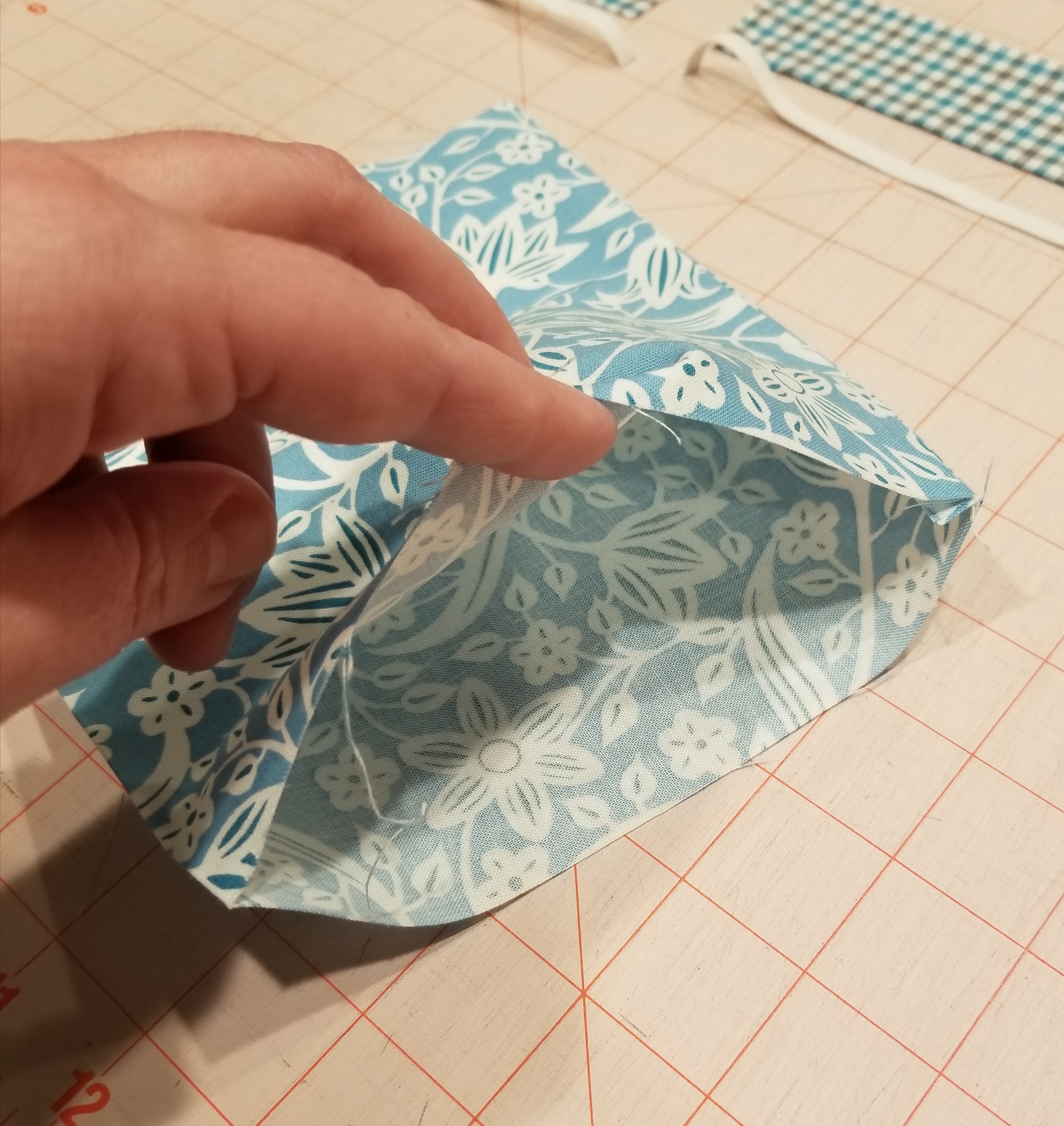
Turn this tube shape inside out, so that the right side of the fabric is now on the outside. Press this flat, keeping the seam to one end of the flattened tube.
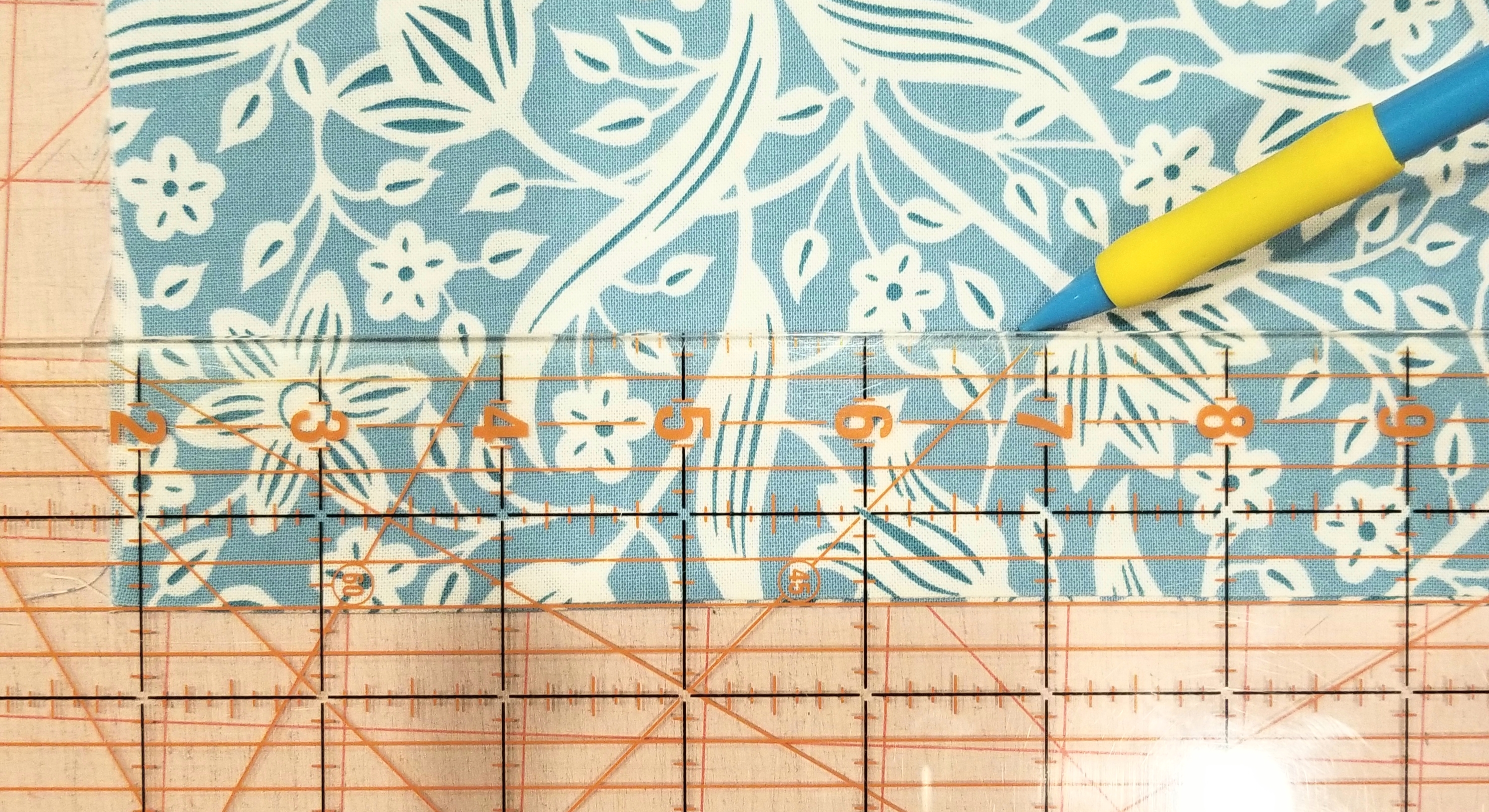
Place the tube of fabric so that the raw edges are on each side and the seam edge is at the bottom. Using a ruler, measure and mark a line 1 1/2 inches from the bottom edge. Make another line 1 inch above this line, or 2 1/2 inches from the seam edge. Don’t use a pencil as you see in the picture, use a fabric pen, or fabric chalk. I used a pencil for illustration purposes.
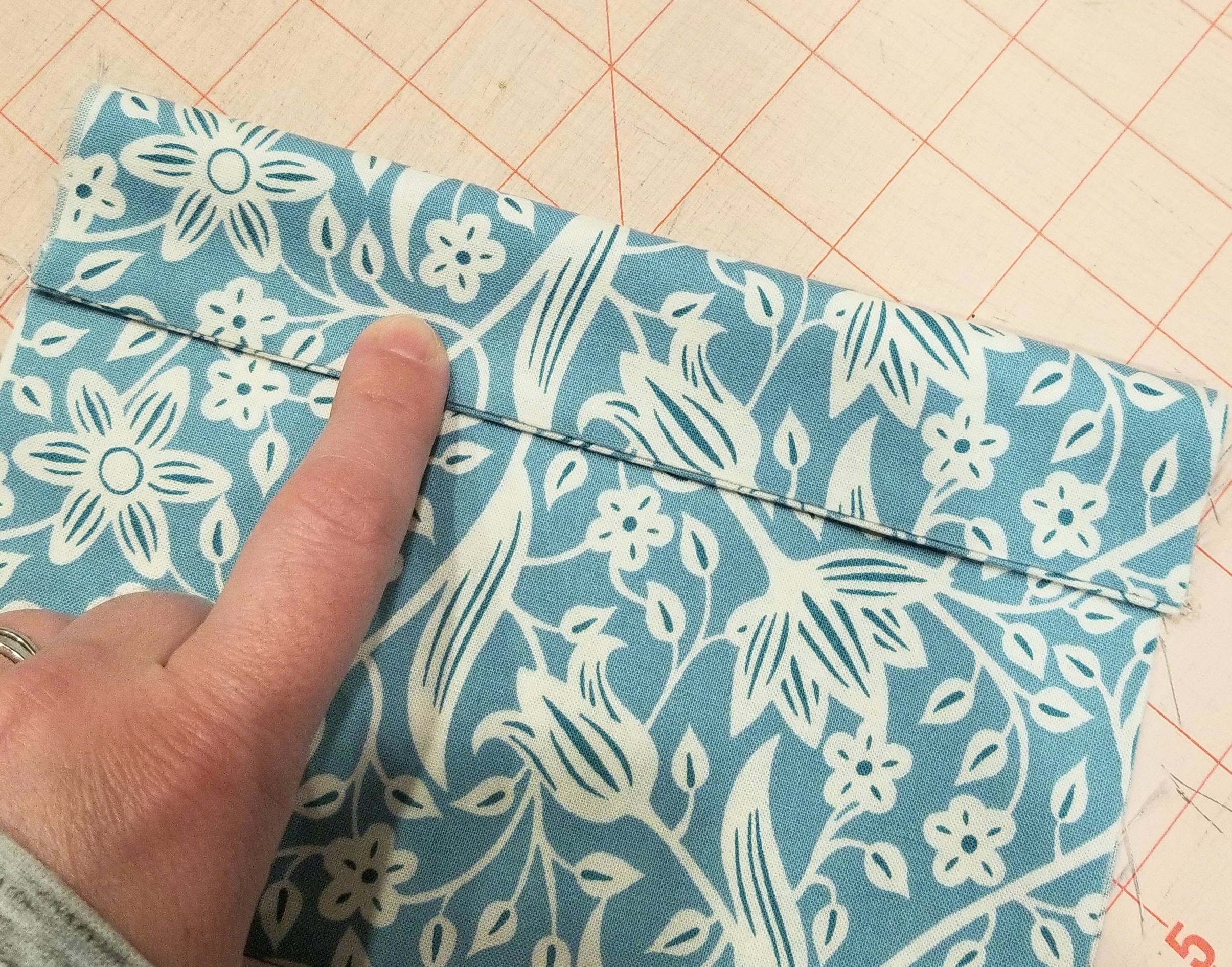
Fold the seam edge up (or down in this picture, as I turned it upside down…sorry) making the crease on the first line that you just marked. You should have 1 1/2 inch edge here.
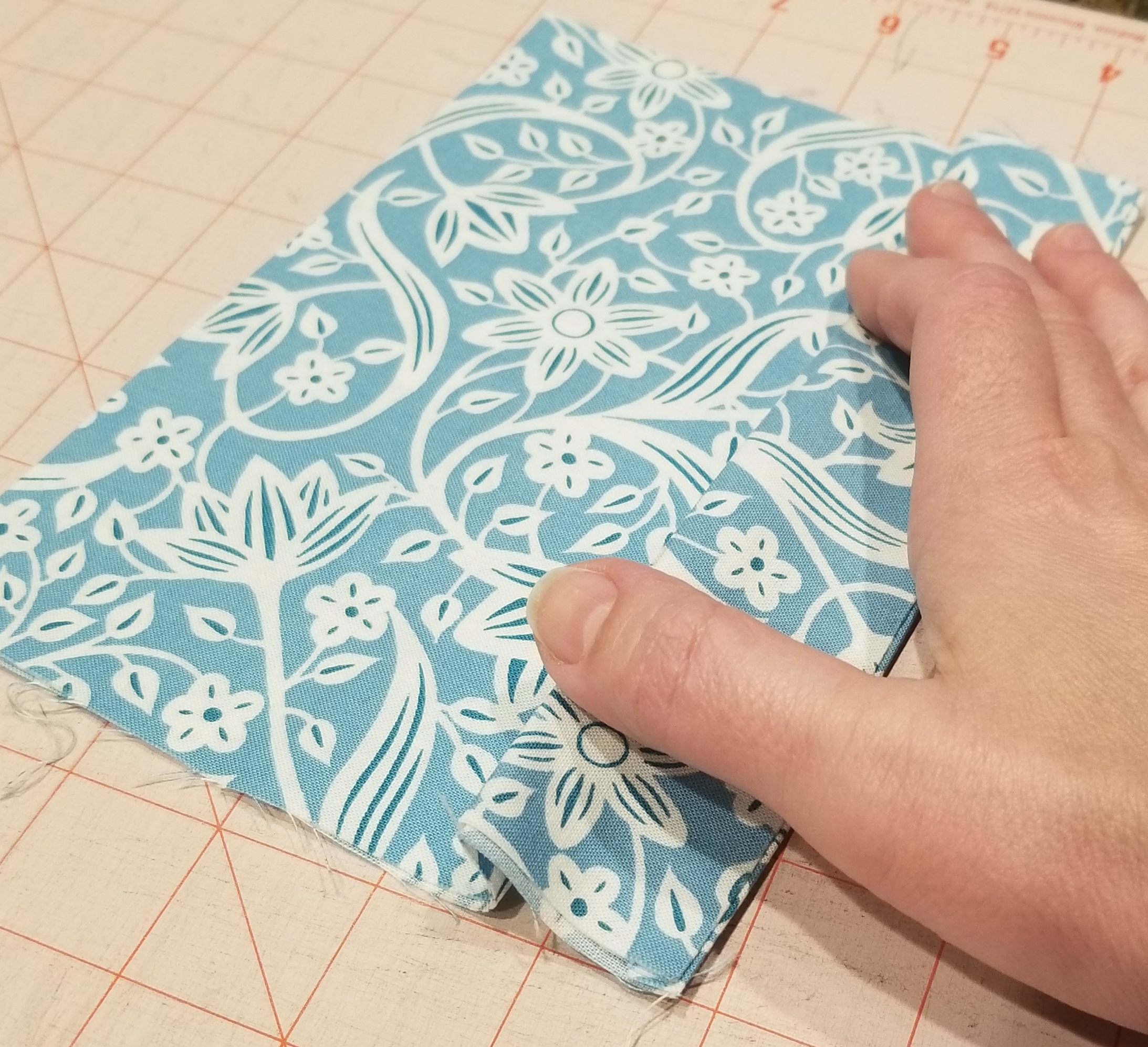
Flip the tube piece over. Match the crease edge to the second line that you made earlier. Press. The pleat that you just created will be 1/2 inch deep. Pin the pleat down on each raw edge end.
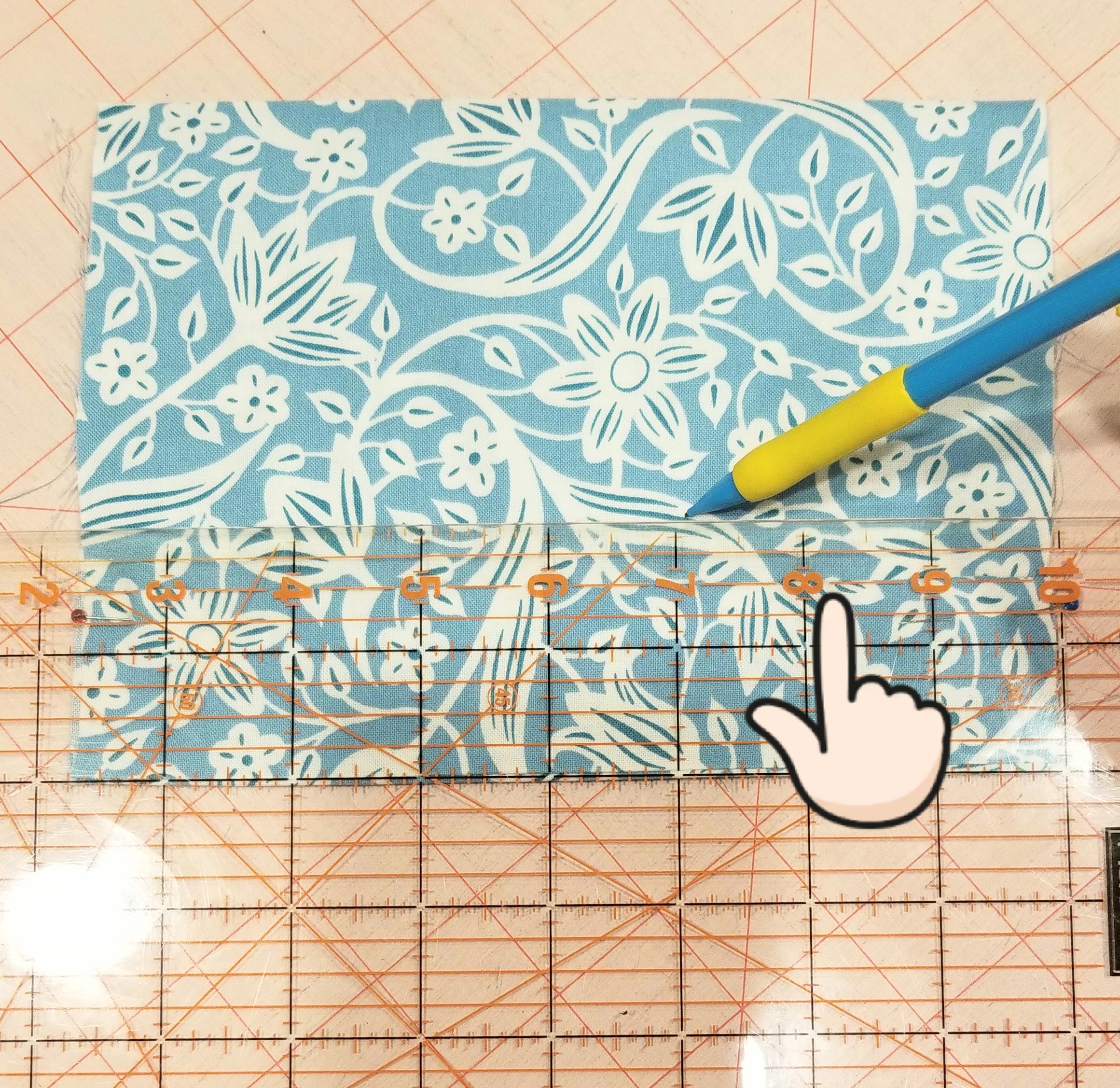
Now you will mark the lines for the second pleat. Mark a line measuring 1/2” from the top crease of the last pleat, (or 2″ from the bottom seam edge). It was difficult to see the top of the crease in this picture, so look at the finger indicator above.
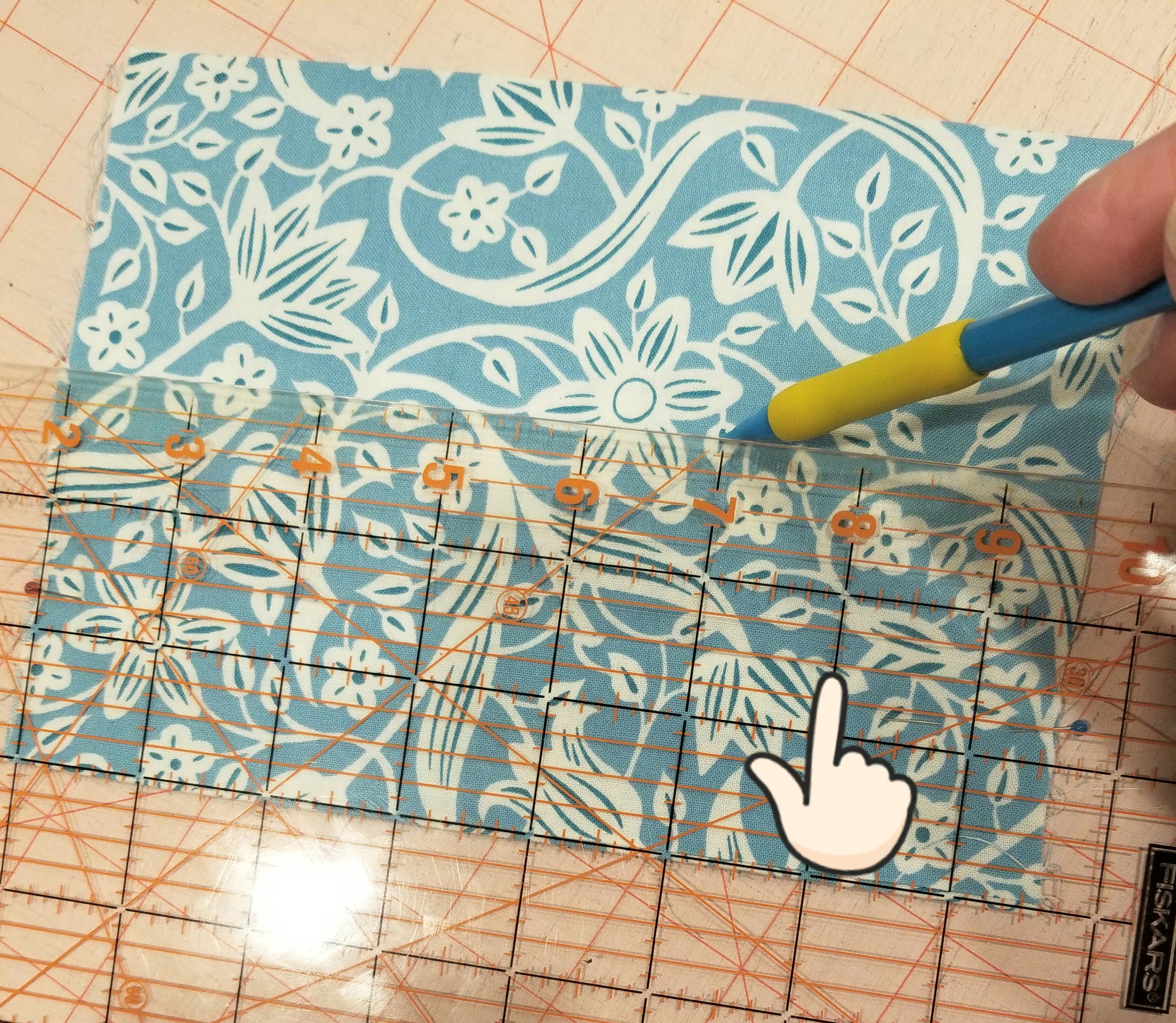
Now mark another line one inch above the last line that you made (or 3 inches above the seam edge). Using these lines as your guide, repeat the steps that you followed to make the first pleat.
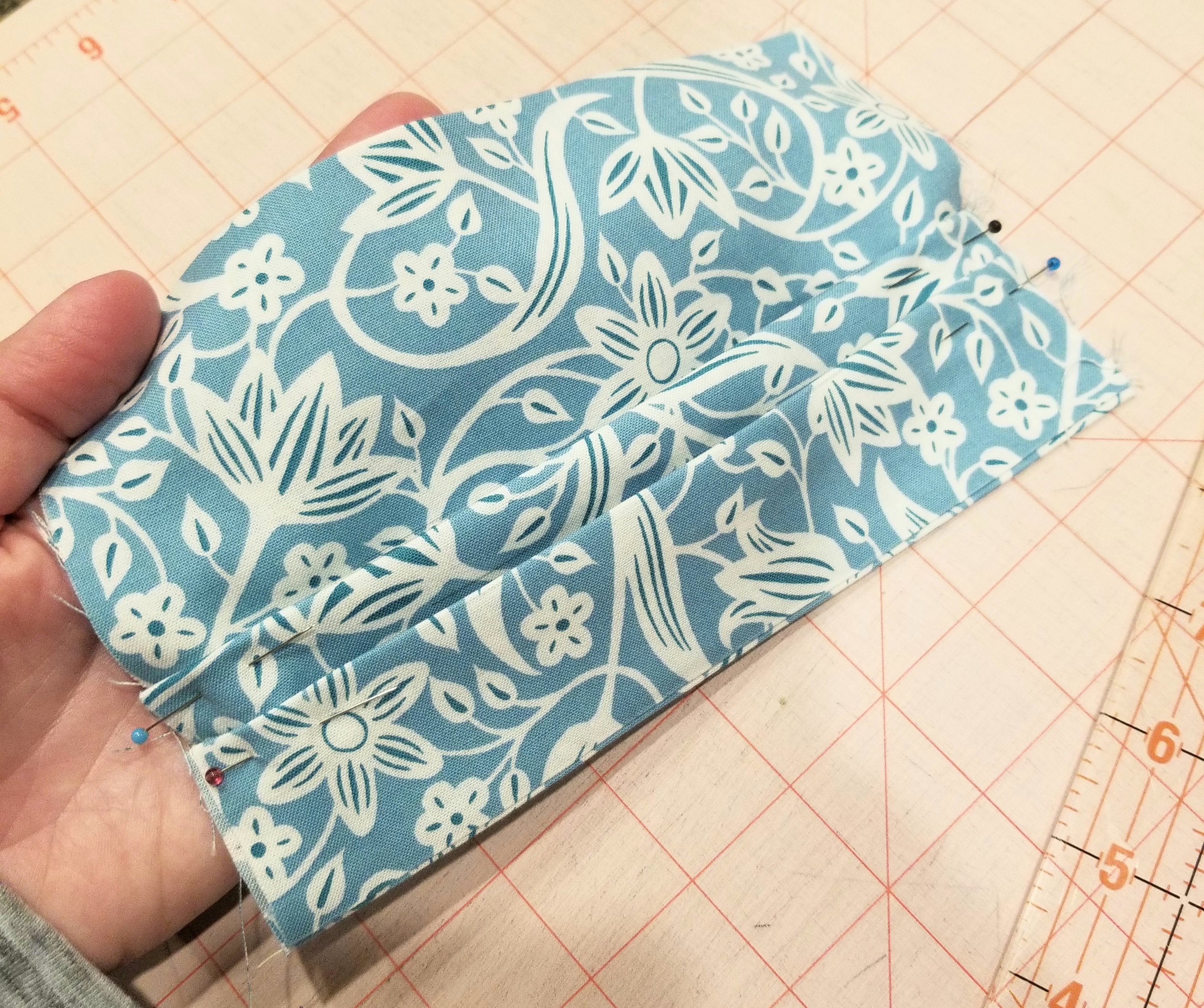
You should now have two pleats, each one being 1/2 inch deep. Repeat the steps you used to make the second pleat, so that you end up with three pleats total. Press.
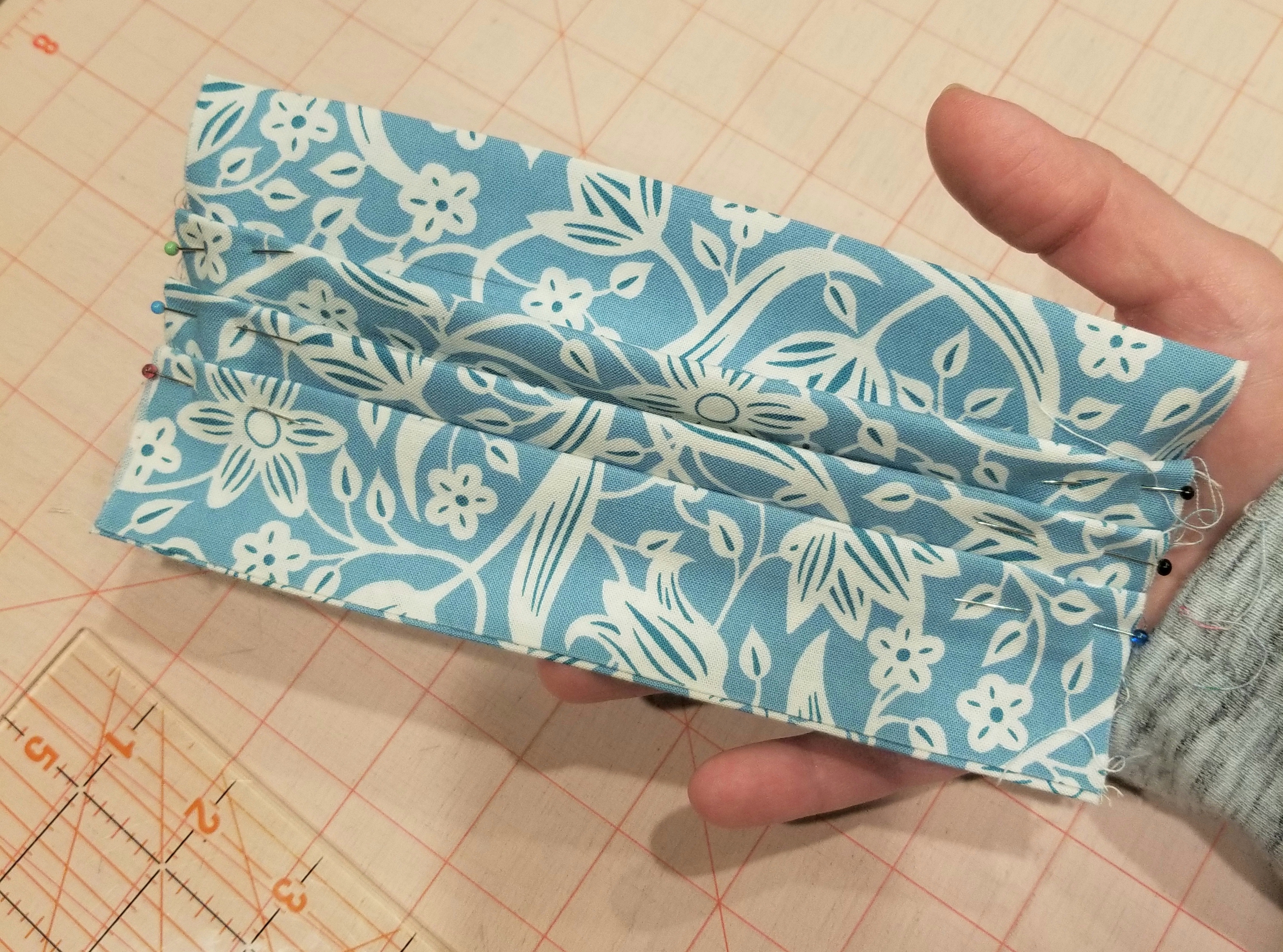
This is what your main piece should look like at this point.
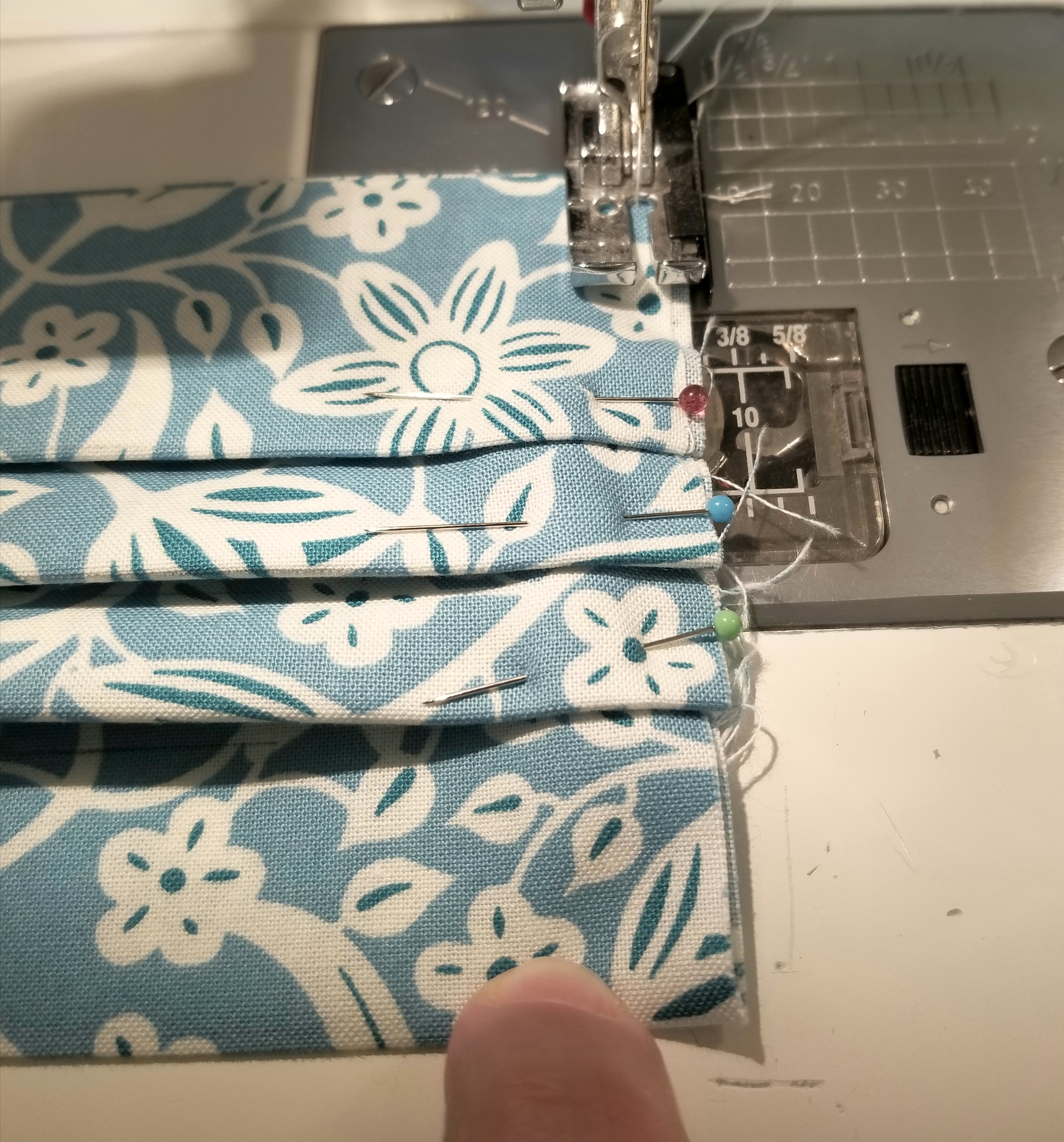
Using a 1/8” seam allowance, baste stitch the raw edges.
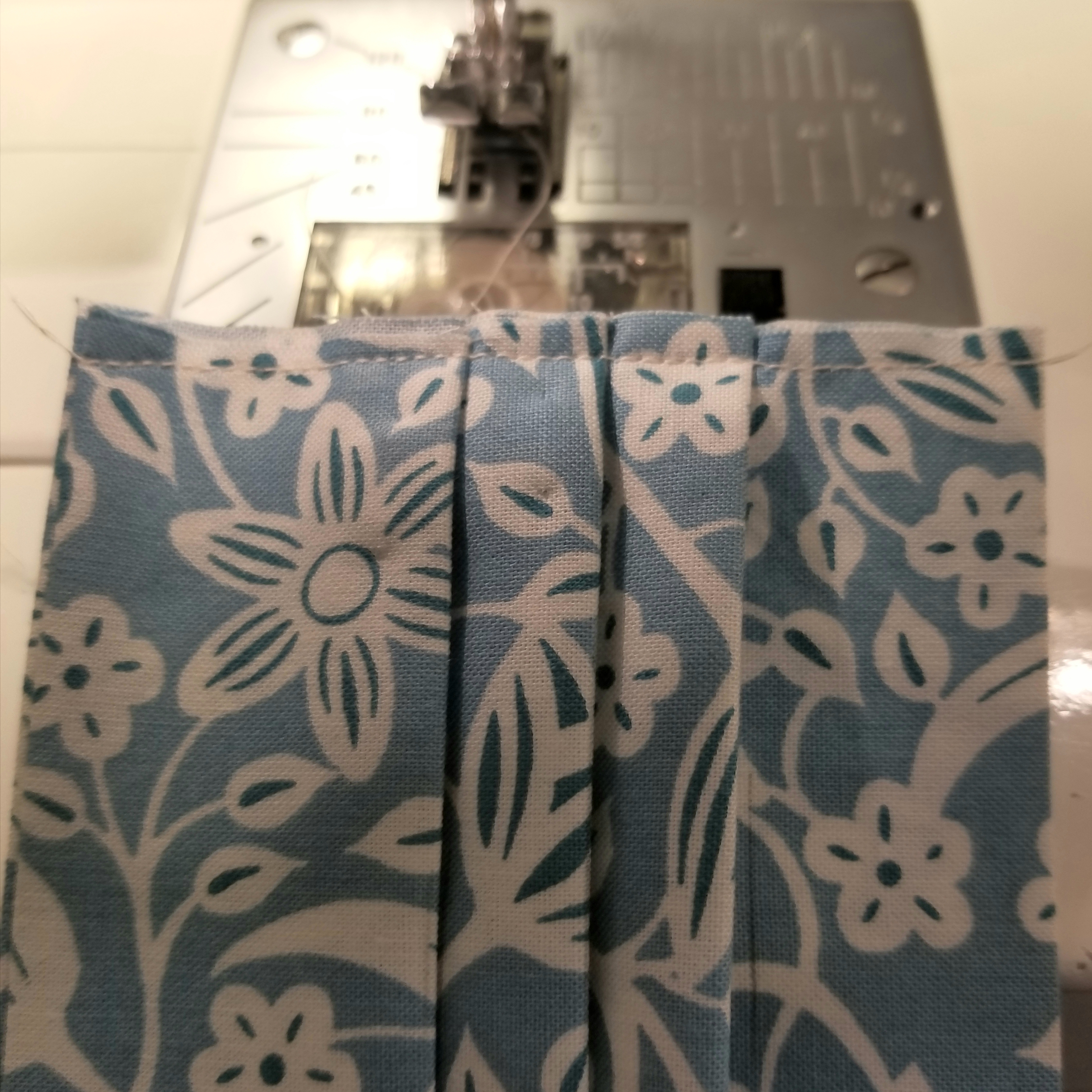
Repeat this step so that both raw edges are basted as shown in the picture above.
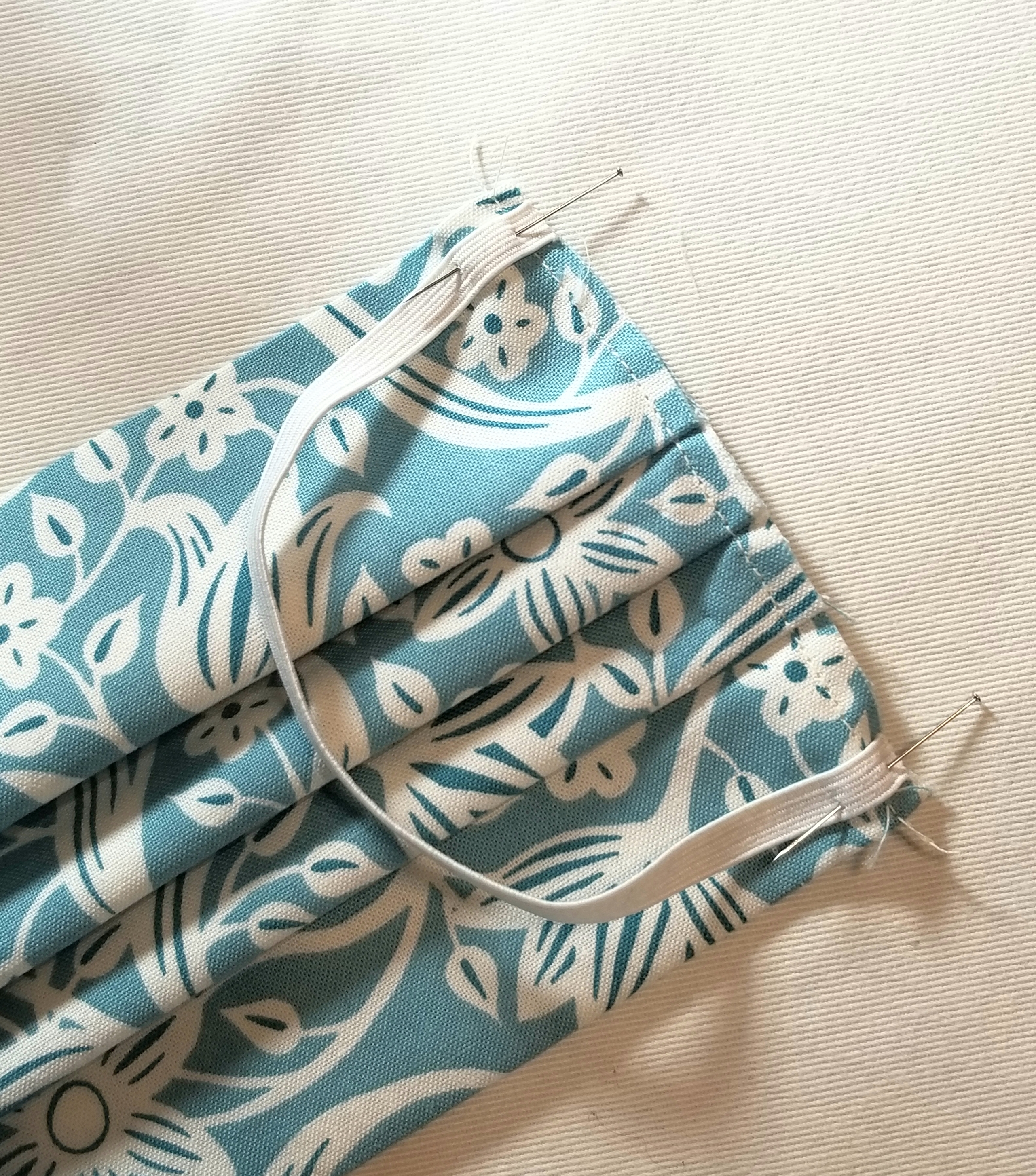
Pin one elastic piece to the raw edge, making sure not to twist it before baste stitching it to the edge at both ends. I placed mine 1/8” from the top and bottom edge of the main pleated piece. Baste elastic in place 1/8” inch from raw edge. Repeat, to attach remaining elastic piece to the other raw edge.
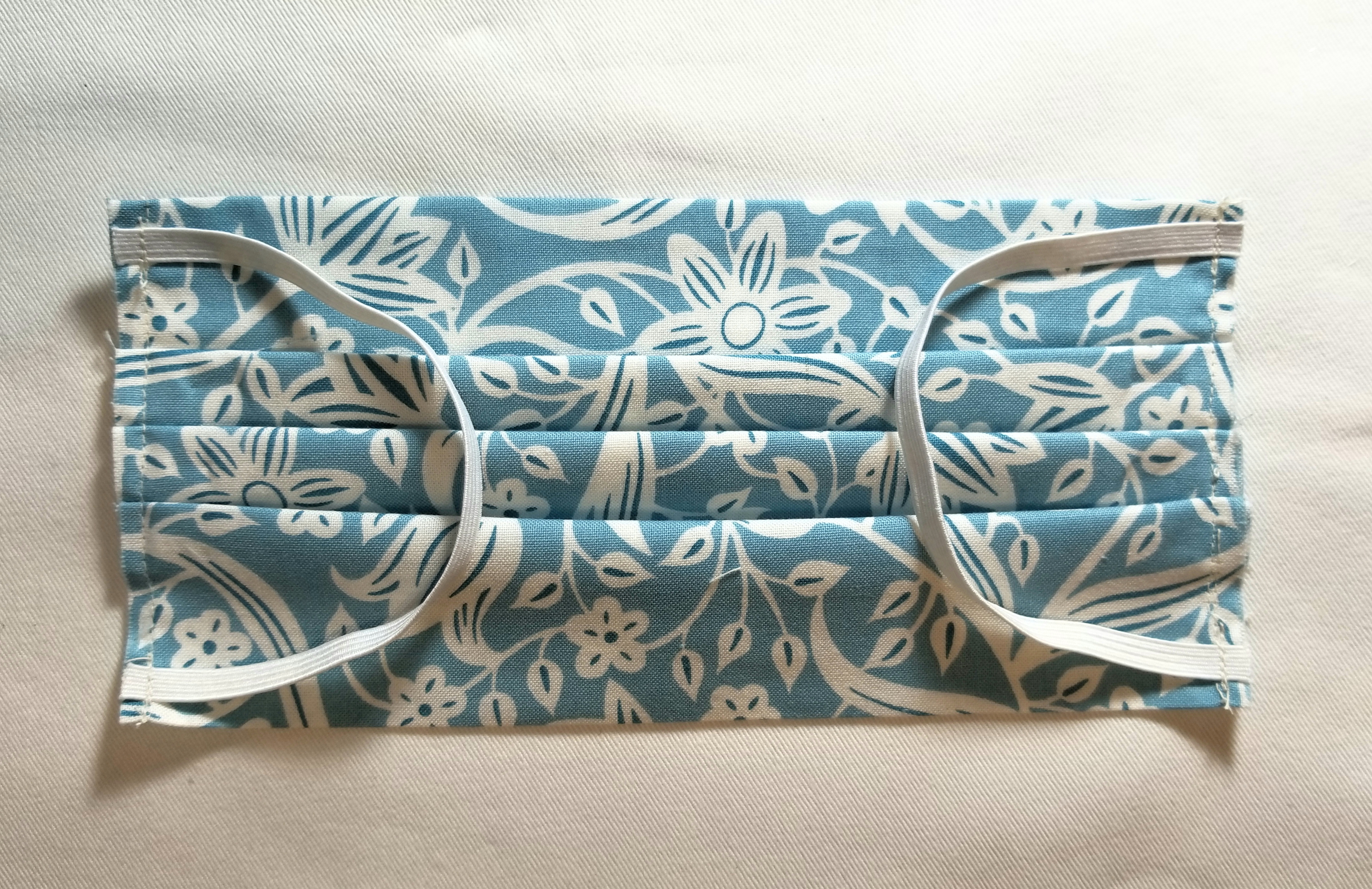
Your pleated piece should now resemble the picture above.
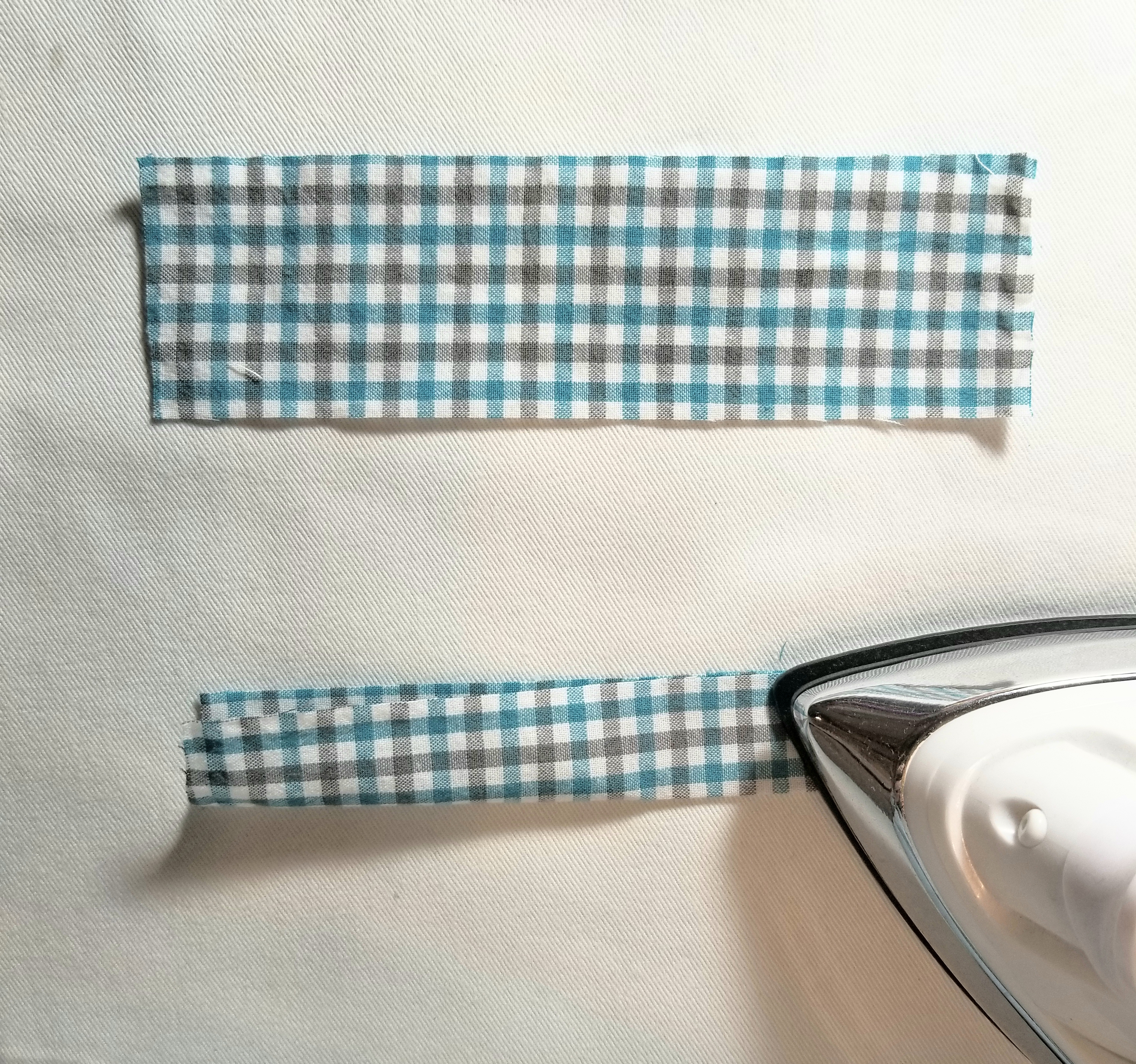
Fold each accent strip of fabric lengthwise in half, matching raw edges, as shown in the picture above. Press.
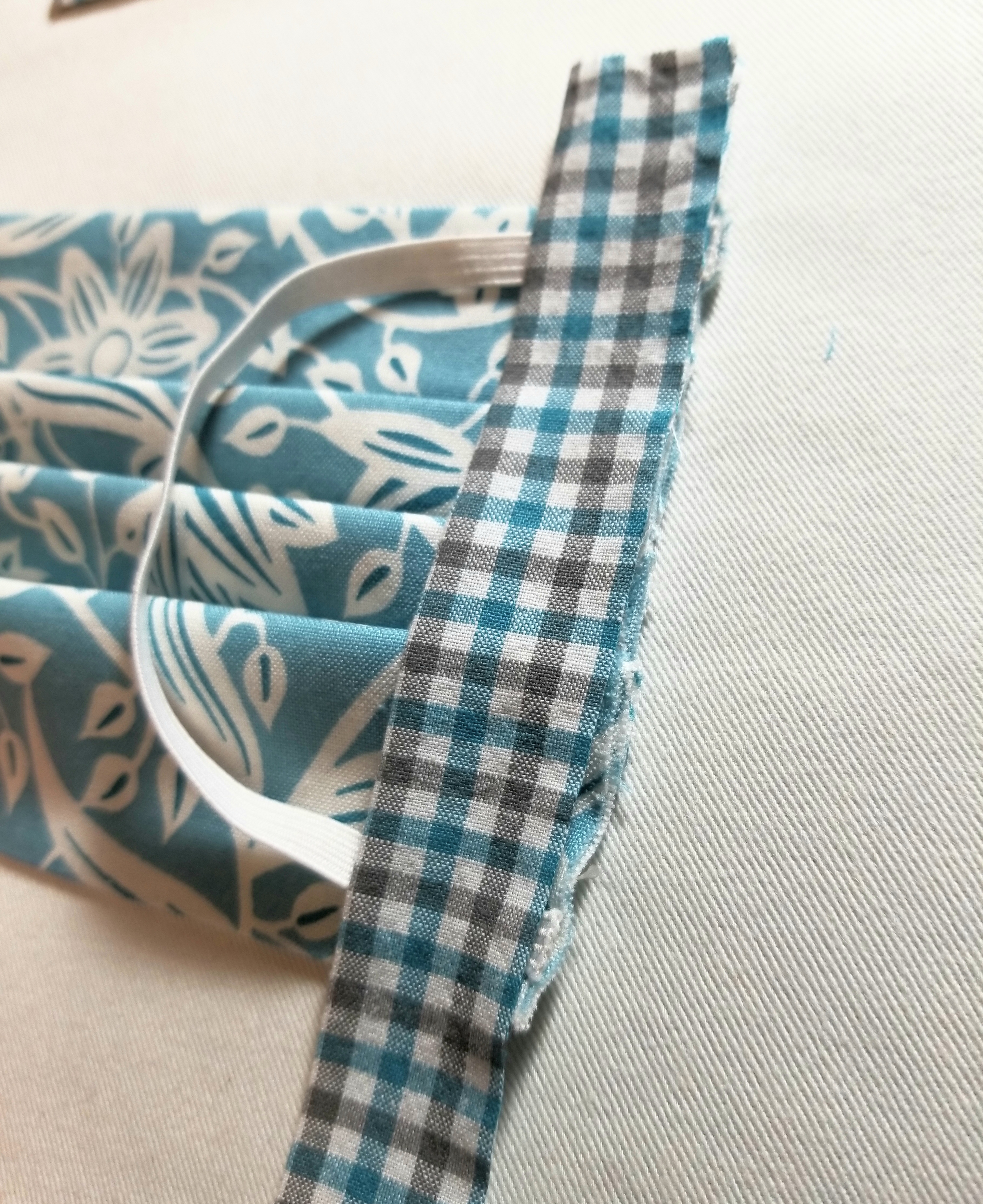
Place the strip on top of the elastic. Make sure the raw edge is facing outward, and the creased edge is facing the main body of the pleated piece. It will be a little longer on the top and bottom and that is okay, as we are going to fold some of that to the back.
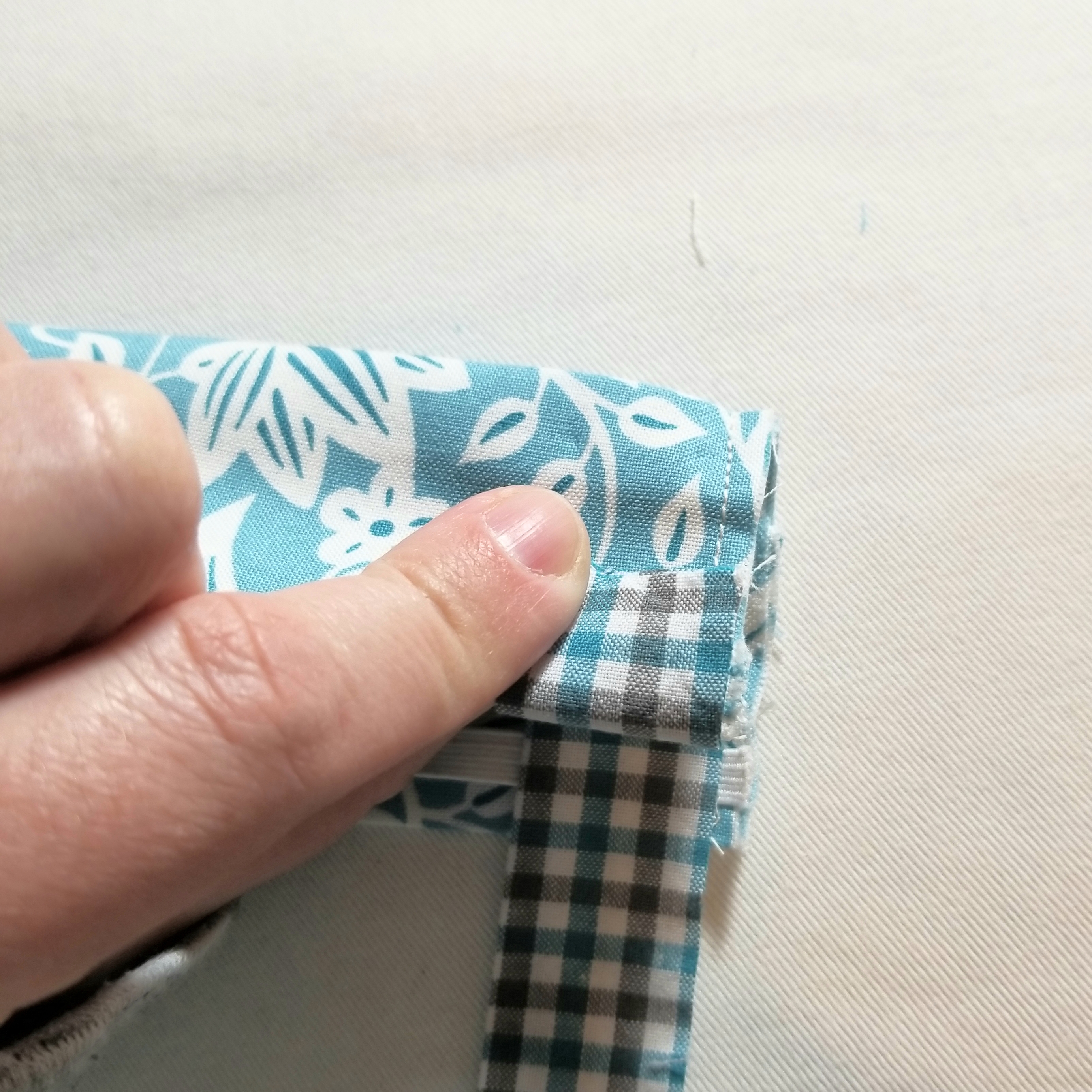
Tuck about 1/2” of the top edge to the back as shown in the picture above.
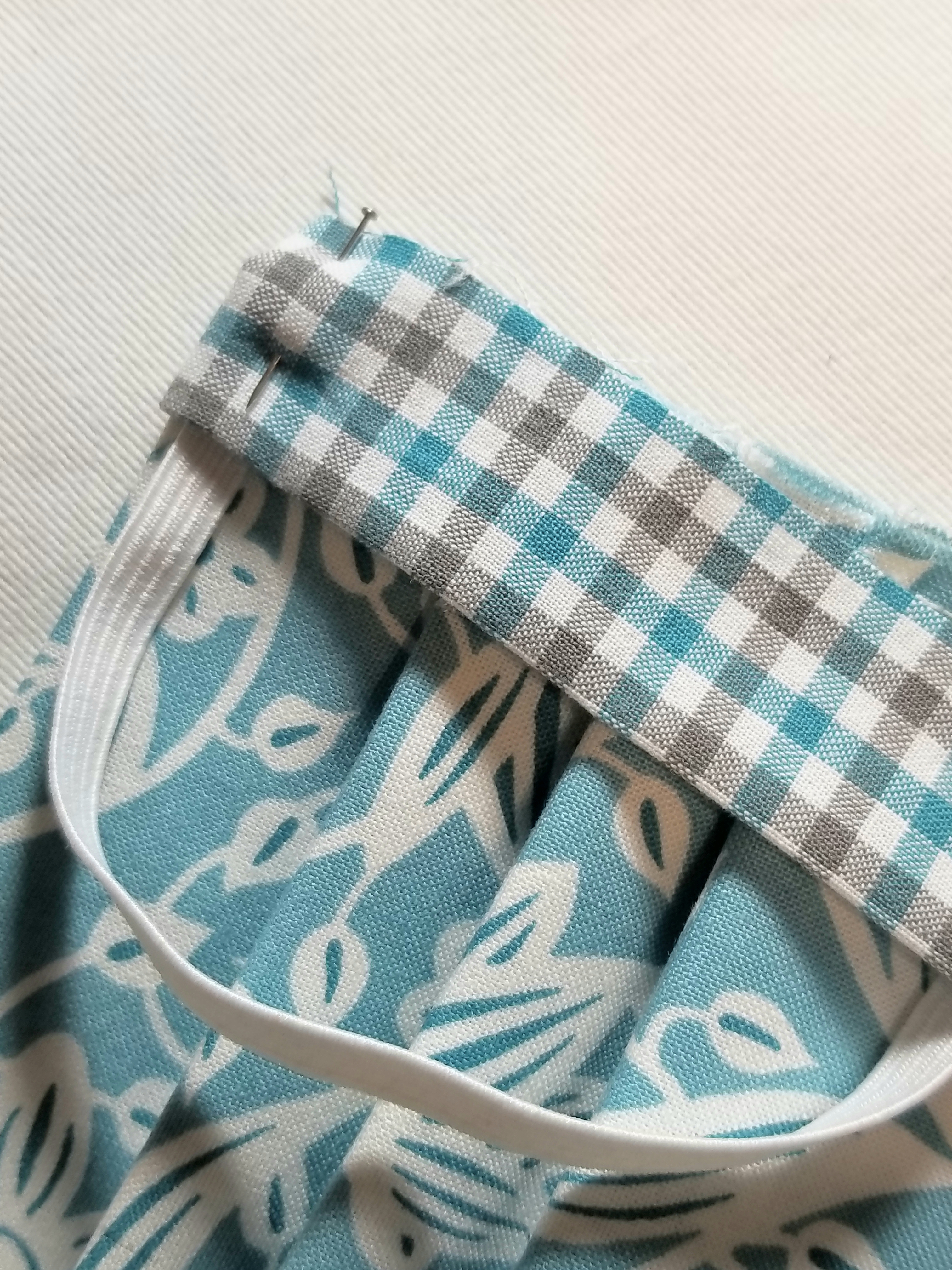
Pin all layers in place.
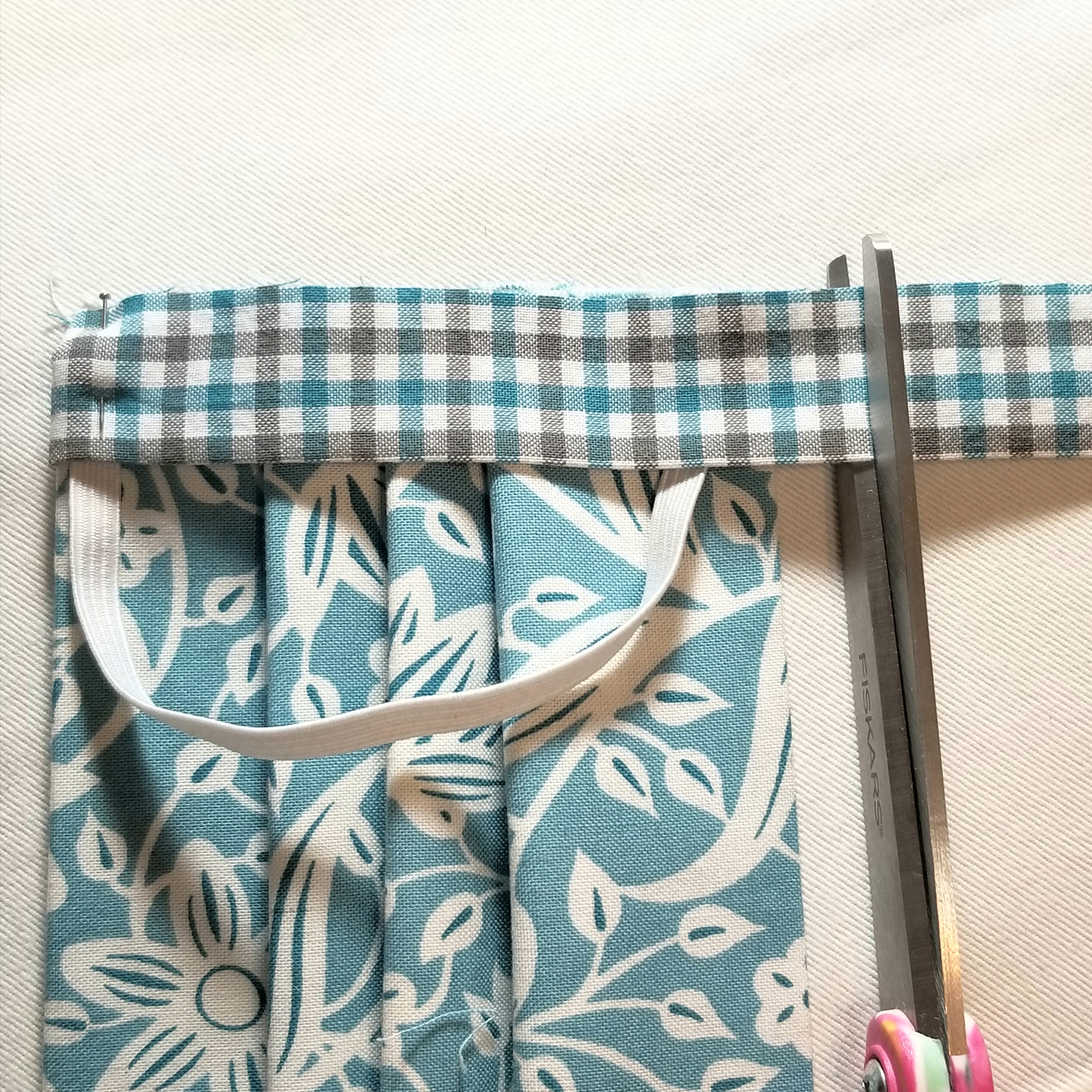
Trim the other end of the accent strip, so that it is about 1/2” longer than the bottom edge of the main pleated piece.
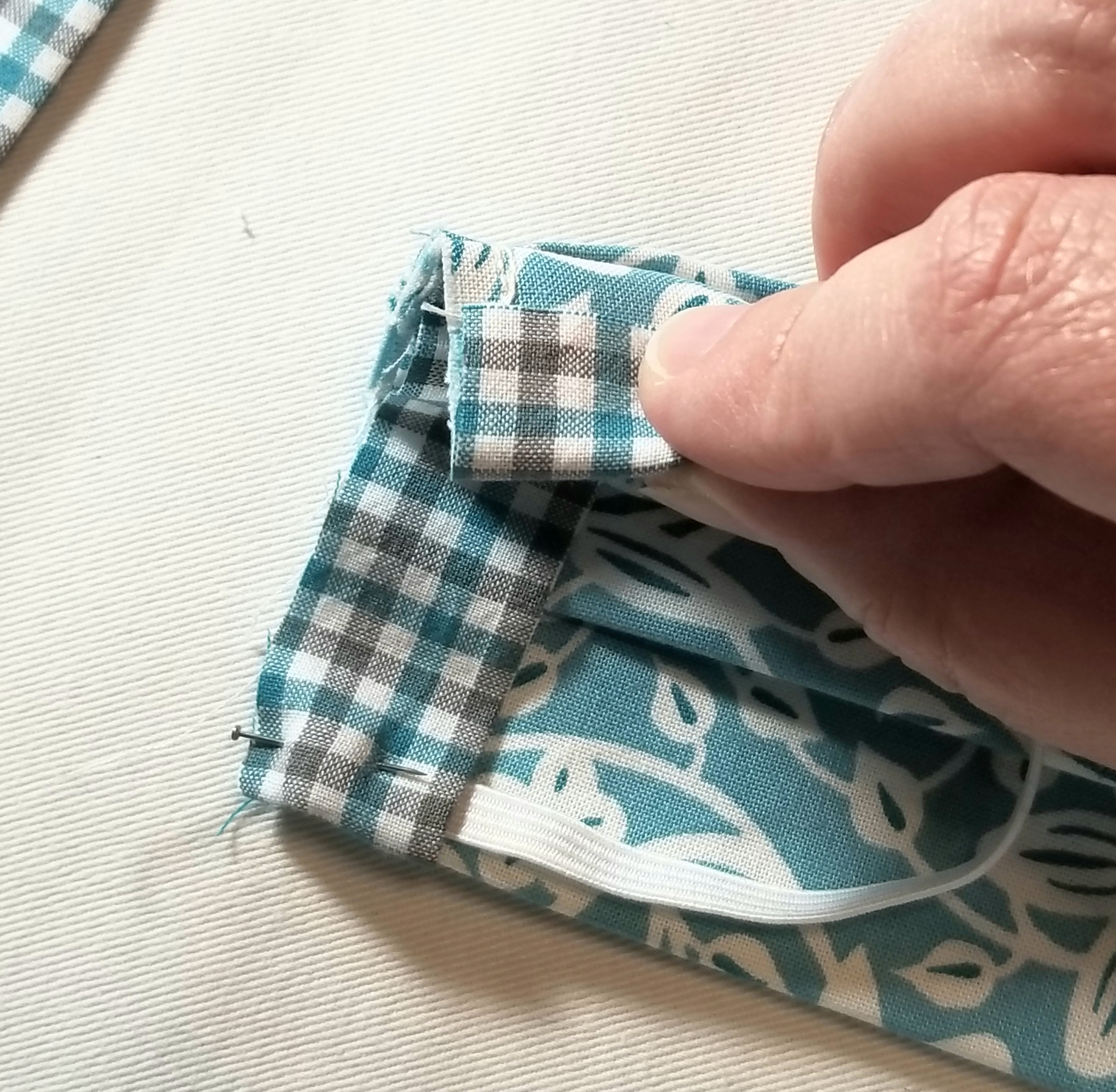
Fold the bottom edge of the accent fabric strip to the back, just as you did with the top edge.
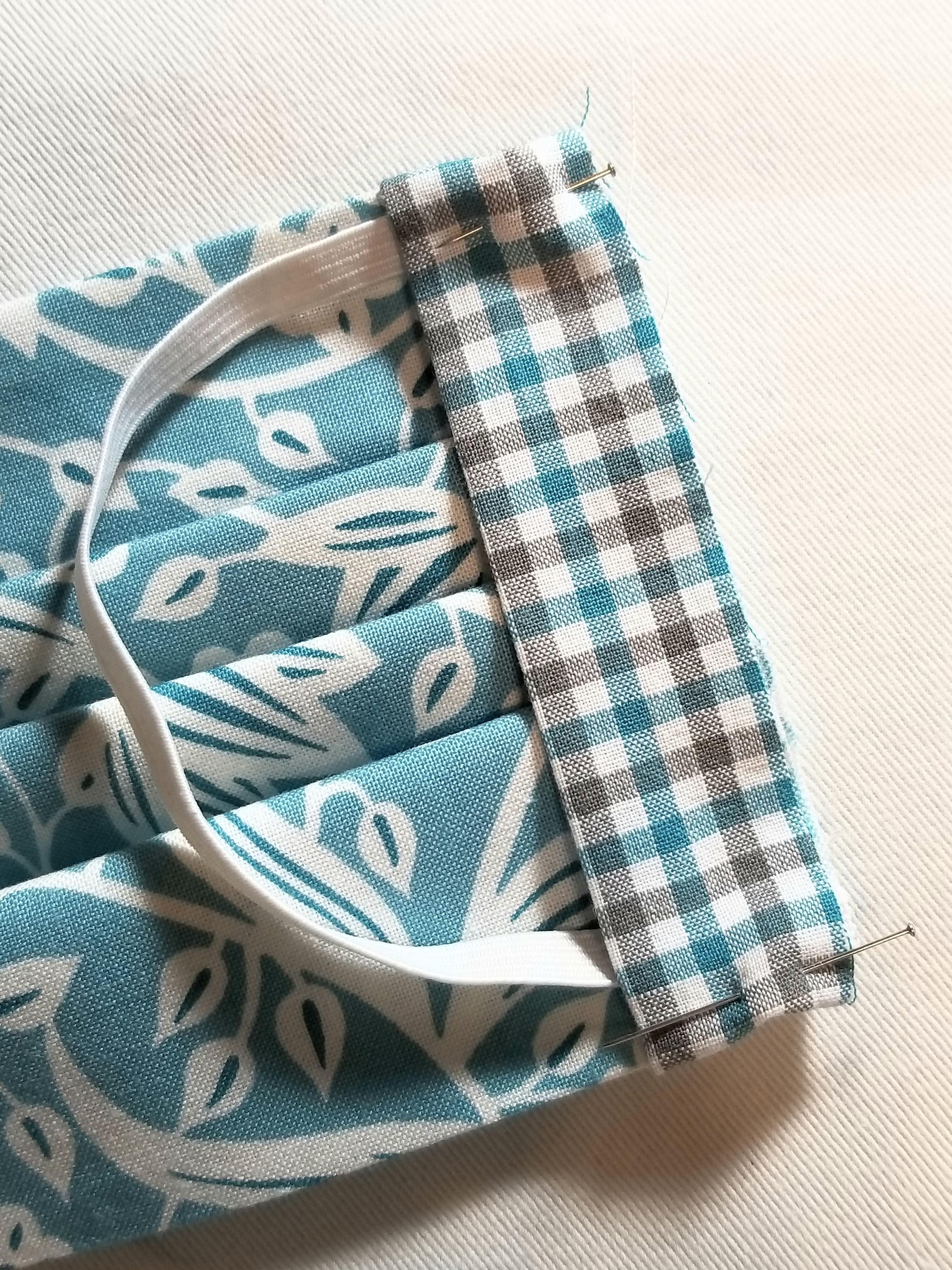
Pin both ends in place.
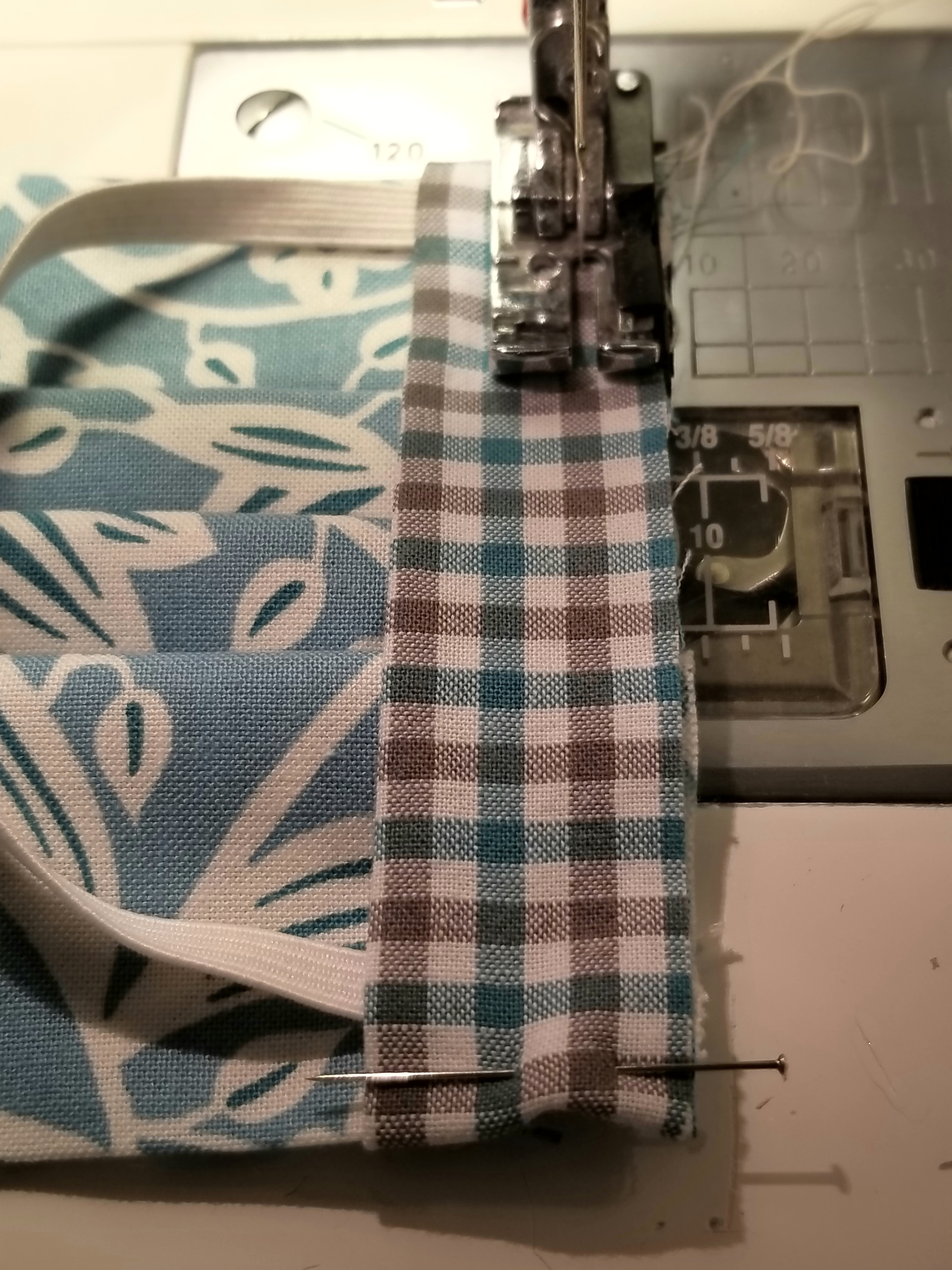
Using a 1/4 inch seam allowance, stitch the length of the entire edge, making sure to back stitch at the beginning and end.
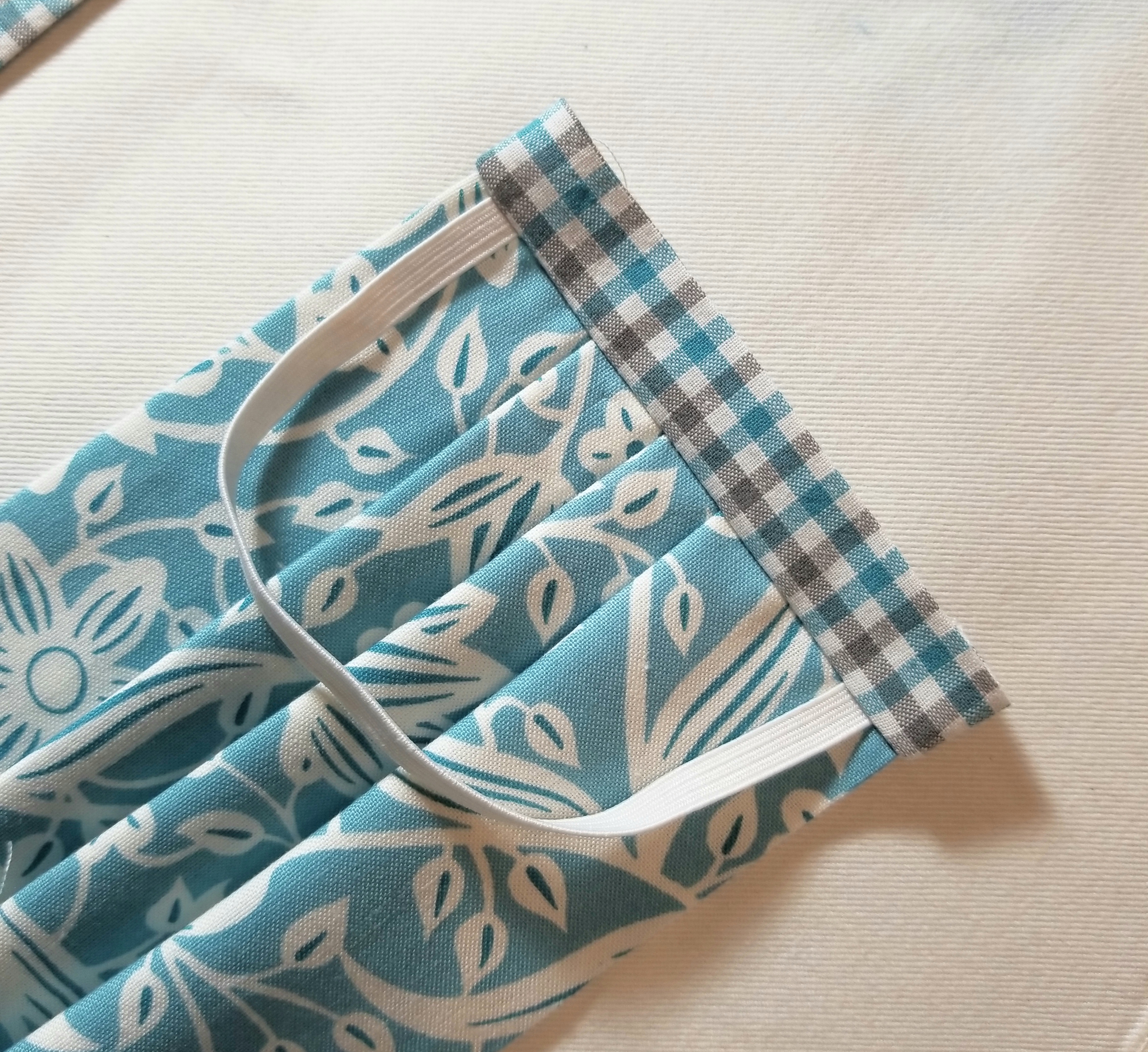
Open the the accent fabric strip seam by flipping it outward away from the main pleated piece, then press.
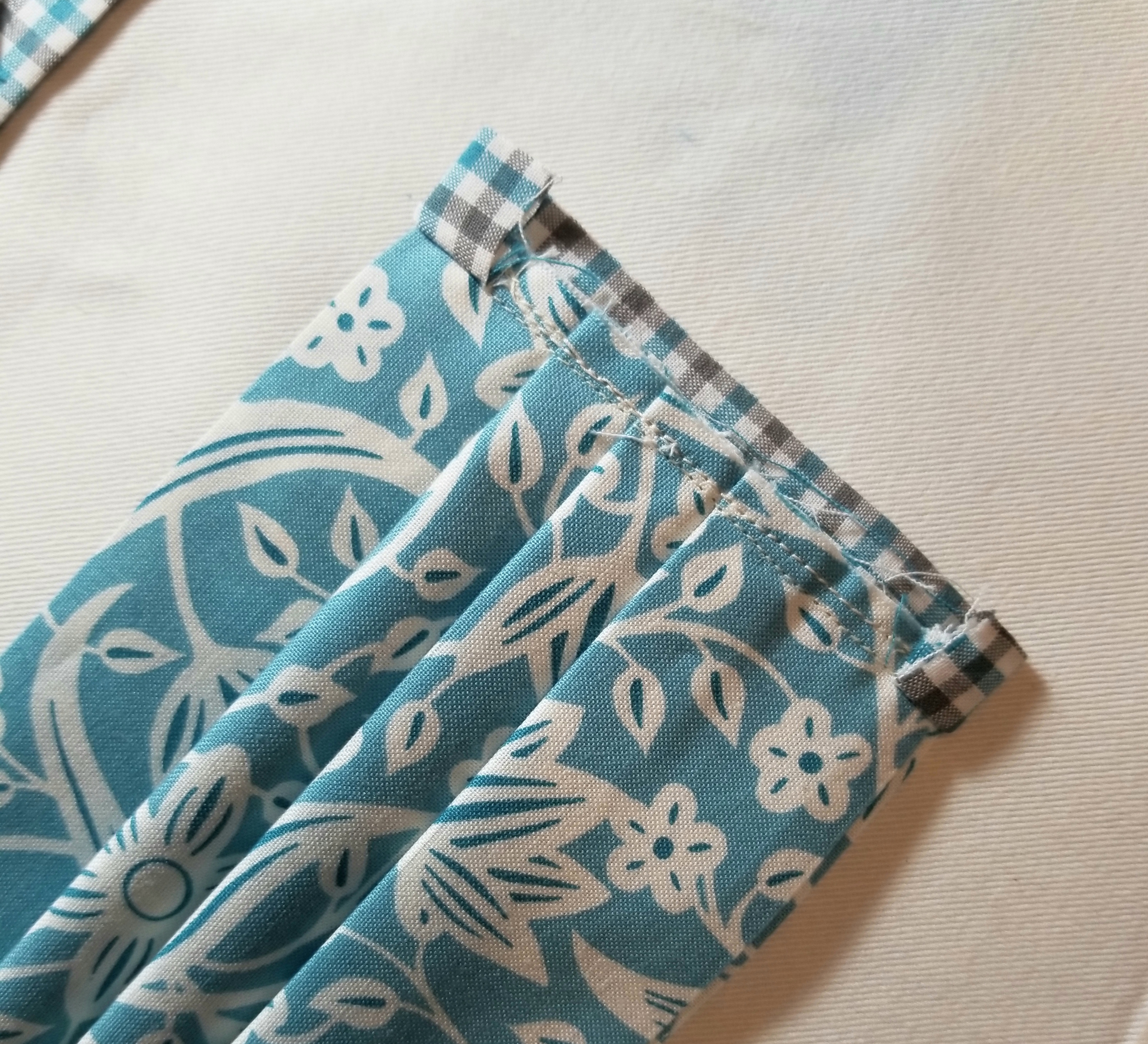
This is what the mask should look like if you flip it over.
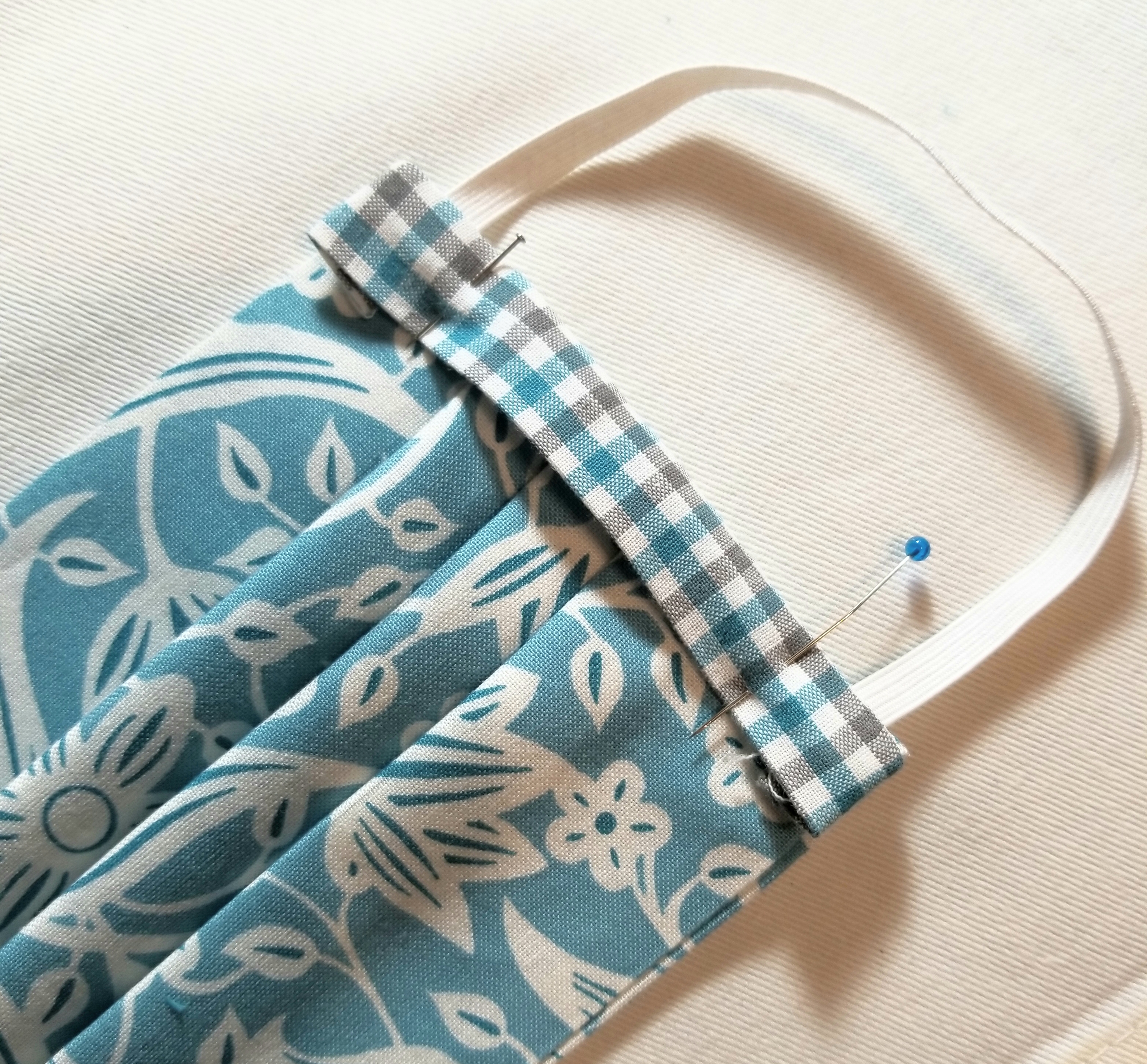
fold the ENTIRE accent piece down toward the main pleated piece, encasing the raw seam. You will now see the accent piece on this side, but not at all on the flip side. Press. Pin edge down.
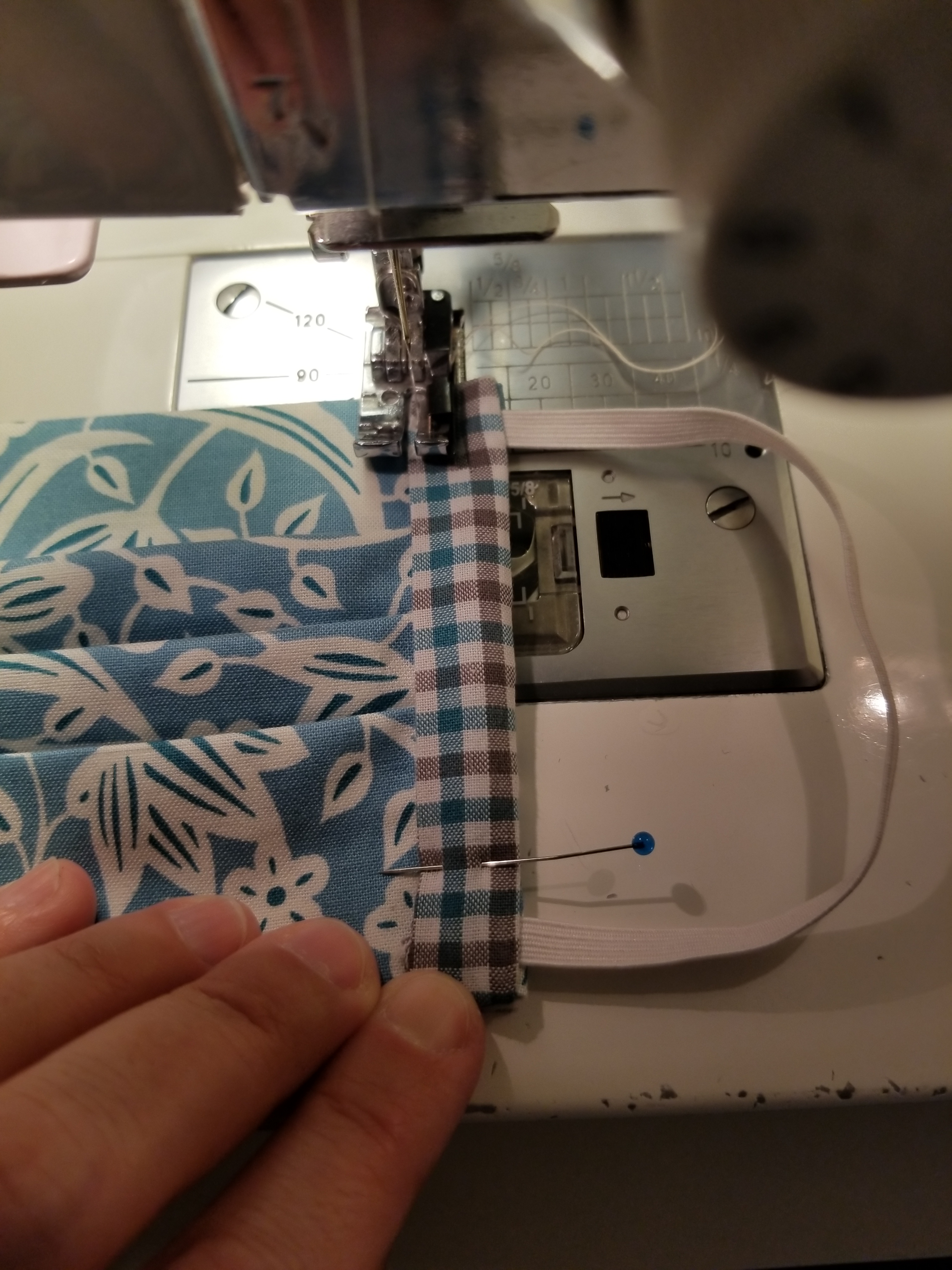
If you are a good sewist, you will change out your presser foot to a straight stitch foot. If you are lazy, like me, you will keep that 1/4″ presser foot on your machine and struggle your way through this next step. 😀 Stitch this accent strip down to the main body of the mask, sewing along the edge, making sure to back stitch at the beginning and end.
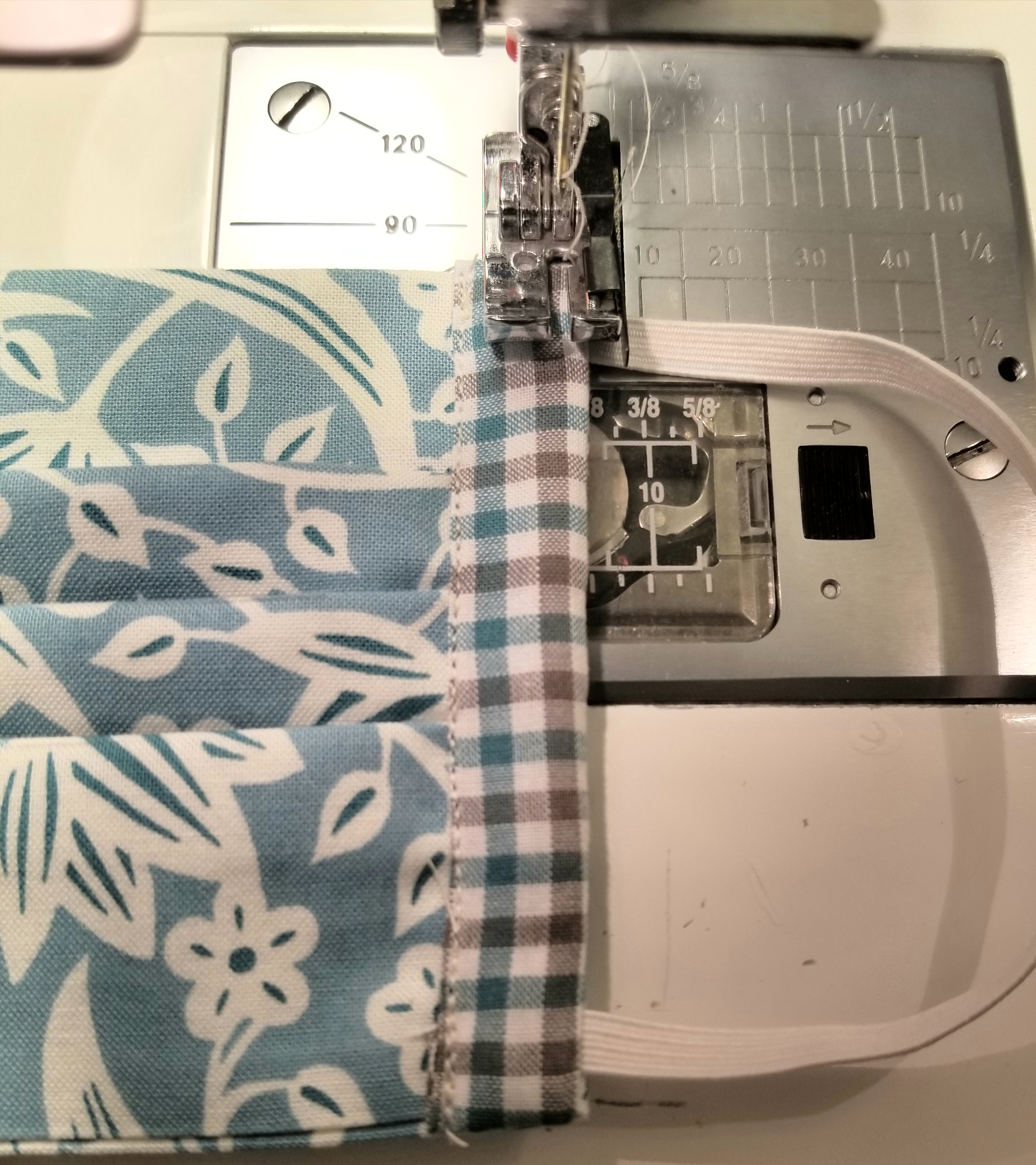
This step isn’t necessary. It just gives it a nice finished look, and helps to give that elastic a little extra stability. Stitch down the edge of the mask close to the elastic side.
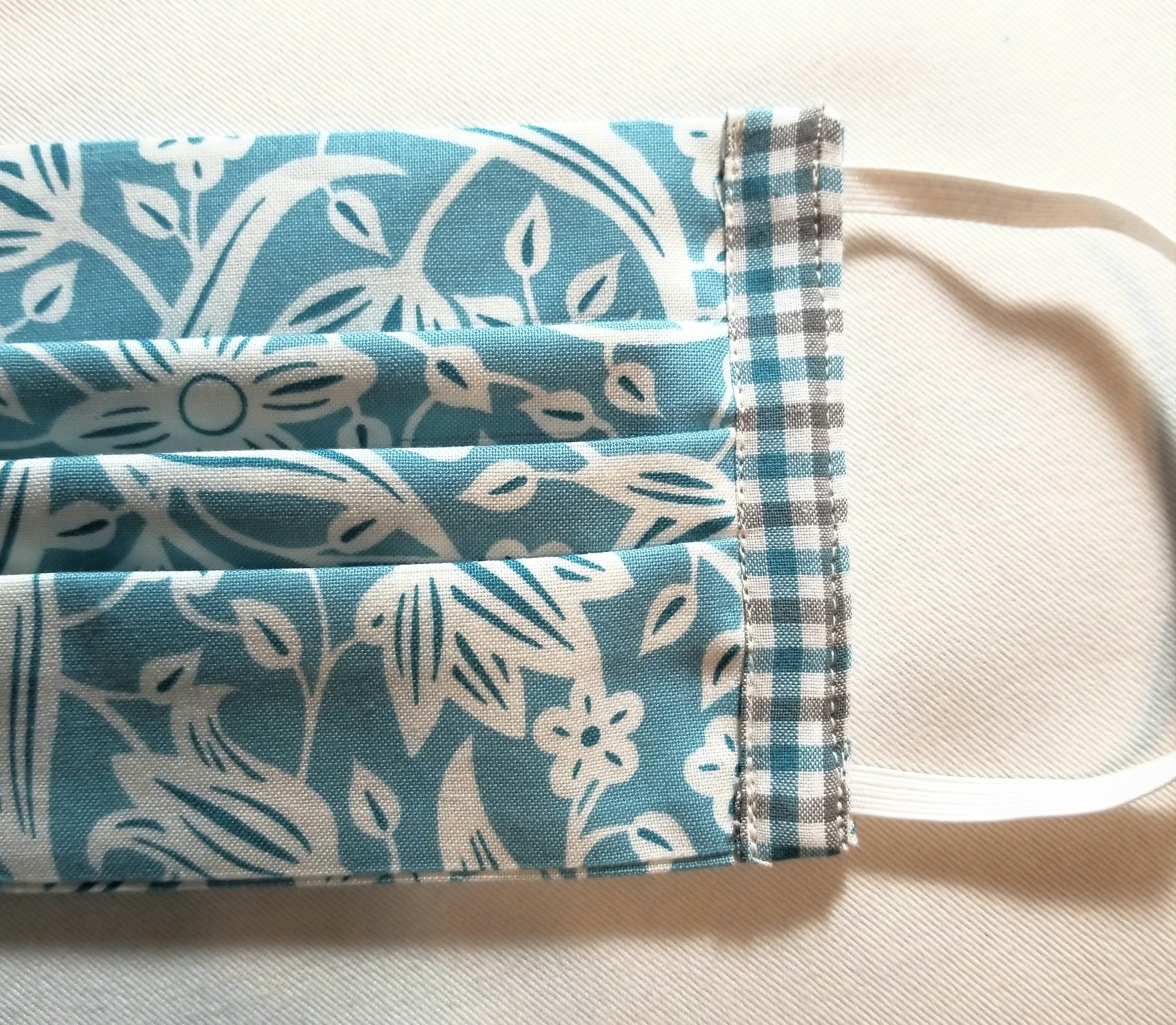
The front of your mask should now resemble the above picture.
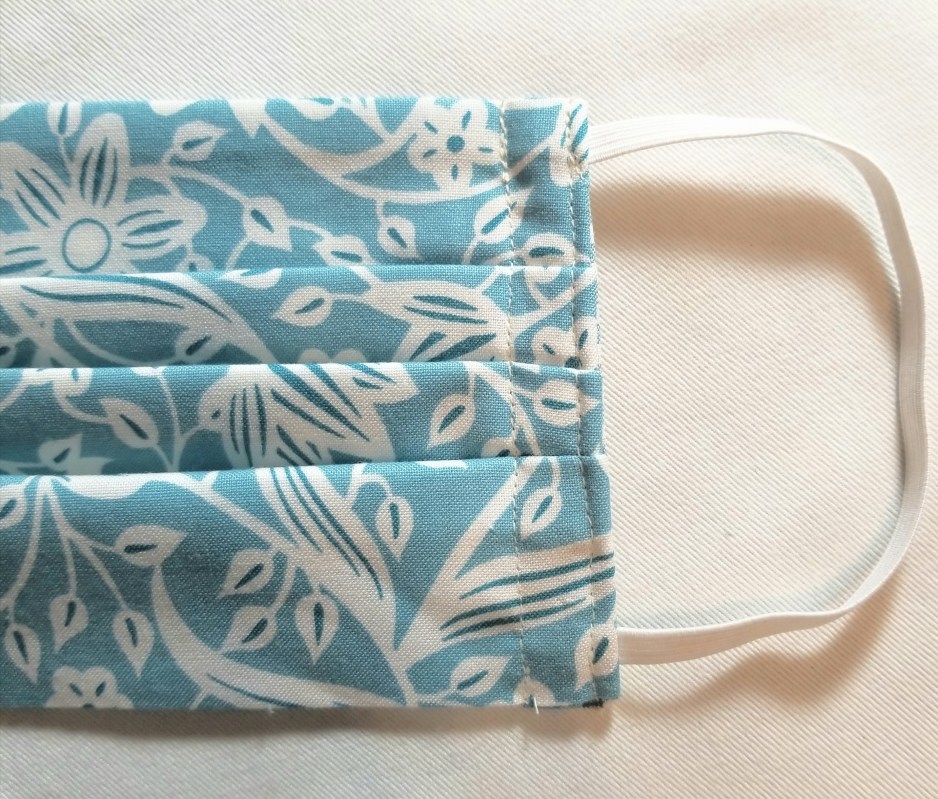
The back of your mask should look like this. Following the previous steps, attach the remaining accent fabric piece to the other end of the mask.
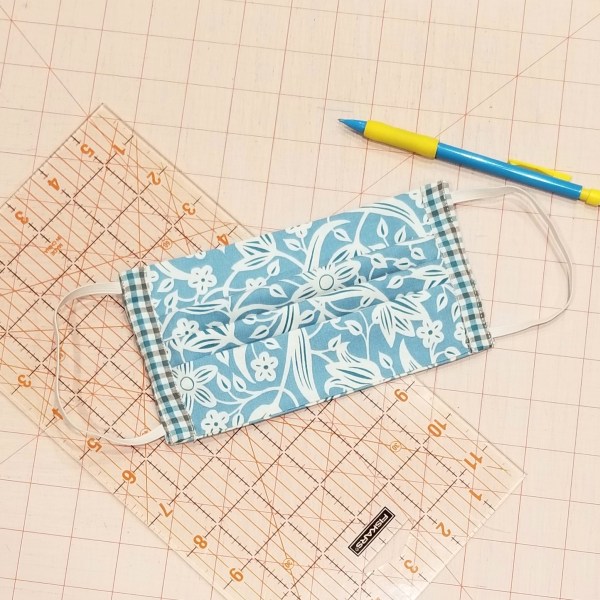
You should now have a reusable, washable mask that measures approximately 4″ x 7″ (unopened).
It took a few hours to put this free tutorial together for you. For this reason, I am greatly appreciative for any mentions that you can give me if you should use this tutorial. If you post a picture on social media, you can use the hashtag: #buttoncountermask. Feel free to share this page, and please tag me in your pictures so that I can see your beautiful creations. Last, I appreciate constructive criticism, so if you notice something that doesn’t look right, or does not make sense, bring it to my attention. I am happy to clarify any steps where you may have questions.
Enjoy!
P.S. Obviously, the elastic length can be adjusted to your facial measurements.
EDIT (March 24 2020): Because this tutorial has recently been used on a large scale, I will be adding a few things here as frequently asked and answered questions, suggestions, and reminders.
- This tutorial was happily shared by me over a year ago. This is not a new tutorial created in light of the current virus pandemic. I am not in charge, nor affiliated with any organization or entity requesting masks to be made. There are multiple organizations that are using this tutorial for their requests. If you have any question regarding what their requirements are, you really, really, really need to ask them. Please understand that I cannot and will not tell you what you should use, or how you should make your mask different from my tutorial.
- Keep in mind also that there are multiple entities that are using this tutorial for their requests. One entity may have completely different requests regarding features than another entity. (for example one organization is requesting a 4 layer mask, while another is fine with the two layer, as their thoughts are that they can be doubled up or used as a cover or liner to another kind of mask.) So, there is no correct or incorrect mask. Who are you making your mask for? Those are the people to whom you direct your questions.
- CHILD OR BABY MASK: After much thought, I have decided that it is in my best interest to NOT supply a mask tutorial for anyone other than an adult. One of my reasons for this is that I feel that a mask could pose as a choking hazard, and I do not want to have any part of that scenario. My suggestion is that you really should ask each individual child’s doctor or provider what their guidelines are, and go from there.
- I will not be held responsible for any mask misuse or malfunction.
- ELASTIC OR TIES? The main reason why my tutorial uses elastic is so I don’t have to tie it behind my head and mess up my hair. That’s it. So, if you are making the tutorial, and you don’t like the elastic, or if the person who you are making your mask for, requests ties; by all means put ties in yours. My pattern is very easily adapted to your preferences. There are organizations specifically asking for elastic, and some that are asking for ties only.
- ELASTIC LENGTH: I have read that a few of you recommend longer elastic; however, mine ended up being slightly loose. Therefore, I will not alter my pattern. I have stated in the tutorial that elastic length will need to vary due to the fact that human heads are not uniform (Thank goodness).
- I don’t have a PDF or printable version of my tutorial. If I decide to do that, I will; but it will be in my own time. I have received many hateful comments (that I deleted) demanding that I provide this. I need to remind those few sour apples that I am under zero obligation to do so. If my absolutely free visual tutorial isn’t to your liking, I invite you to go find one that makes you happy. If you are a person who often finds themselves using the words ”I need you to…”, you might fall into this category.
- I am completely honored that many of you are using my tutorial, or even certain aspects of it to help people in need. Even if you are using a completely different tutorial or pattern and just stopped by to check this one out, I applaud you for being a maker during this time. I cannot express enough how happy it makes me feel to see so many humans getting together to do something for the greater good. Please continue being that human. Those are the best ones.
I am signing off now to take care of my family, who needs me now more than ever. Thank you all for your kindness and understanding. God Bless.


thank you for this pattern at this crazy virus time
thank you for the pattern. It was very kind of you to share it with us.
Thank you so much for your tutorial. It is very instructive and makes a pretty as well as useful mask. I am adapting it so that I leave an opening near the top so a filter can be added for a little more protection if the wearer feels the need to do so. I also used a folded pipe cleaner in the top so it can be formed to the nose of each individual. I really needed the measurements to make the masks more uniform, as I made some larger and some smaller before I saw your tutorial.
a piece of wire, can be a trash tie or floral wire would be helpful on the top to make the mask form to your nose and cheeks. Without this you have big gaps on either side of your nose. This also keeps the sides flatter to your face and keeps the mask from slipping either off your nose or up into your eyes.
It would be easier to follow if you would say the right side or front of mask and the back of mask for placing the elastic, side pieces, etc. I’ve had to go back multiple times to figure out how to put it so the end pieces are in the front not the back.
Thanks for the pattern
I think I just wasted some fabric cause I was going by the written instructions of cutting the longer sides 14 inches, but it wasn’t lining up right, as in there isn’t enough room for all the pleats and to have extra on the top and bottom. When I looked back the image shows 15 inches so I’m short a whole inch on the ones I’ve already cut. 😦
No, you are not. It really is 14 inches. The fabric started on the 1 inch line in the picture, not the zero…go ahead and count the squares. 😉
Thank you so much for posting this! I am sorry people have been demanding instead of thankful! Your instructions are great!
Thank you so much for taking the time to share this with us! You are appreciated!!!💜
I think I have turned your tutorial into a printable pdf. I felt bad about people giving you a hard time. If you want me to email it to you, I will. Not to individuals, just to the owner of the blog.
Thank you, but I have received over thirty PDF files now. I have not decided whether I want to attach it or not. I appreciate your kindness, but I have my reasons for hesitating.
Great tutorial- no need for a PDF. It was super easy to follow and my mask turned out perfect! Thank you for providing this. I’ll be making masks for all of my family.
My response to those that insist ‘I need a’ whatever is that Ineeda doesn’t work here…thanks for the tutorial. It was well done. I changed mine a bit because my husband didn’t like his behind the ears, so
My elastics goes behind the head and neck. Elastic, ties, rubber bands, whichever. People
Need to figure it out and stop harassing you for being nice and posting this!
Pingback: A Sewers' Dozen: Face Masks for Everyone • A Crafty Composition
It looks like a fine mask…thank you for the tutorial. Stay well.
can anyone tell me how long it takes to make one? how many can be made in a day of dedicated focus?
You are awesome for spending your time to make such an easy to follow tutorial. Such a shame that these trying times and not allergies brought us to it. Stay well, and Thank You!
Thank you for your easy to follow, step-by-step instructions. As a quilter, I have had little need to make pleats. You break it down nicely. Trying to help my community, I found a need to make masks for those who can not. Though I am not a seamstress, even I am able to contribute to my community. Thank you for your contribution.
En français es possible
Thank you so much for allowing everyone to see and share this tutorial. God Bless and stay healthy.
Monica, thanks a lot for this clear explanation of how to make a face mask! It is the best tutorial I have found in the web. I will start sewing my family’s mask right now! Stay safe!
Thanks for making this pattern and tutorial possible. Really appreciate the step by step directions and pictures. It has been most helpful!
Hello, thank you for the tutorial. I am going to attempt to make a mask. I have one question. In one picture you folded back about half an inch of the material for the edge on each side to the back, however in the finished picture of the back of the mask you cannot see that edge material on the back of the mask, what did you do with those two half inches of material that were folded to the back?
That all gets incased on the other side when you fold it at the seam to the other side, then stitch it down.
Thank you SO much for this tutorial. Love that you have step by step instructions with pictures of each step. The first time making it is SO helpful….Much appreciated.
Great tutorial and the mask comes out perfectly fitted for my face! I’ve developed a way to make a bendable nose crimp – admittedly this is not something that most people would have on hand but it worked for me, so here goes: Awhile ago I bought patterned tin sheets to replace the inserts in my radiator covers. Having saved the extra pieces, I used tin snips to cut a 2-1/2 inch by 3/16 inch strip, then rounded the edges as best I could. After wrapping the strip in tape [folded over lengthwise several times] I sewed a small pouch [made of soft flannel from old PJs] into which I slipped the wrapped strip, then tacked the pouch to the inside top of the mask. Now that I’ve made one mask, for all subsequent masks I’ll insert & tack the pouch at step one – into the fold created when folding the 8X14 fabric piece in half. Thanks again for a great pattern. I’m going to make a few more for friends!
Thank you!
This is one of the most descriptive tutorials I’ve found and I plan to use it for my family’s masks. Thank you so much for putting it out there for all of us to use. I don’t know what’s wrong with all the folks who are such naysayers nowadays. Shame on them…
Thank you! I was asked by my Momma to see if I can make her a few masks during these crazy times with Covid-19 putting everyone at risk. Your instructions make it seem like a task that I can definitely accomplish.
Thank you for this great pattern. Has anyone figure out how to adapt it to add the pocket for a filter? The healthcare workers I’m making these for have requested it. Thank you!!
I haven’t made one of these masks yet, but our hospital is requesting that the homemade masks have a pocket to insert an N95 mask. So I plan to make the inner layer (closest to the face) out of two pieces of fabric that overlap, with fi ished edges to prevent fraying. This is how pillow shams are often constructed. I haven’t decided whether to do the opening vertically or horizontally.
Thanks so much for this tutorial. I am an experienced sewer but have not sewn for a few years. I will be making these for my family members and also for others who work at the hospital with my daughter who is a nurse.
Awesome. Thank you so much. I just cannot follow a video. Written instructions is exactly what I need.
Thank you so much for the facemask tutorial. I do not sew much and your tutorial was fantastic! I was able to follow your instructions and match my piece to the picture.
Thank you. God bless you.
Hand quilter here–first time sewing pleats. (Whew)
Thanks for the tutorial.
Have a great day.
VERY DETAILED INSTRUCTIONS….I LIKE THAT. THANK YOU SO MUCH!
Allergies, I feel your challenges. I moved from a province in Canada to a new city surrounded by orchards of all types of fruit trees and ornamental trees that all seem to flower at once. With this virus – my runny nose, watering eyes and cough get me all sorts of dirty looks. So when I went on to the internet to find a pattern for a mask I landed on your site. THANK YOU SO MUCH for your pattern. It made it much easier than reinventing the wheel myself. As a retired nurse I have worn many masks but never thought to study how they were put together. You pattern is so easy to use and is very functional. Thank you again. Take care and may you and your family stay well.
Hi there! I have made several masks the last few days, going to try yours tomorrow. Love the picture you posted with your instructions. I am so disappointed in the way people post negative comments, I agree, if you don’t like it- move on OR better yet you come up with your own pattern. Reminds me of posted recipes, they try it and then comment on all the changes they made 🤓 so generous of you to provide us with this great pattern. Thank you!
Thank you so much, this is easy to follow and makes a great mask. Thanks for taking the time to post and share with us 🙂
Pingback: What type of mask should I make? - Piece of My Heart Studio
thank you so much for your generosity in providing the pattern information. I have sent my sister a message to check your site for the patterns.
Again, your generosity of time and information is greatly appreciated.
Thank you for the great instructions. So, tonight I am going to sleep after the 1st read through, and then print the instructions in the am. So, hope my sewing machine cooperates, as I have not used mines years. Anyway, after severe pollen events here this Spring in Central, FL, I too am looking for relief. I also think some local sewers used this pattern for some hospital workers, as I noticed the same pattern, and tried to trace it. They just used extend trim materials; as tie ons. L. 04.10.20.
THANKS FOR SHARING
Thanks for your efforts to encourage others to use their abilities to help others by making masks. Your efforts are appreciated!
Thanks for your efforts to encourage others to use their abilities to help others by making masks. Your efforts are appreciated!
Pingback: How to make your own face mask | Explorer Chick
Thank you!
I’m a novice at sewing. I think your pics and verbage was easy to follow. I have a question about adding a filter for these. Could you just only sew one side of elastic bands and leave a opening for this?
I leave an opening in the middle of the long edge to insert a filter when I make my masks.
there are tutorials on you tube that show an opening in the original seam to insert a filter, or just use lightweight or medium weight pelon as a filter and sew it in, or, if fusable, fuse it to half of the outer fabric.
Hello – Thank you for these instructions. However, I don’t have elastic. Are fabric ties okay?
Thanks for any assistance you can provide.
You could use hair bands. Cut it where two ends bond, so they will not unravel. Then tie using a square knot, left over right, right over left. Cheers!
Just finished my second mask with ties instead of elastic. Used 18 ” double fold bias tape, 4 pieces. Happy with results but hope for faster and improved appearance by number 10!
Hello, I made this and I did not have elastic either. It worked fine with fabric ties! It turned out great.
What kind of cotton is best to use? Premium? Quilters?
The CDC recommends “Use tightly woven cotton, such as quilting fabric or cotton sheets.” https://www.cdc.gov/coronavirus/2019-ncov/prevent-getting-sick/diy-cloth-face-coverings.html?fbclid=IwAR2fL4XojRzPQYZMR2xE0sFhDrK7ca4iYpbiUmlvULq7hHckxJIVXXfPWCU
Thank you
Thank you for the pattern. However, it’s really large for all of us, even my husband.
Thanks so much for the tutorial, basically I sew and could of done this myself but why not see how someone else has done it right? So, for those sour pusses who are berating you for not having it in PDF form, all they need to do is right click on the page, click print, then save it as a PDF file, ,morons, sorry, but there is NO EXCUSE for giving you a hassle for that reason, it’s ridiculous to say the least. I never knew I could do this either, however, I would never of thought to ridicule the nice person posting the free pattern. OH BOY, people can be so weird and rude sometimes, Thanks again!
Thank you for supporting the woman that posted the instructions! How rude to point out negativity on her for anything. Whoever did that wasted time NOT making a face mask. I found several patterns I like, and have used a couple, this one looks good and easy to customize.
For those of us that know how to sew, it’s a good start to get the creative juices flowing for modifications that the sewer or wearer can utilize better for more comfort. For those that don’t sew well, make a few stabs at it or find out where they are being made and buy a few.
I devised a strip of cloth with 4 buttons on it that goes across the back of the head with the buttons out. The ones with the holes all the way through the button work best. I found that the ones with a pass through the back of the button was more difficult to sew on quickly and didn’t hold the elastic as well. I suppose there could be a strip from the top and bottom of the mask with button holes in them that would go over the buttons on the back. I’m going to try that today. The elastic on each side can loop over the buttons for the best fit without irritating the skin behind the ears for those that are wearing masks all day for their jobs.
A friend made two pieced of elastic or a soft cord that she looped through a small plastic bead and tied the ends with knots to prevent it slipping back through the bead. Then the wearer can slide the cord or elastic through the bead and adjust for themselves. I tried the back strip of cloth with her idea of being able to adjust the bead and looped the beaded elastic over whatever button works and it’s more comfortable than tying and catching hair or having things slip up or down on the face.
Thank you to everyone that provided hints, tips, and especially for the healthcare workers who are working hard all day to help others and putting themselves at risk at the same time.
And, there will always be complainers.
Those who see everything with negativity, will never see anything with positivity! How sad for them!
Your tutorial was fabulous. Thank you for your updated comments to your original posting. You are right on target with what you said and why. Your statement was succinct, unapologetic yet very kind. Good for you! May blessings fall on you and your family.
Thank you so much for your time and energy to put this together. I’ve made a ton of these for my friends that work at our local hospital. They said these are the sturdiest and have lasted the longest. Great work!!
Yes if you make the fabric longer you can roll the ends and sew them so that you string a cord or ribbon or paracord or boas tape for ties. This way it is adjustable as well.