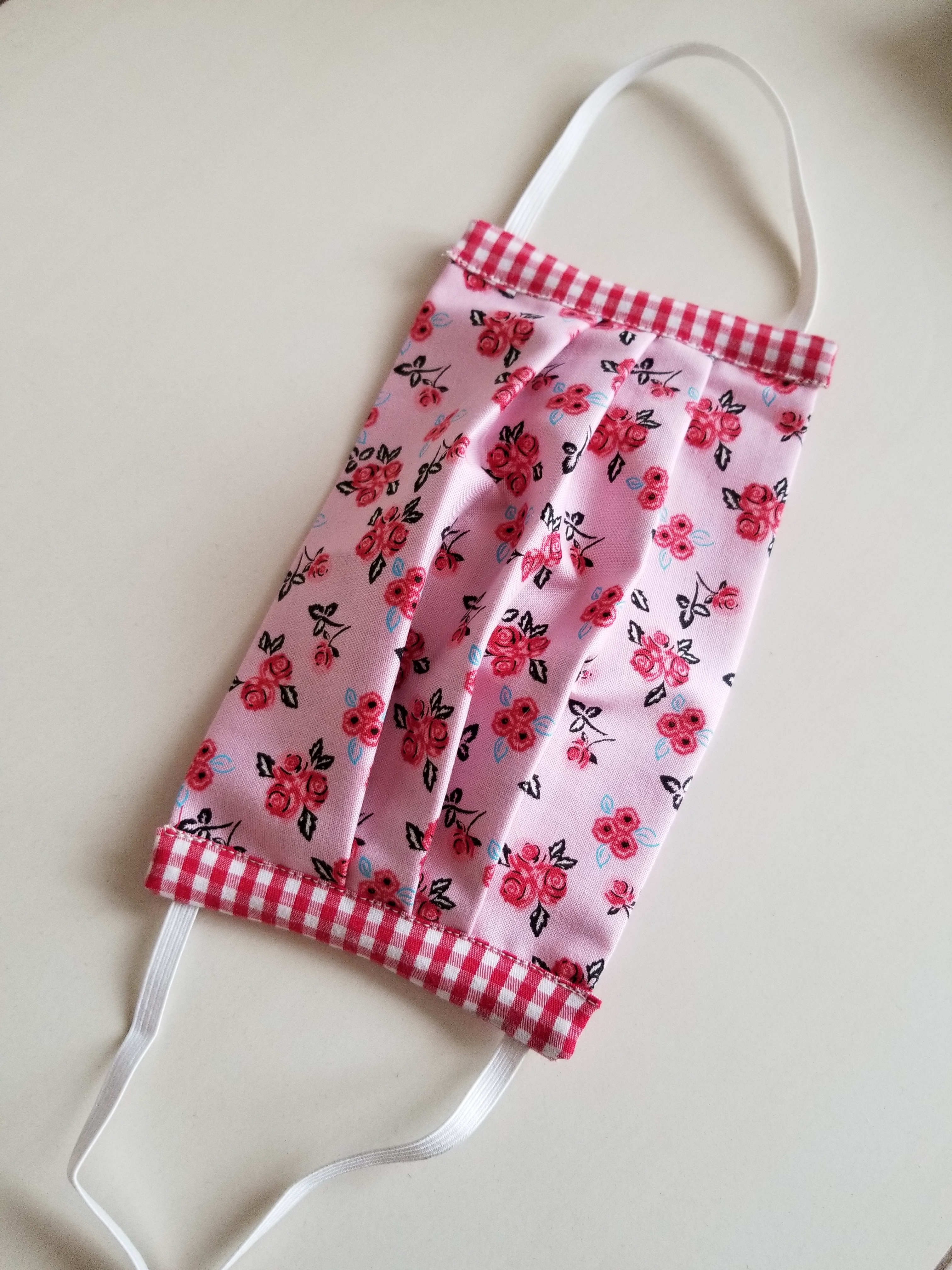
My allergies have been incredible this year, and by that I mean that they have been worse than they have ever been. (Please, please, please do not suggest medical advice here. Much appreciated.) I see an allergy specialist who gives me 2 shots, 2-3 times a week to help with my symptoms. They have helped a lot; however, Juniper Ash (Cedar Fever!) here in Austin is 6 times worse than average this year, and boy oh boy, do I feel it. She suggested that I wear a face mask when I go outside to help reduce the amount of pollen that is going into my lungs and sinuses. After going to a few different stores to purchase some, I found that many other Austinites had already bought them out. No worries, right? I know how to sew. I will just make one. When I finished, I had many requests for a tutorial, so here you go:
Materials needed:
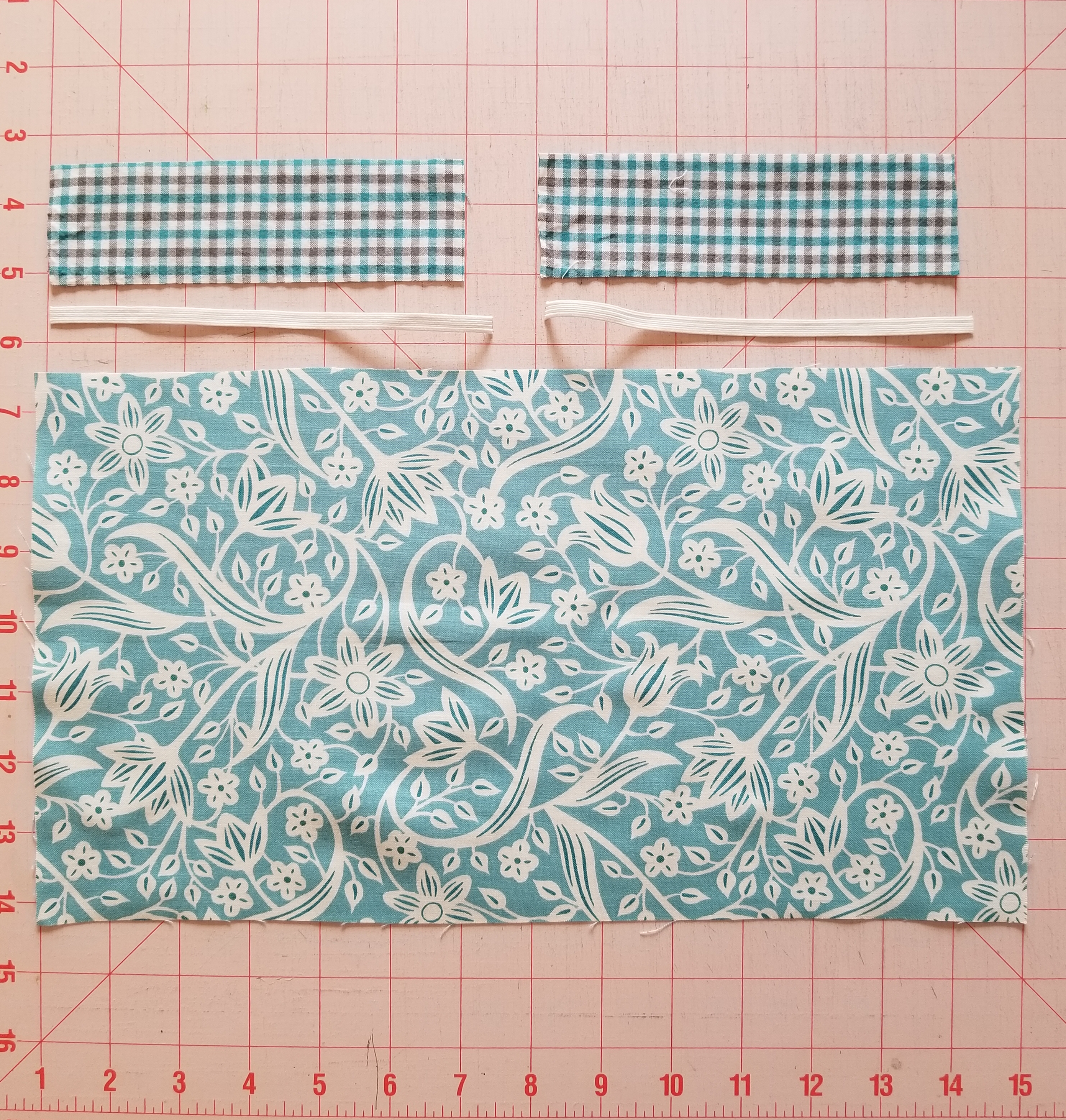
- 1 piece of fabric measuring 8” x 14”. Until you get familiar with this tutorial, I would suggest a non-directional print. One that has a scattered image printed on the surface such as the one shown.
- 2 strips of fabric measuring 1.75” (1 3/4”) x 6”. This will be the accent edge piece. It can be the same fabric as the main piece or a small-scale print or solid.
- Two pieces of 1/4” width elastic. These will be about 6 1/2” long.
- Ruler
- Fabric marking tool.
- Pins
- Scissors
- Sewing machine, threaded.
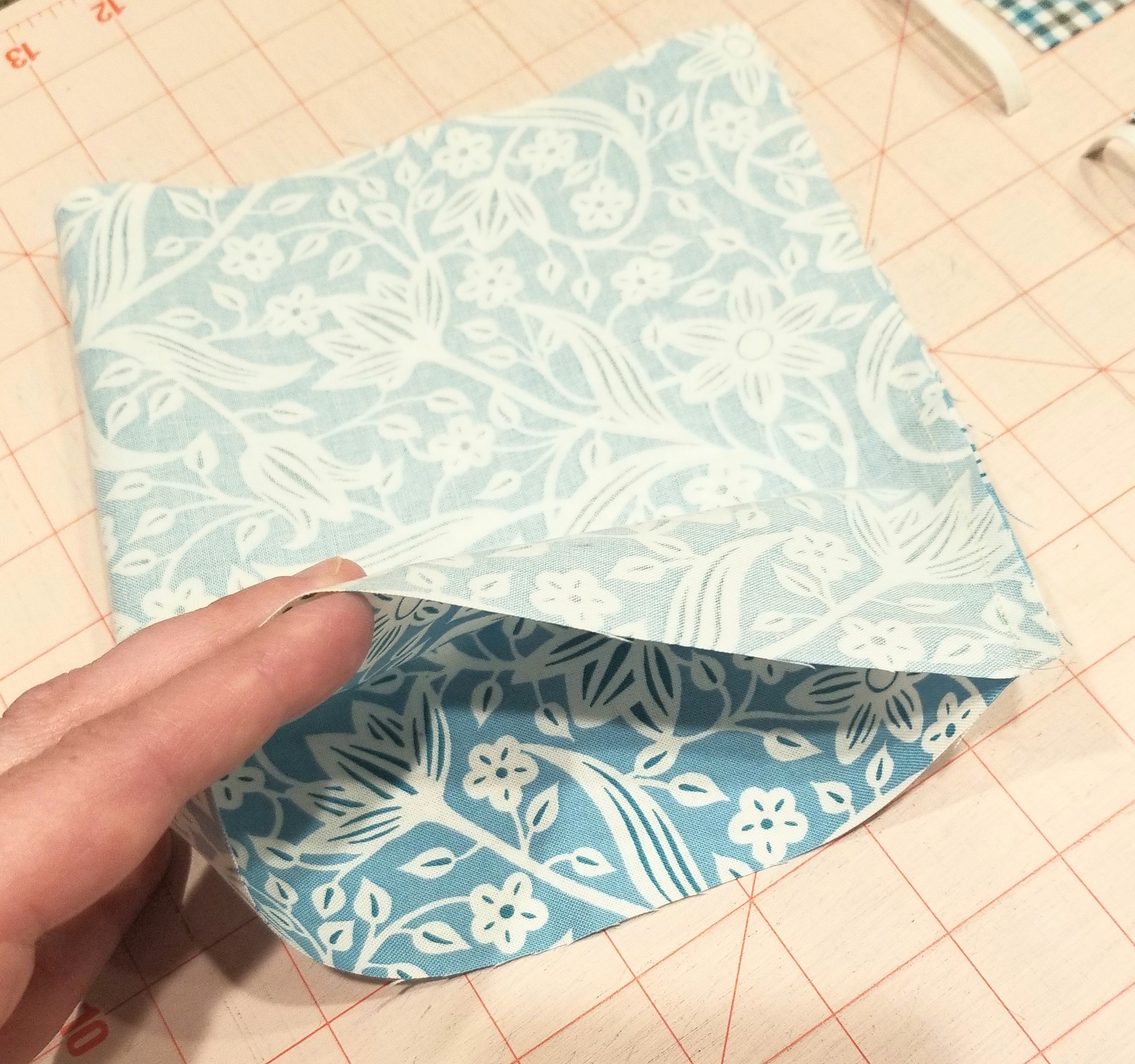
Fold the main piece of fabric in half, right sides together. Sew along the 8 inch width edge, using a 1/4 inch seam allowance.
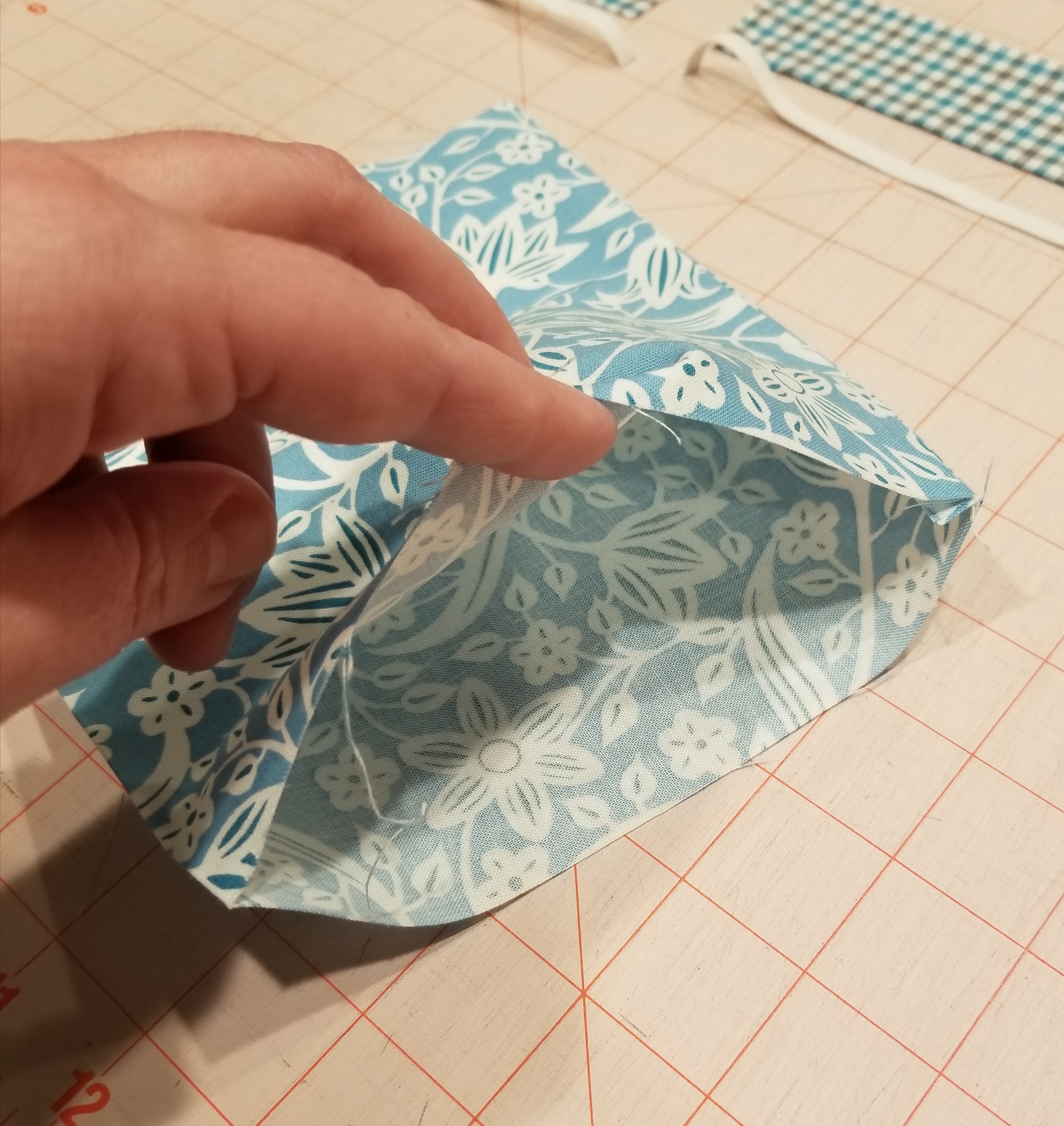
Turn this tube shape inside out, so that the right side of the fabric is now on the outside. Press this flat, keeping the seam to one end of the flattened tube.
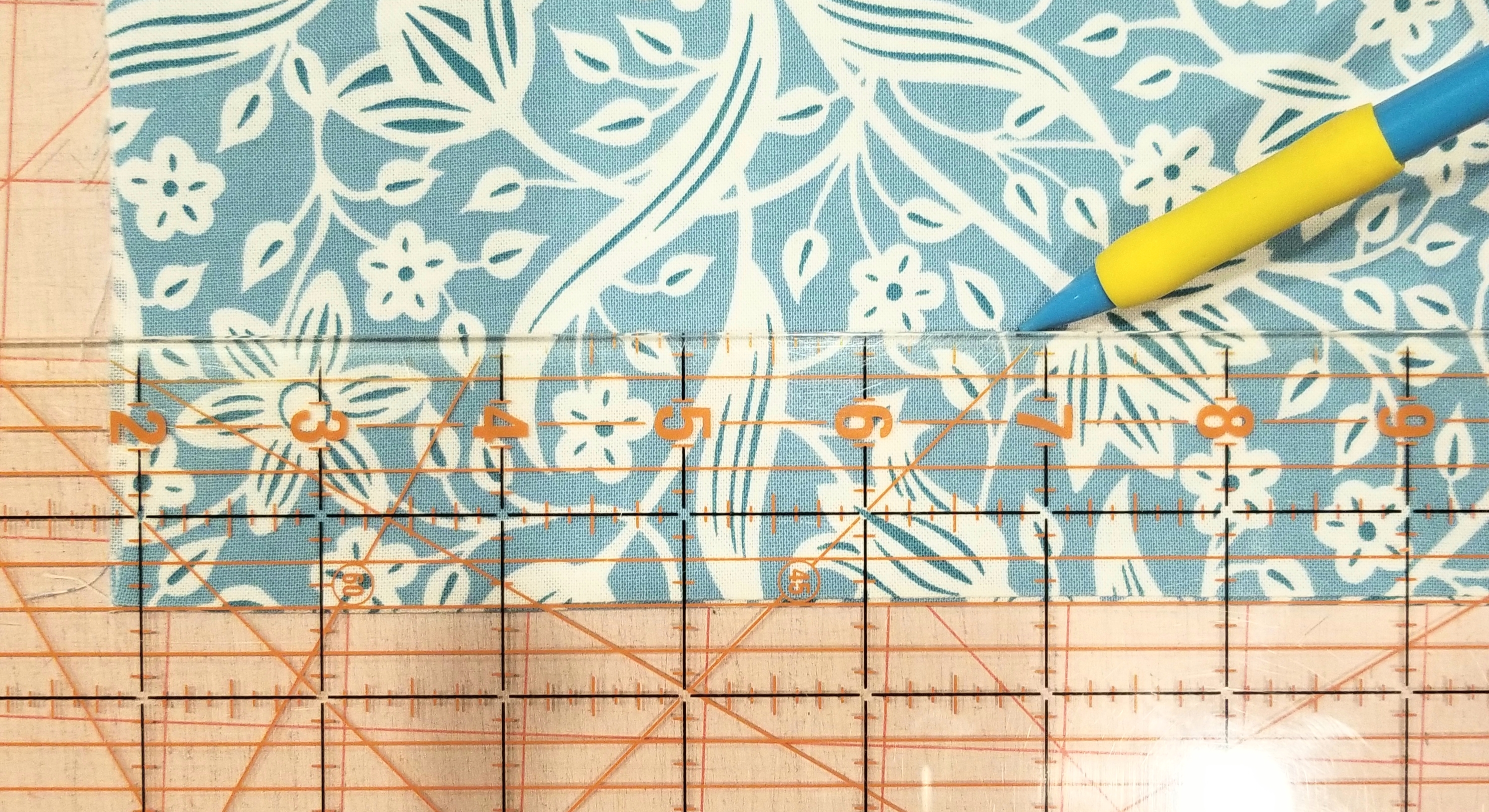
Place the tube of fabric so that the raw edges are on each side and the seam edge is at the bottom. Using a ruler, measure and mark a line 1 1/2 inches from the bottom edge. Make another line 1 inch above this line, or 2 1/2 inches from the seam edge. Don’t use a pencil as you see in the picture, use a fabric pen, or fabric chalk. I used a pencil for illustration purposes.
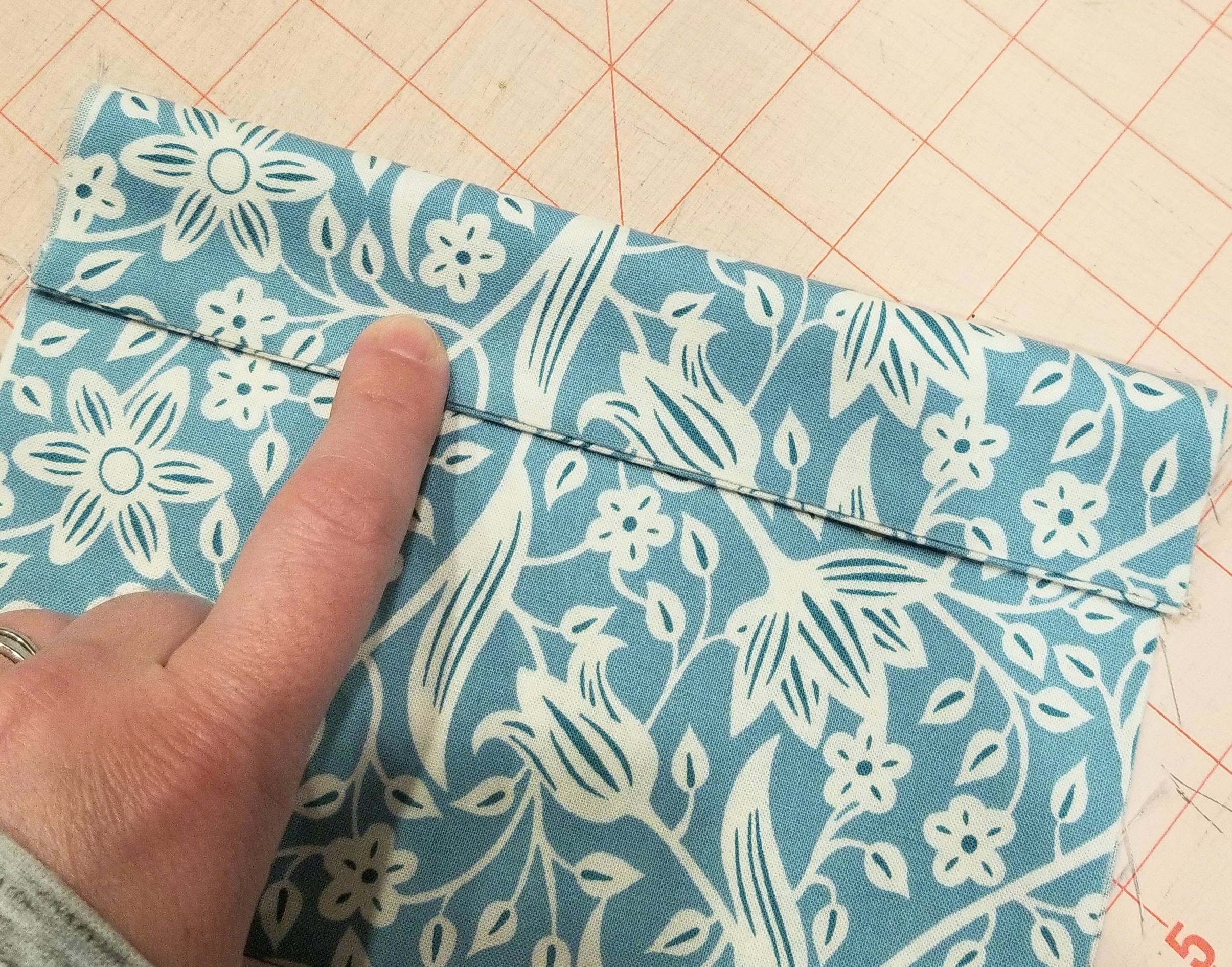
Fold the seam edge up (or down in this picture, as I turned it upside down…sorry) making the crease on the first line that you just marked. You should have 1 1/2 inch edge here.
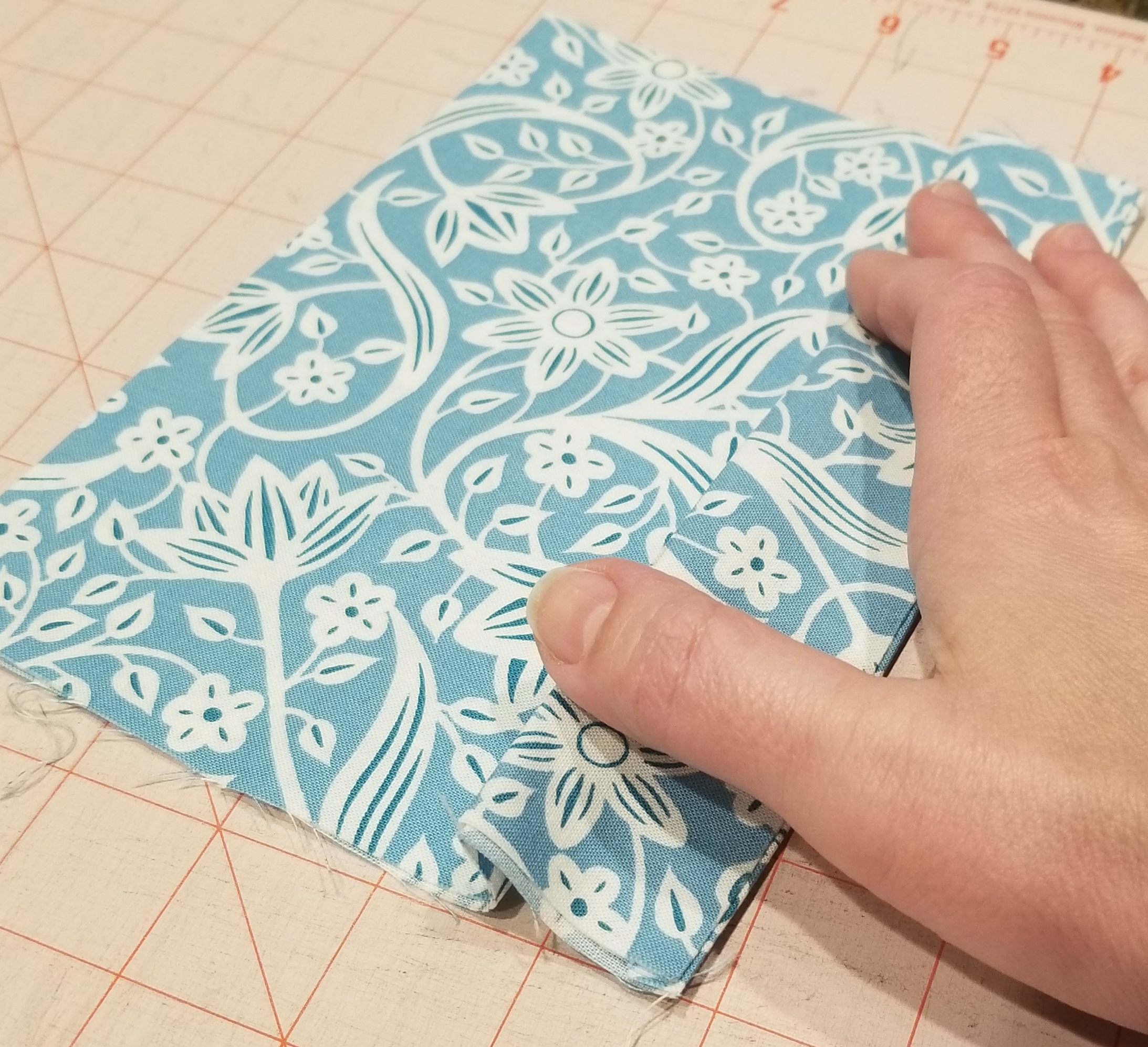
Flip the tube piece over. Match the crease edge to the second line that you made earlier. Press. The pleat that you just created will be 1/2 inch deep. Pin the pleat down on each raw edge end.
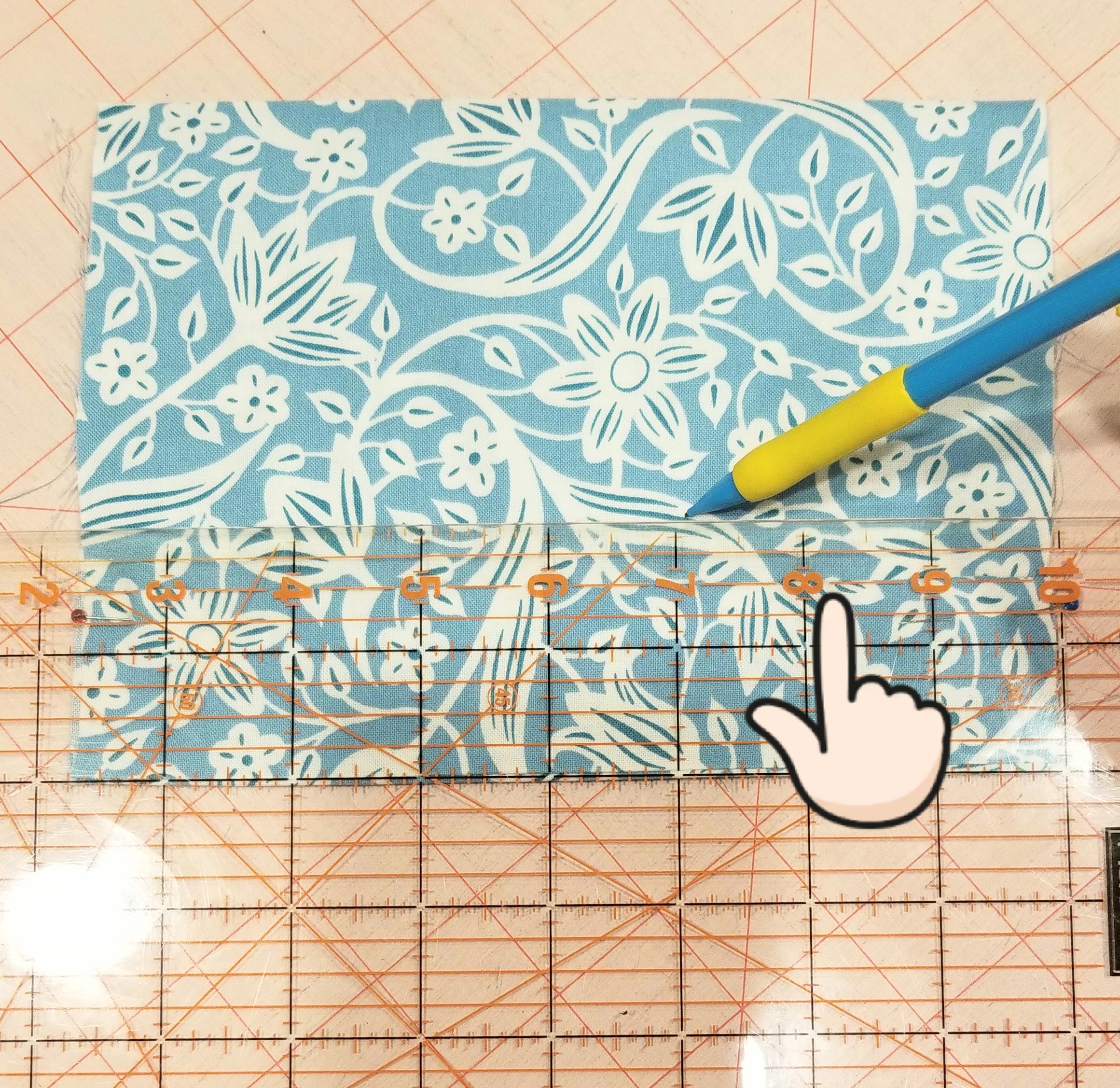
Now you will mark the lines for the second pleat. Mark a line measuring 1/2” from the top crease of the last pleat, (or 2″ from the bottom seam edge). It was difficult to see the top of the crease in this picture, so look at the finger indicator above.
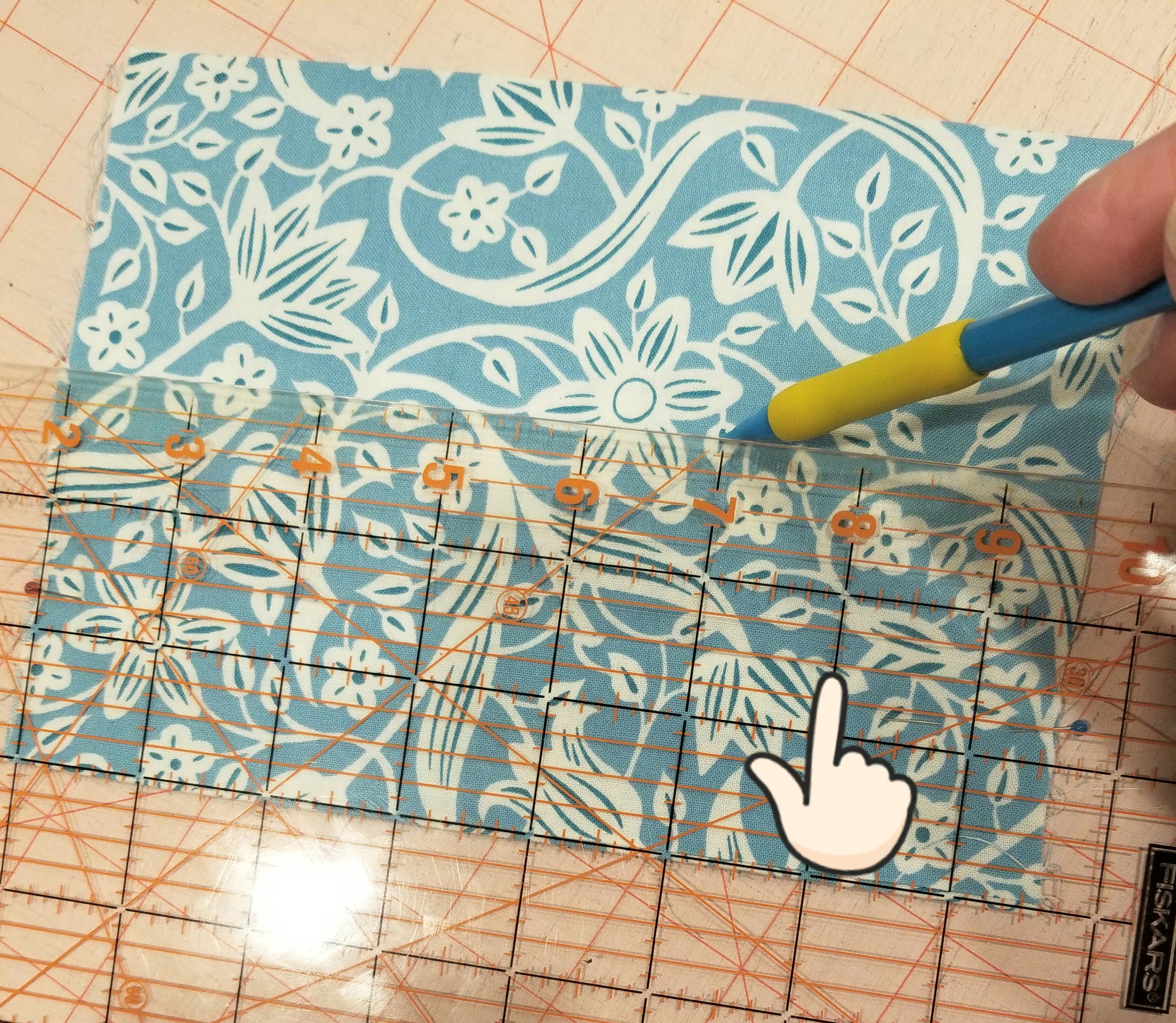
Now mark another line one inch above the last line that you made (or 3 inches above the seam edge). Using these lines as your guide, repeat the steps that you followed to make the first pleat.
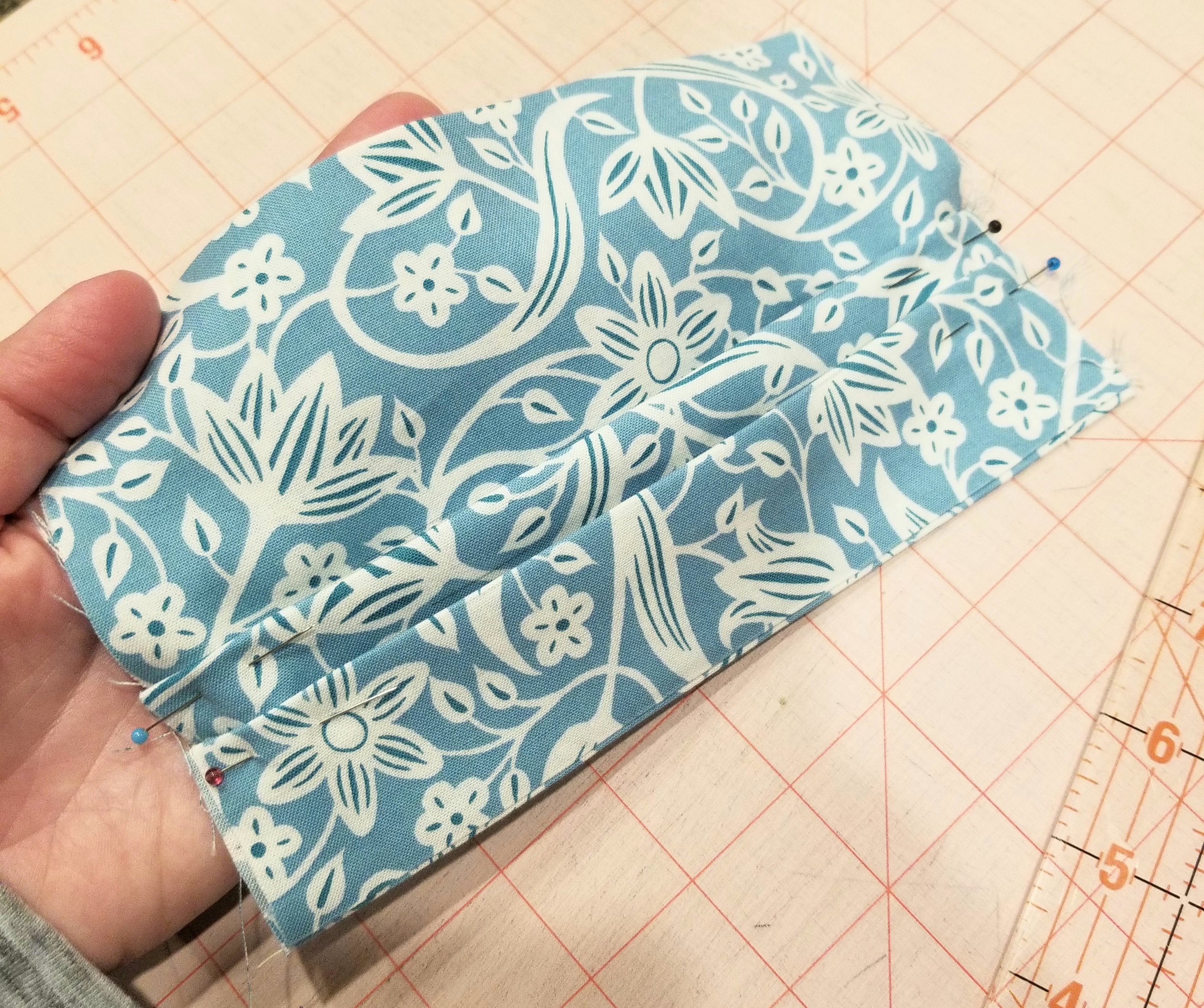
You should now have two pleats, each one being 1/2 inch deep. Repeat the steps you used to make the second pleat, so that you end up with three pleats total. Press.
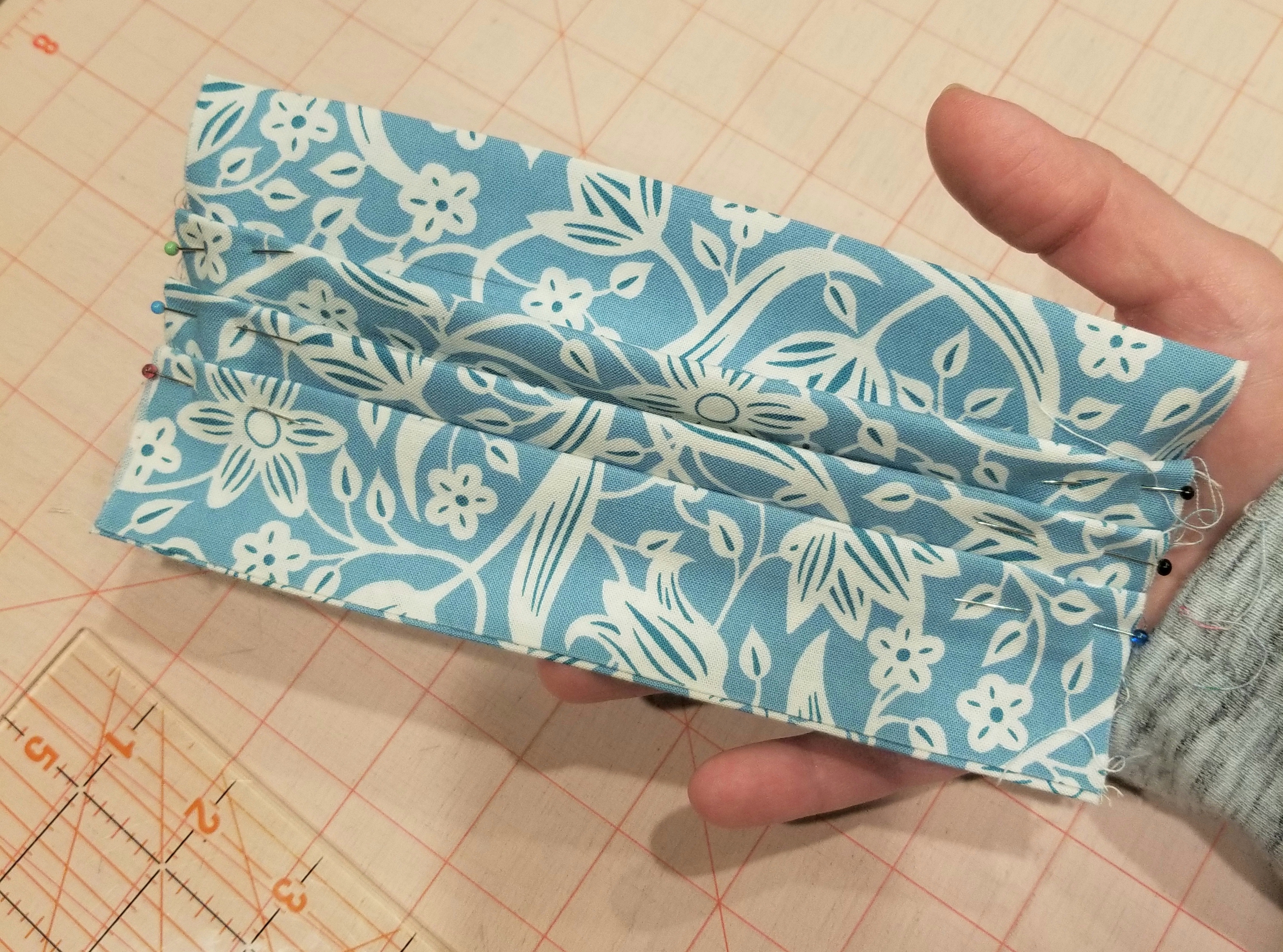
This is what your main piece should look like at this point.
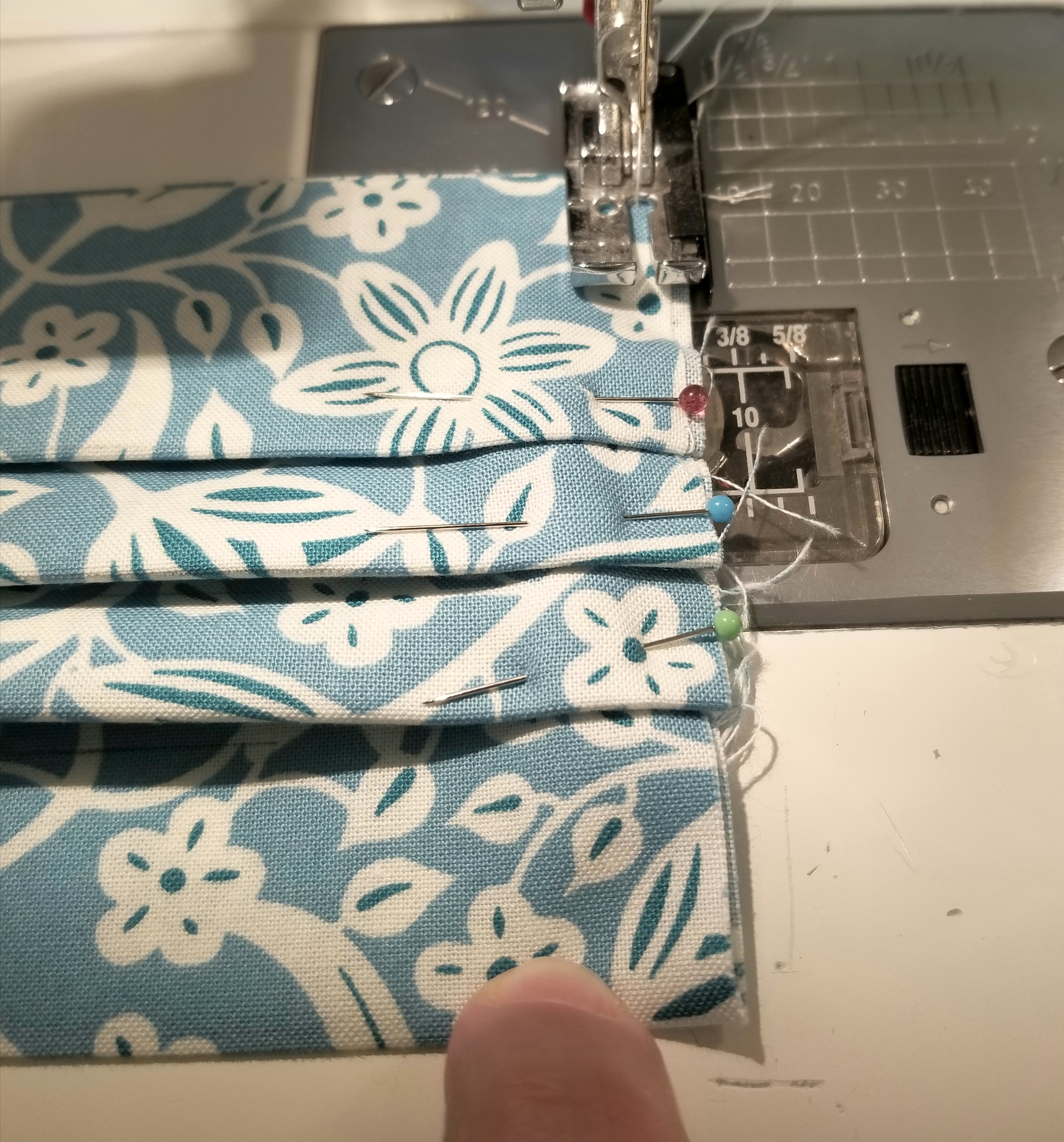
Using a 1/8” seam allowance, baste stitch the raw edges.
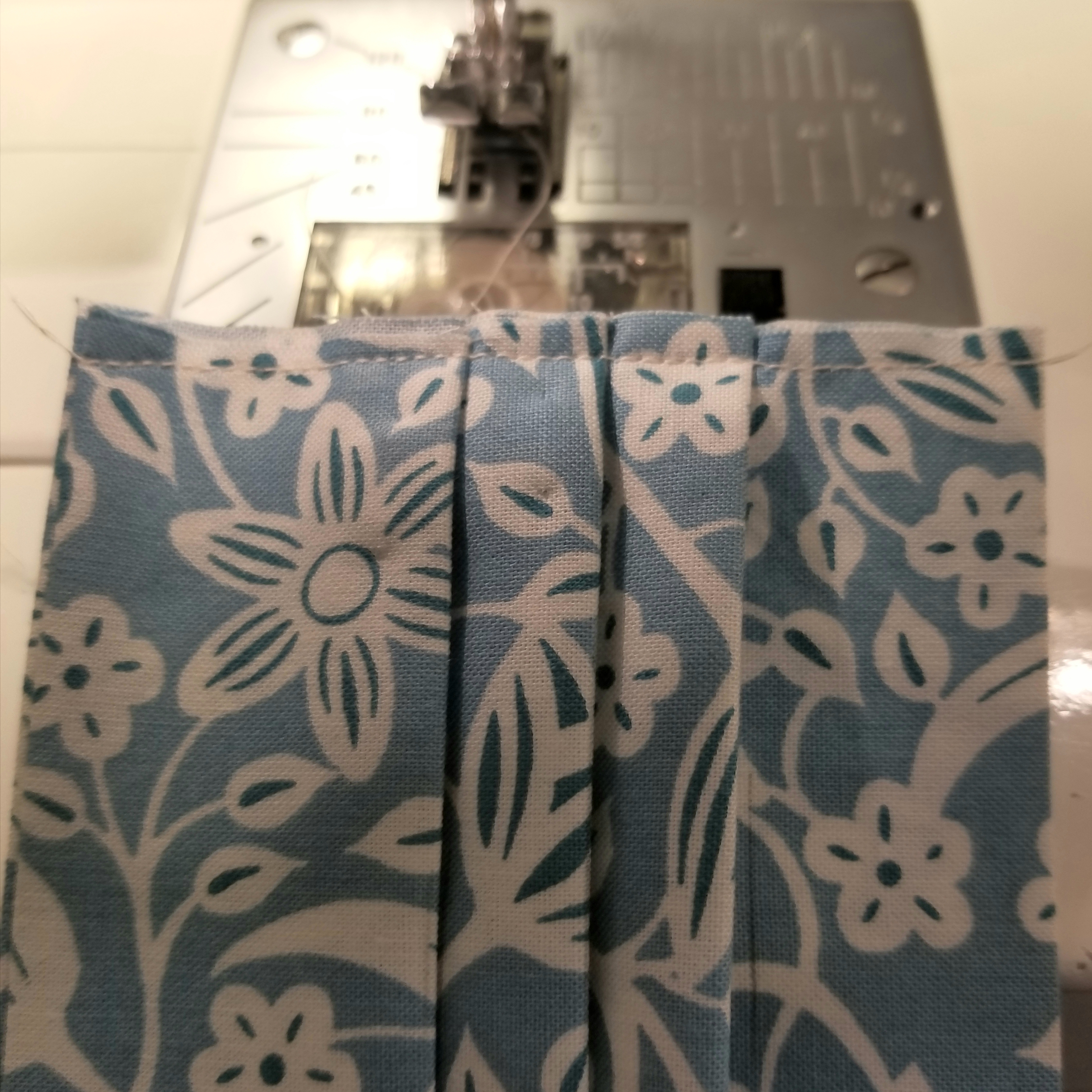
Repeat this step so that both raw edges are basted as shown in the picture above.
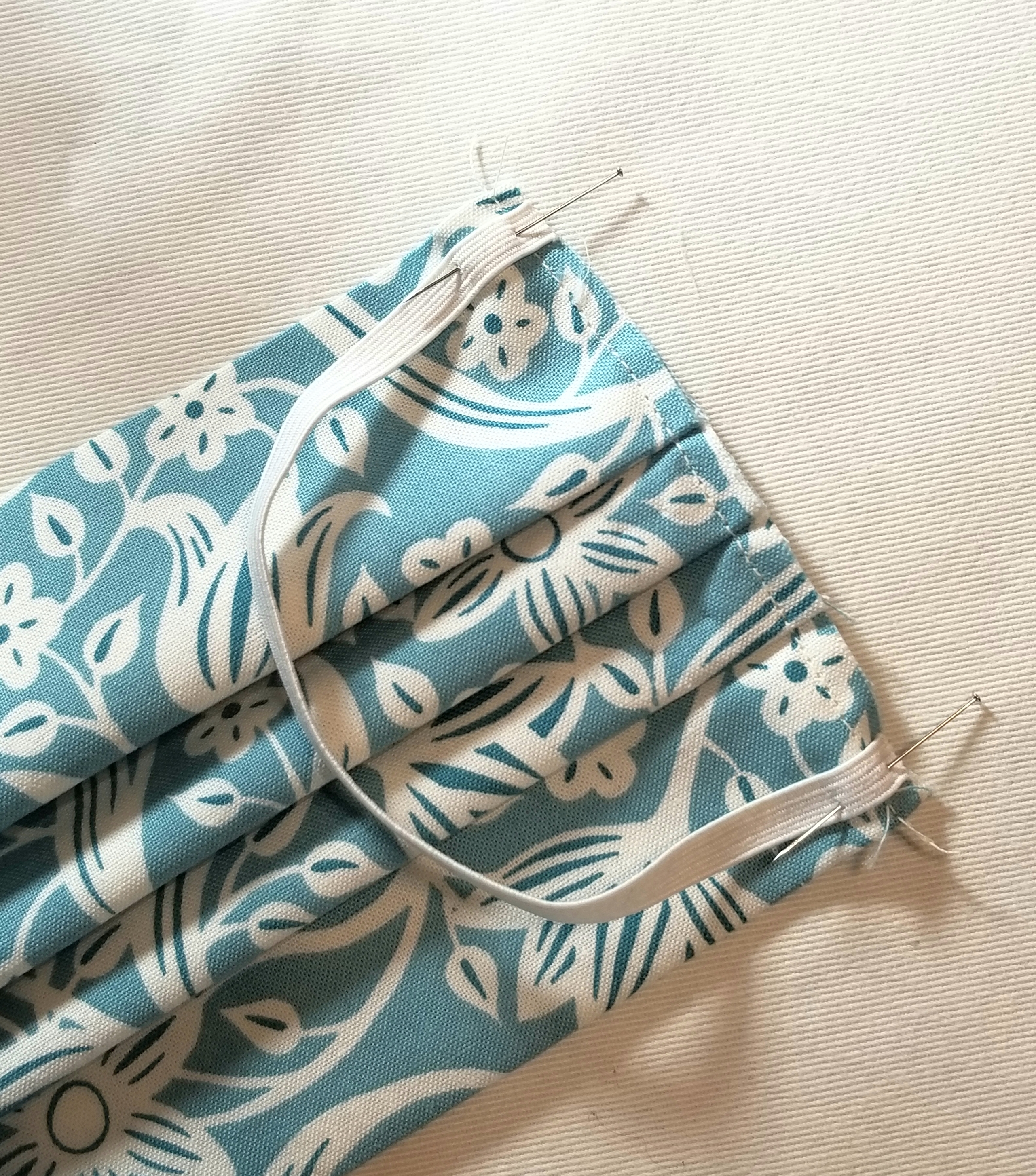
Pin one elastic piece to the raw edge, making sure not to twist it before baste stitching it to the edge at both ends. I placed mine 1/8” from the top and bottom edge of the main pleated piece. Baste elastic in place 1/8” inch from raw edge. Repeat, to attach remaining elastic piece to the other raw edge.
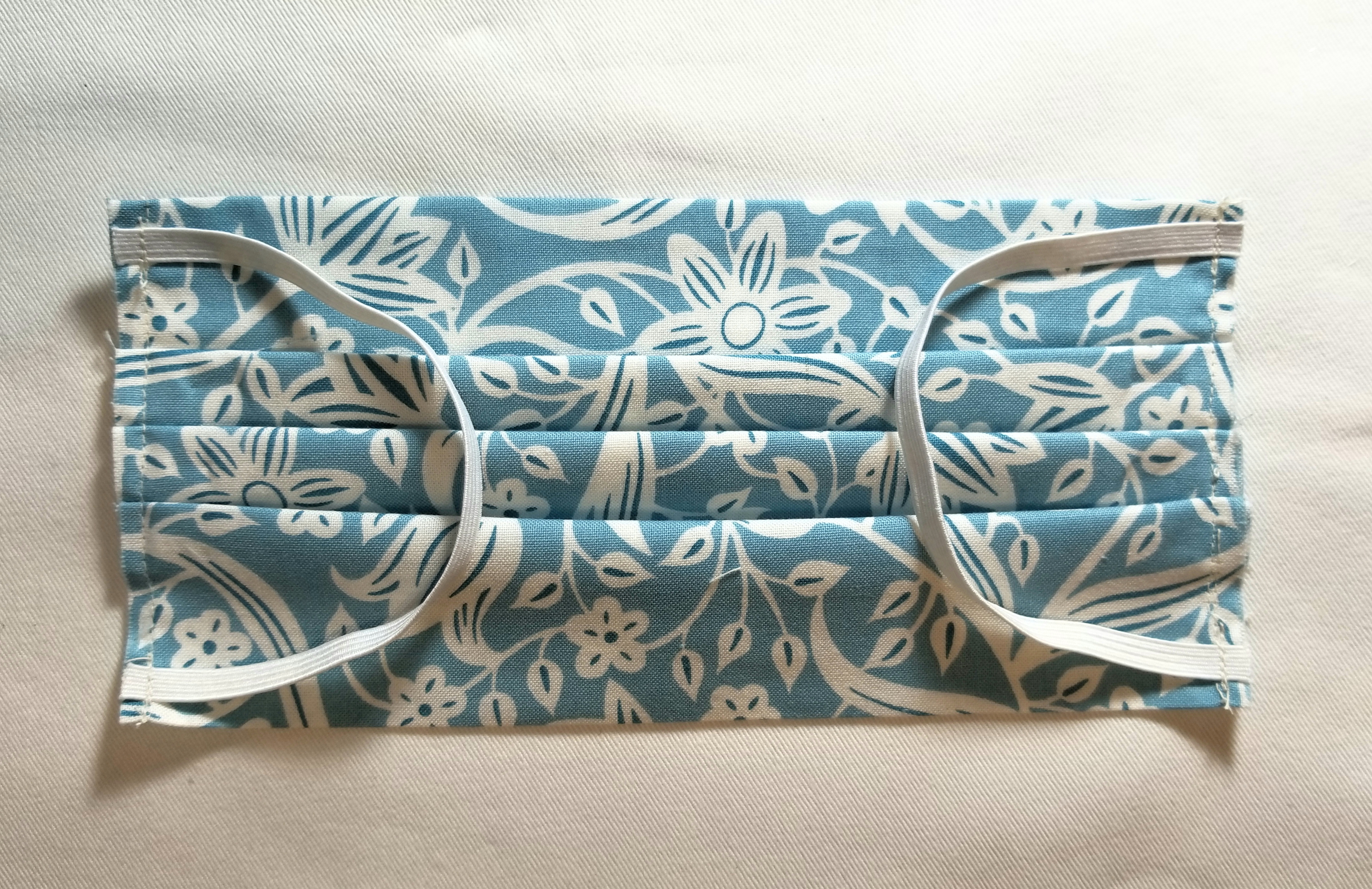
Your pleated piece should now resemble the picture above.
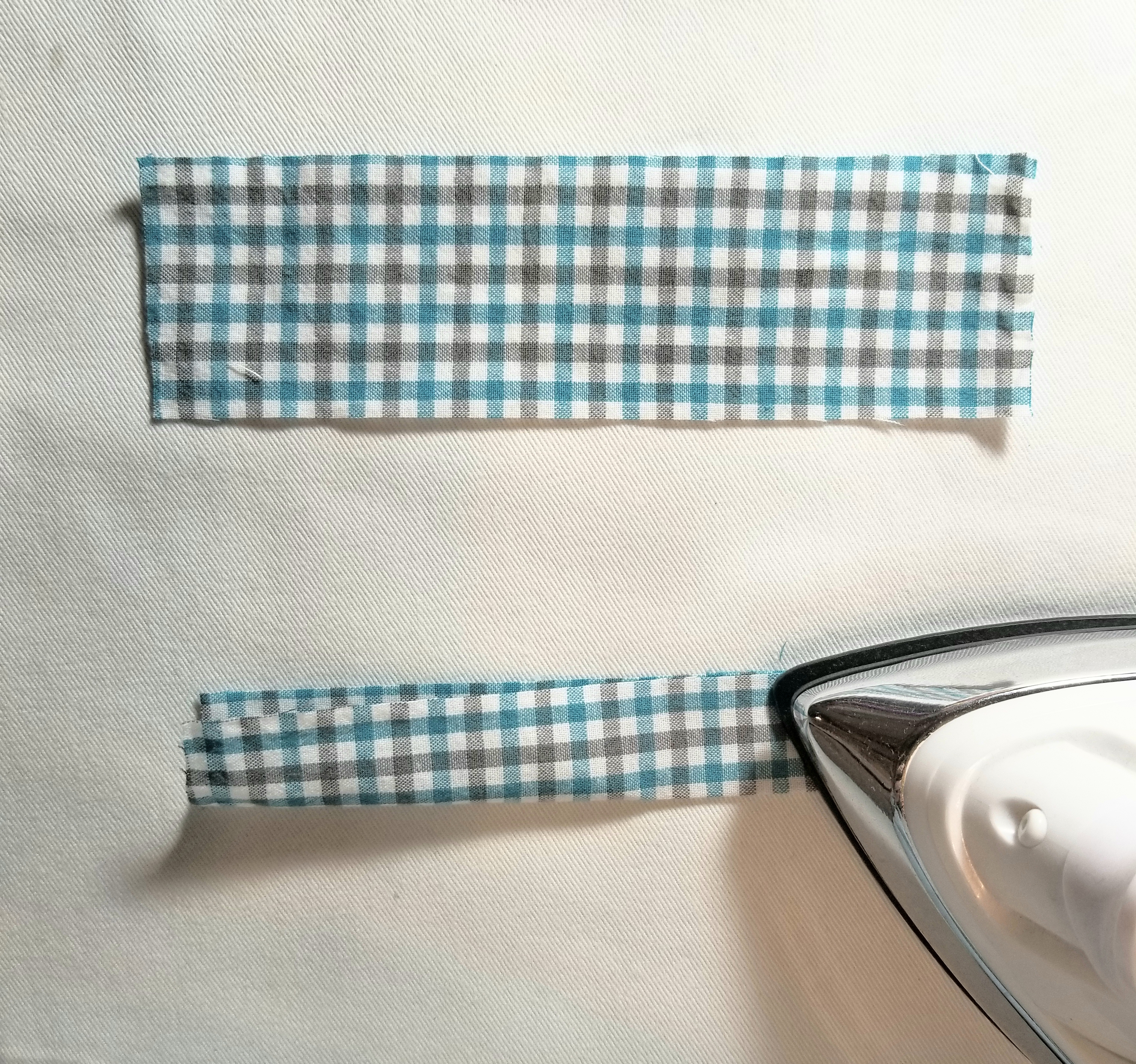
Fold each accent strip of fabric lengthwise in half, matching raw edges, as shown in the picture above. Press.
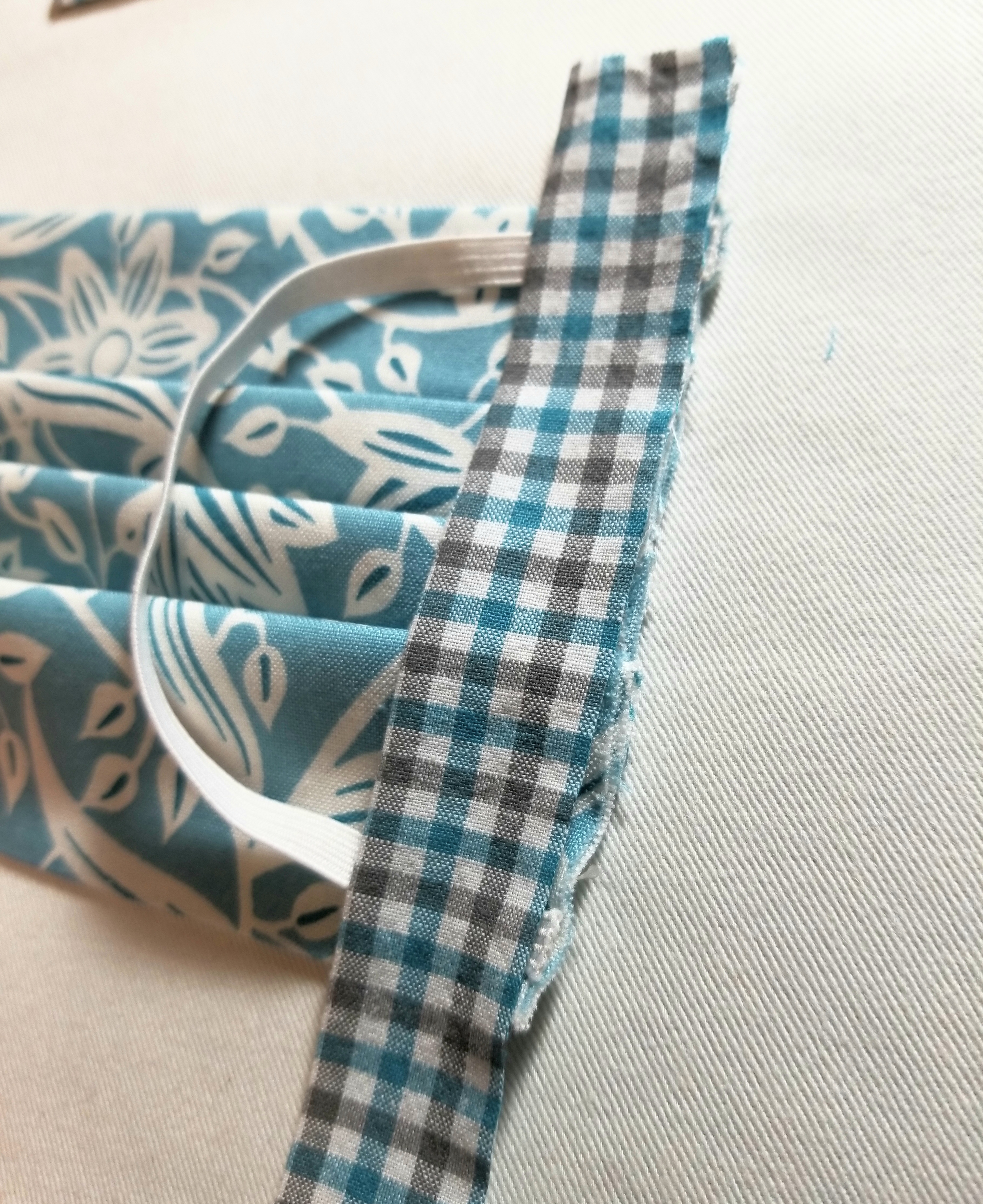
Place the strip on top of the elastic. Make sure the raw edge is facing outward, and the creased edge is facing the main body of the pleated piece. It will be a little longer on the top and bottom and that is okay, as we are going to fold some of that to the back.
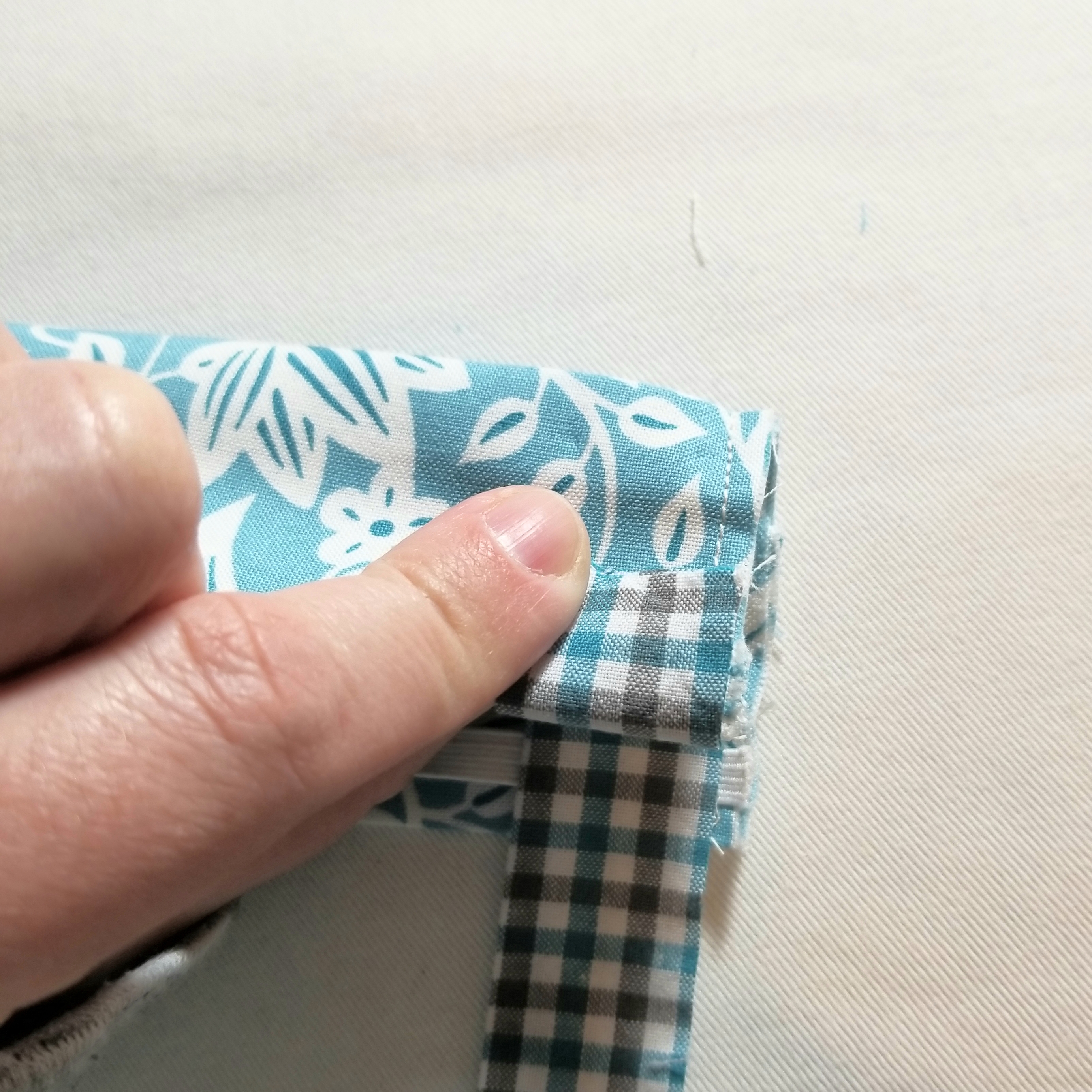
Tuck about 1/2” of the top edge to the back as shown in the picture above.
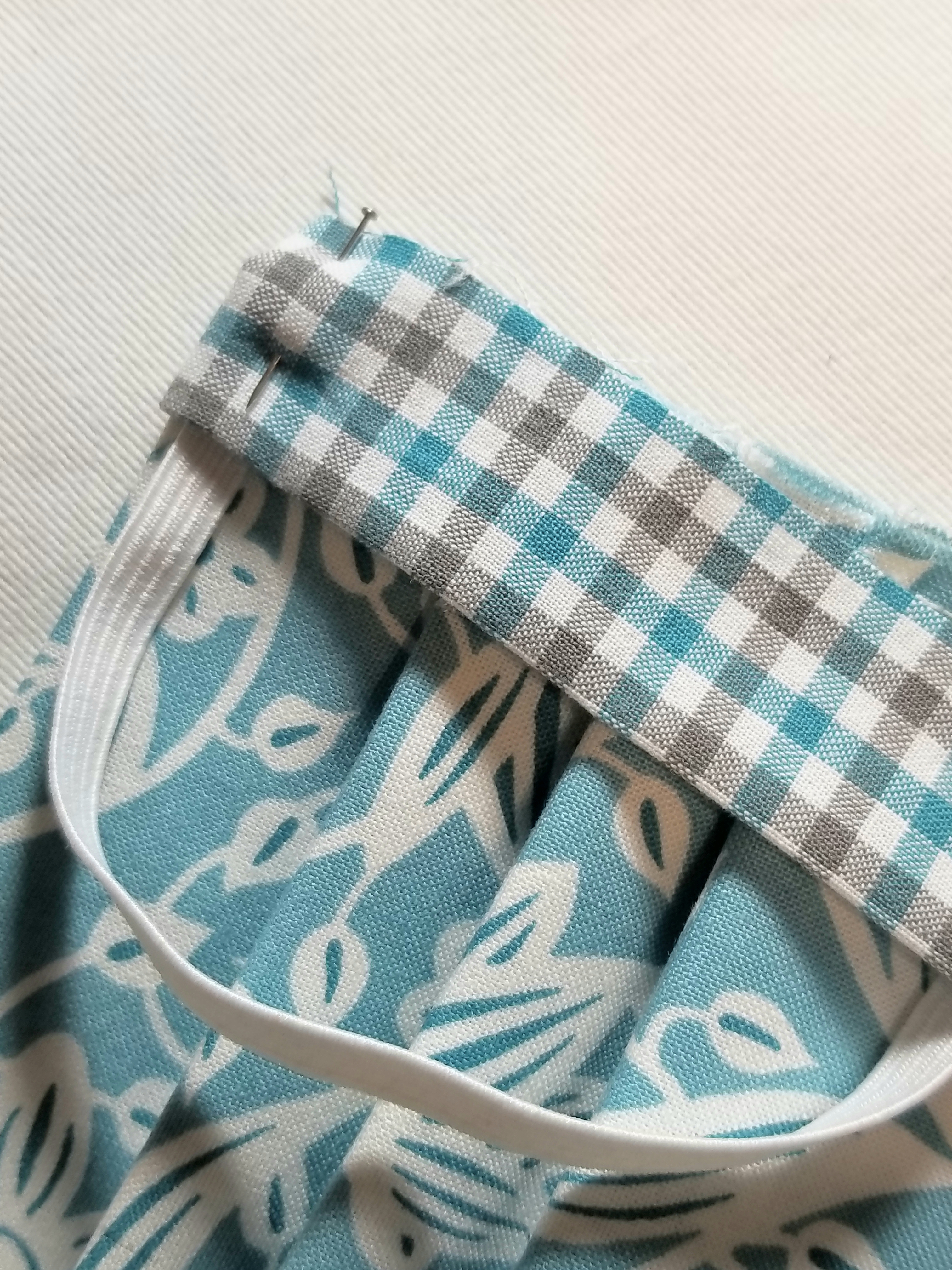
Pin all layers in place.
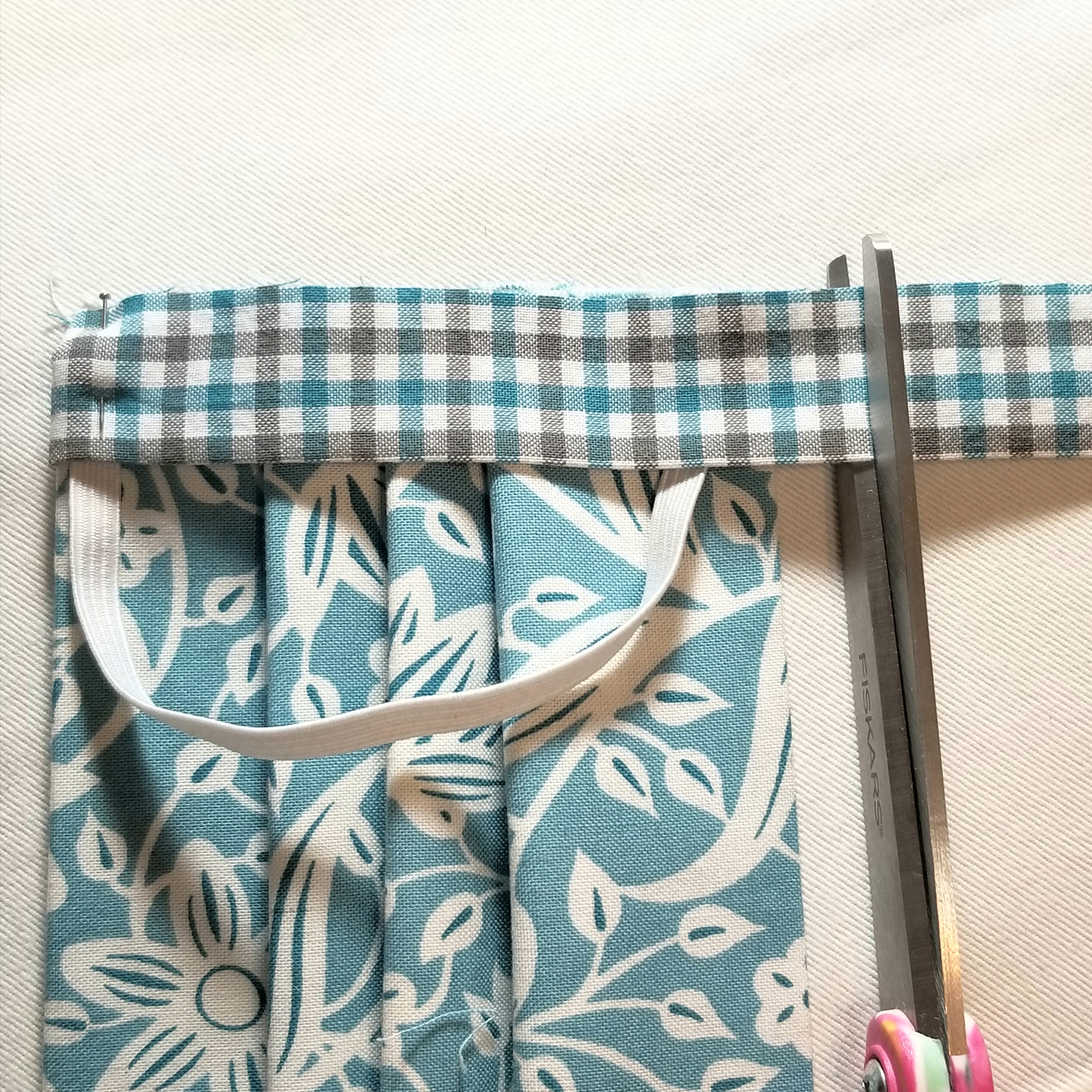
Trim the other end of the accent strip, so that it is about 1/2” longer than the bottom edge of the main pleated piece.
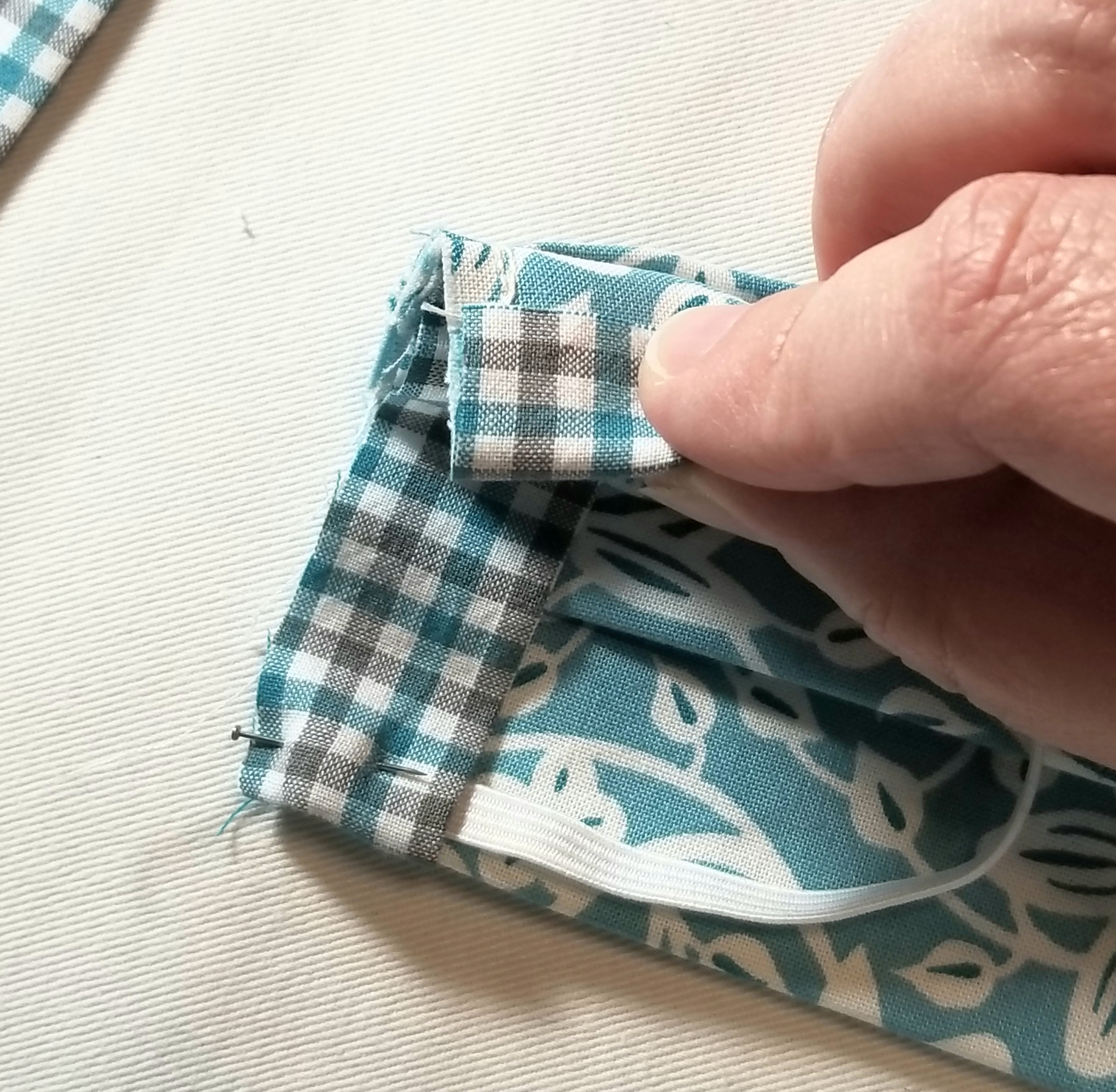
Fold the bottom edge of the accent fabric strip to the back, just as you did with the top edge.
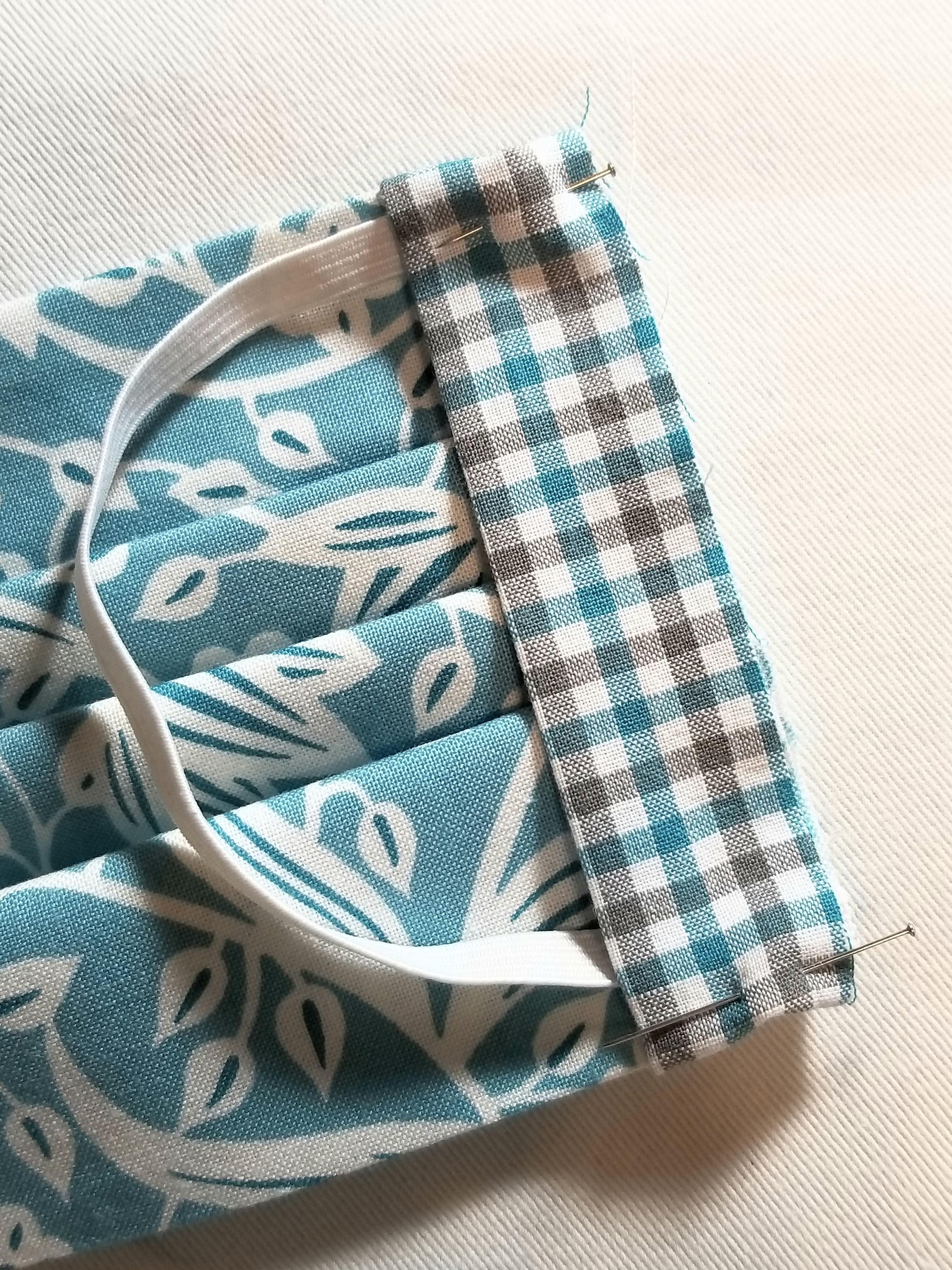
Pin both ends in place.
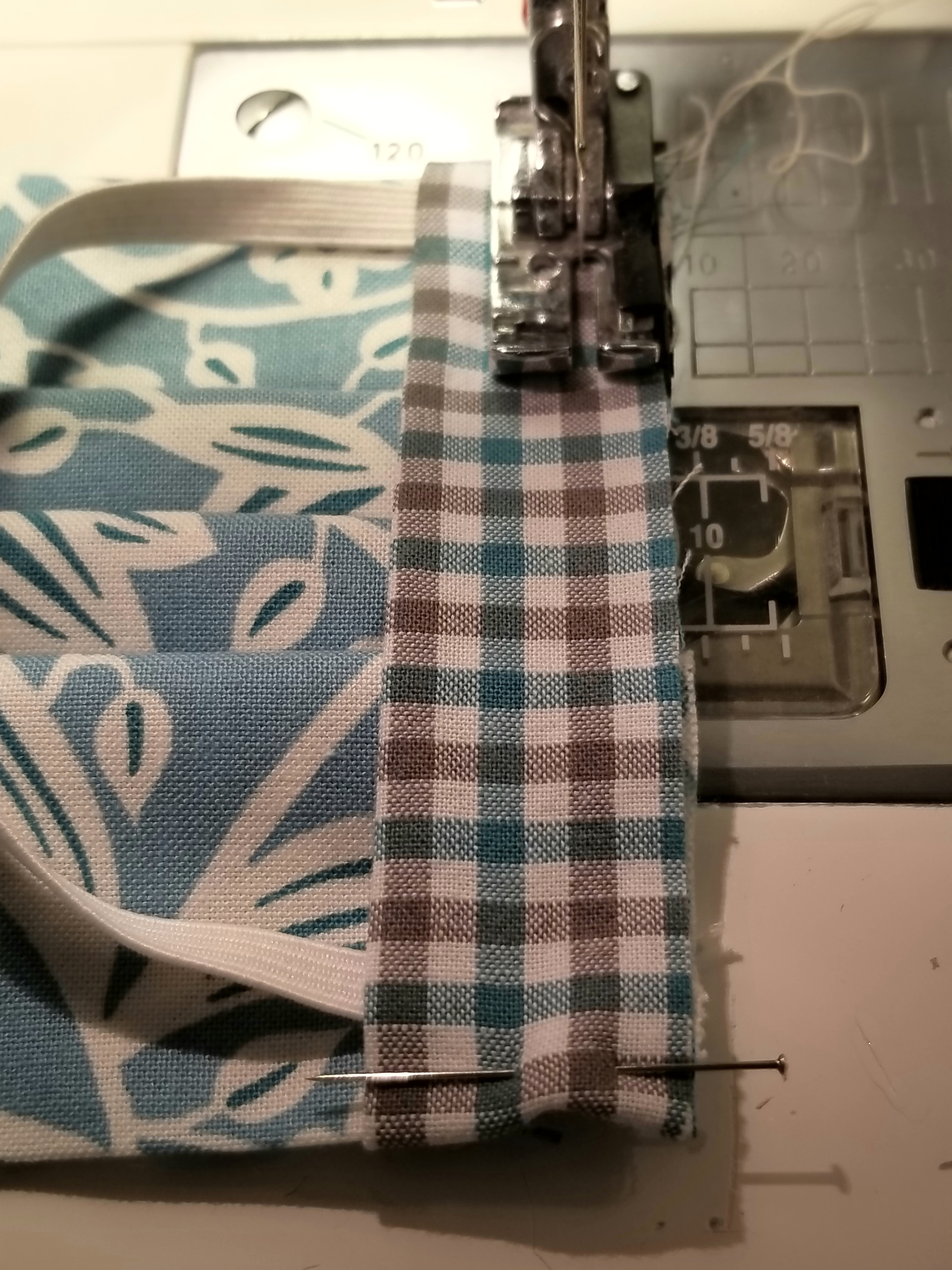
Using a 1/4 inch seam allowance, stitch the length of the entire edge, making sure to back stitch at the beginning and end.
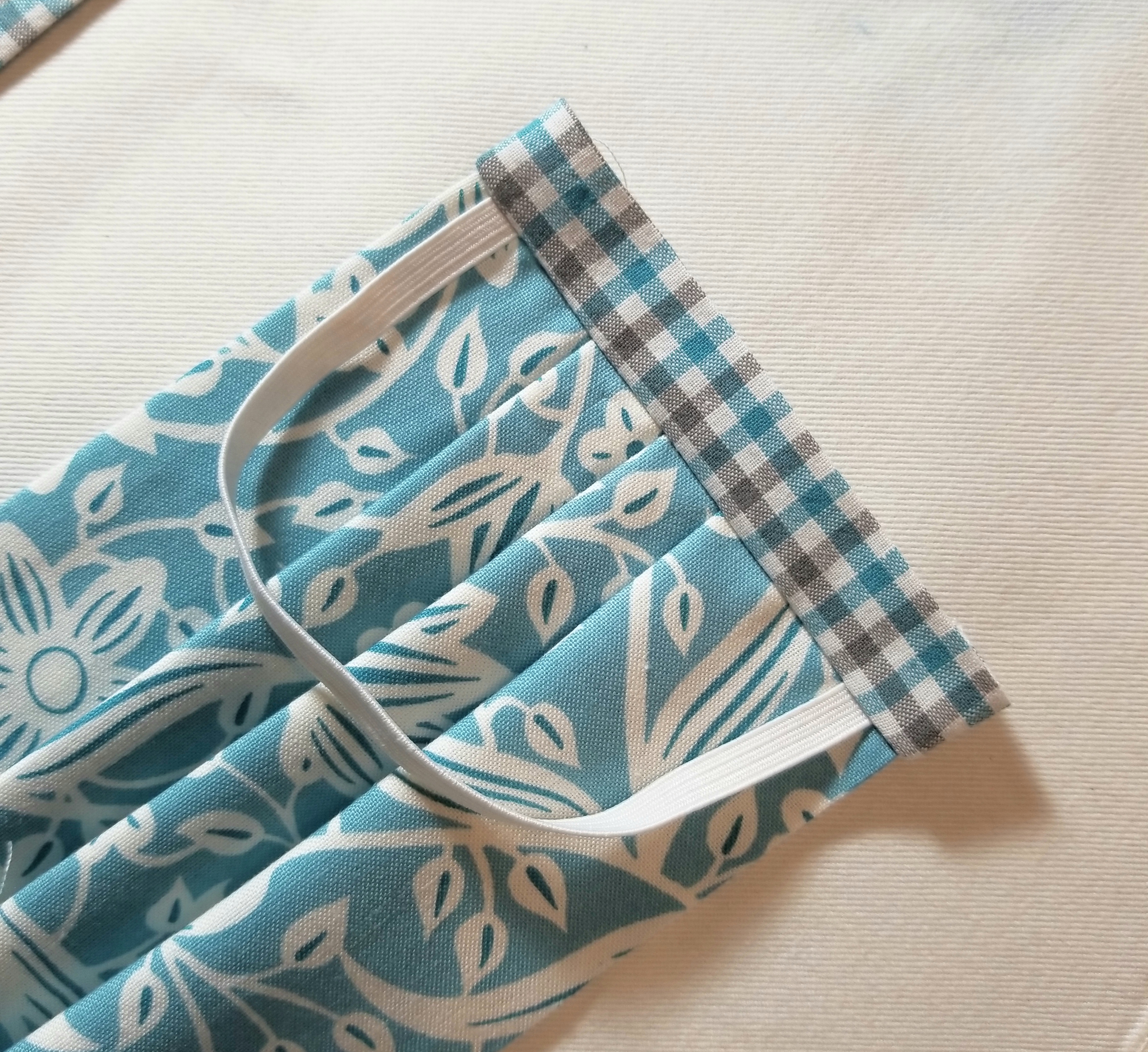
Open the the accent fabric strip seam by flipping it outward away from the main pleated piece, then press.
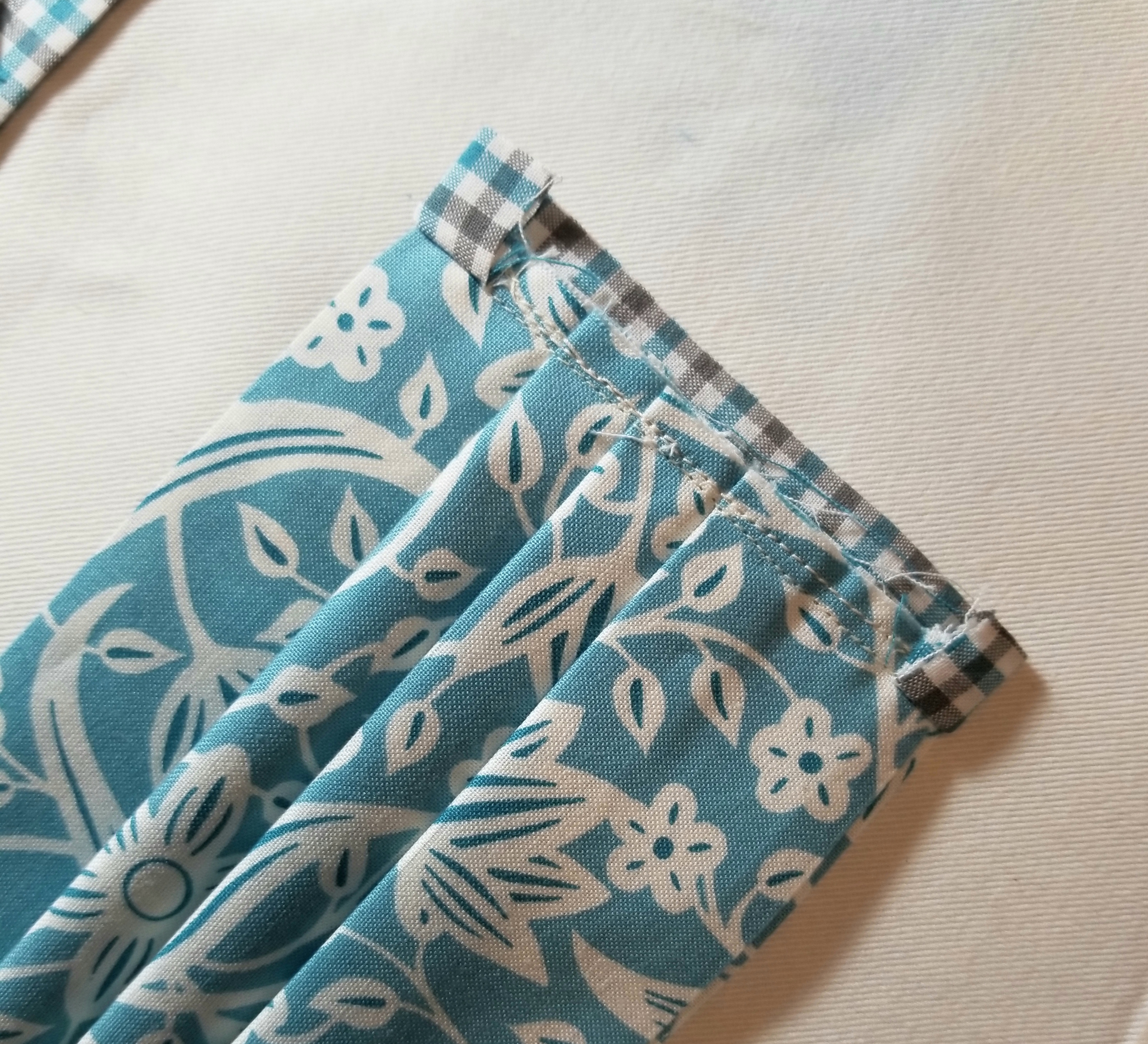
This is what the mask should look like if you flip it over.
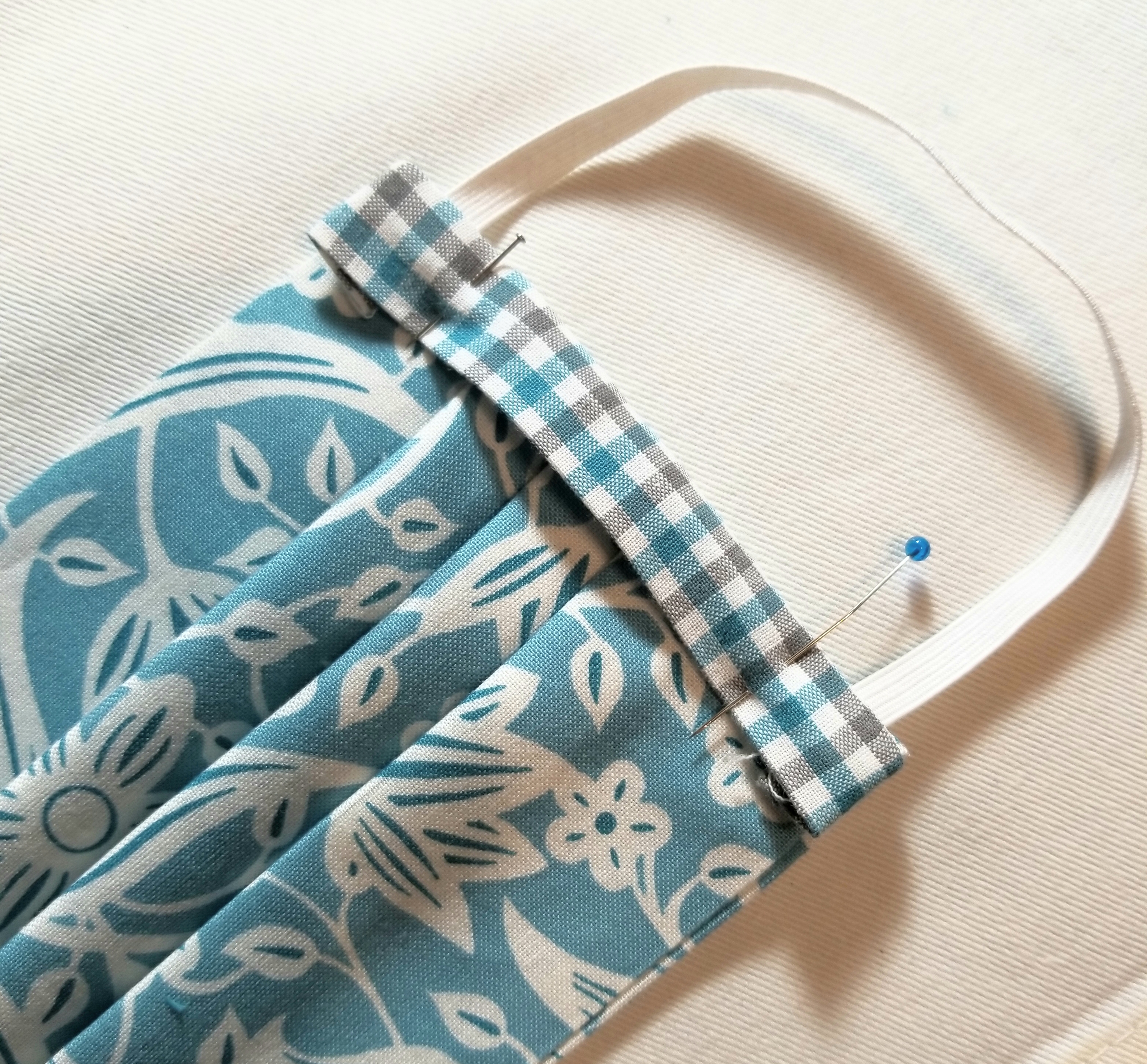
fold the ENTIRE accent piece down toward the main pleated piece, encasing the raw seam. You will now see the accent piece on this side, but not at all on the flip side. Press. Pin edge down.
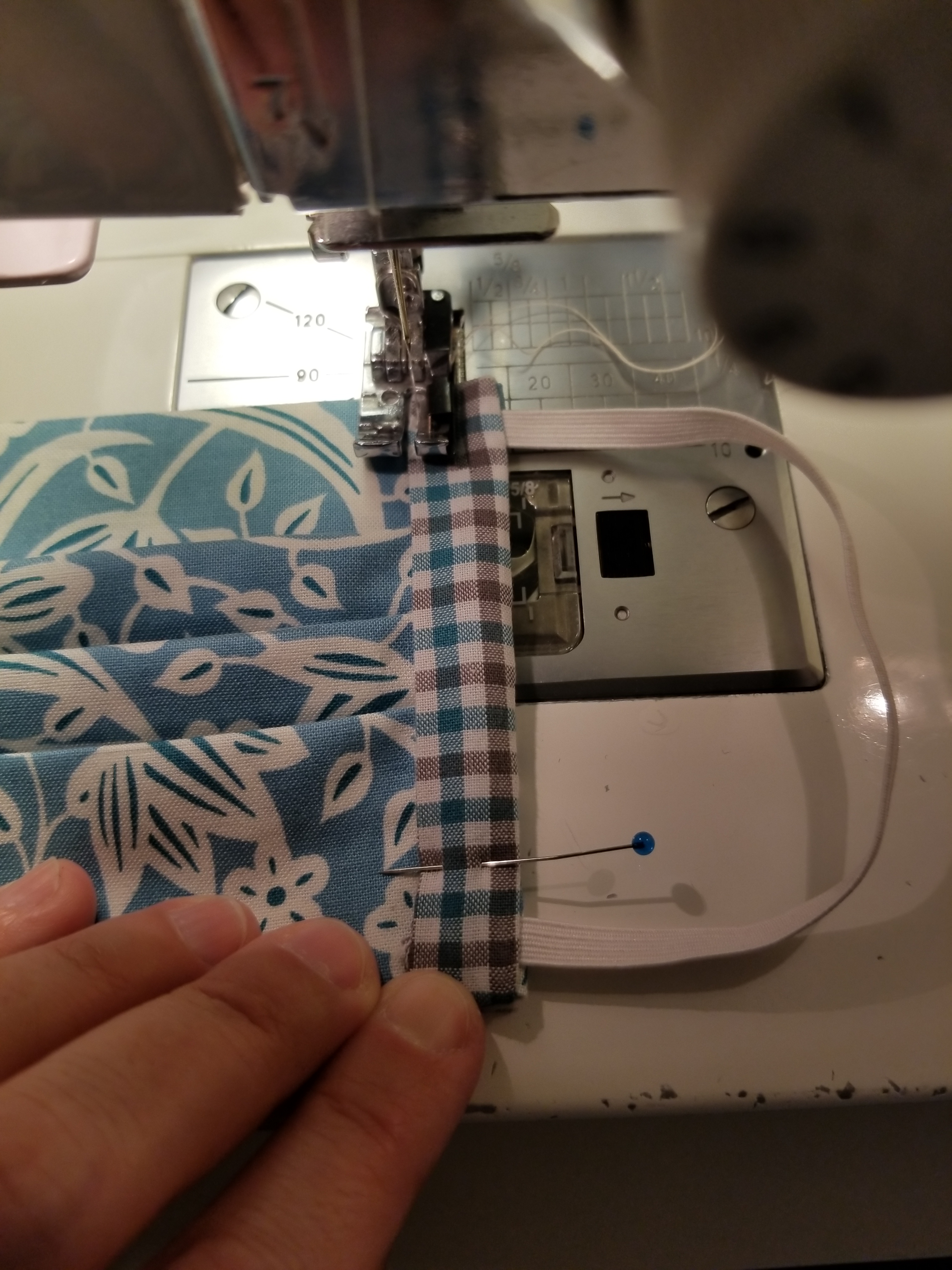
If you are a good sewist, you will change out your presser foot to a straight stitch foot. If you are lazy, like me, you will keep that 1/4″ presser foot on your machine and struggle your way through this next step. 😀 Stitch this accent strip down to the main body of the mask, sewing along the edge, making sure to back stitch at the beginning and end.
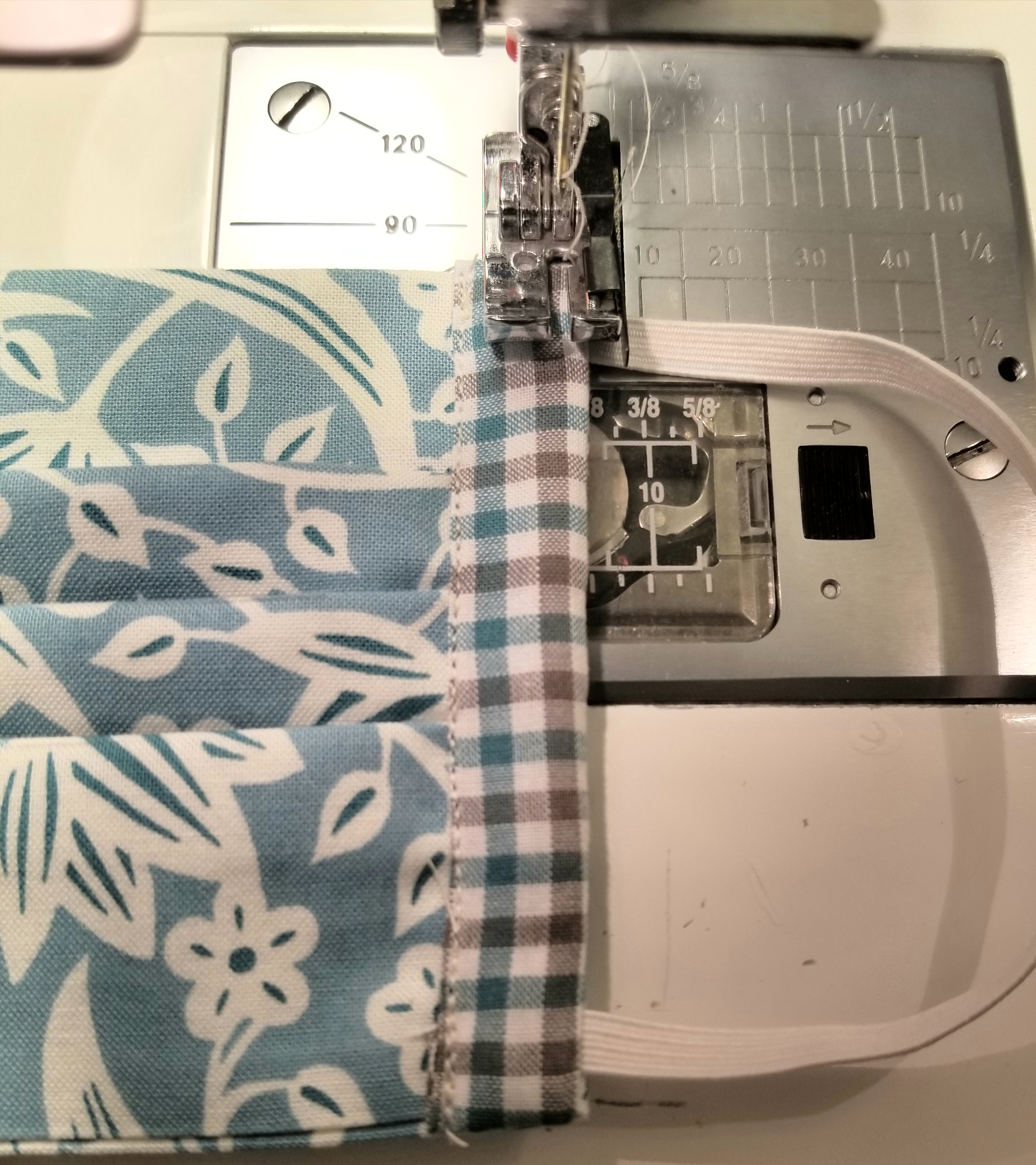
This step isn’t necessary. It just gives it a nice finished look, and helps to give that elastic a little extra stability. Stitch down the edge of the mask close to the elastic side.
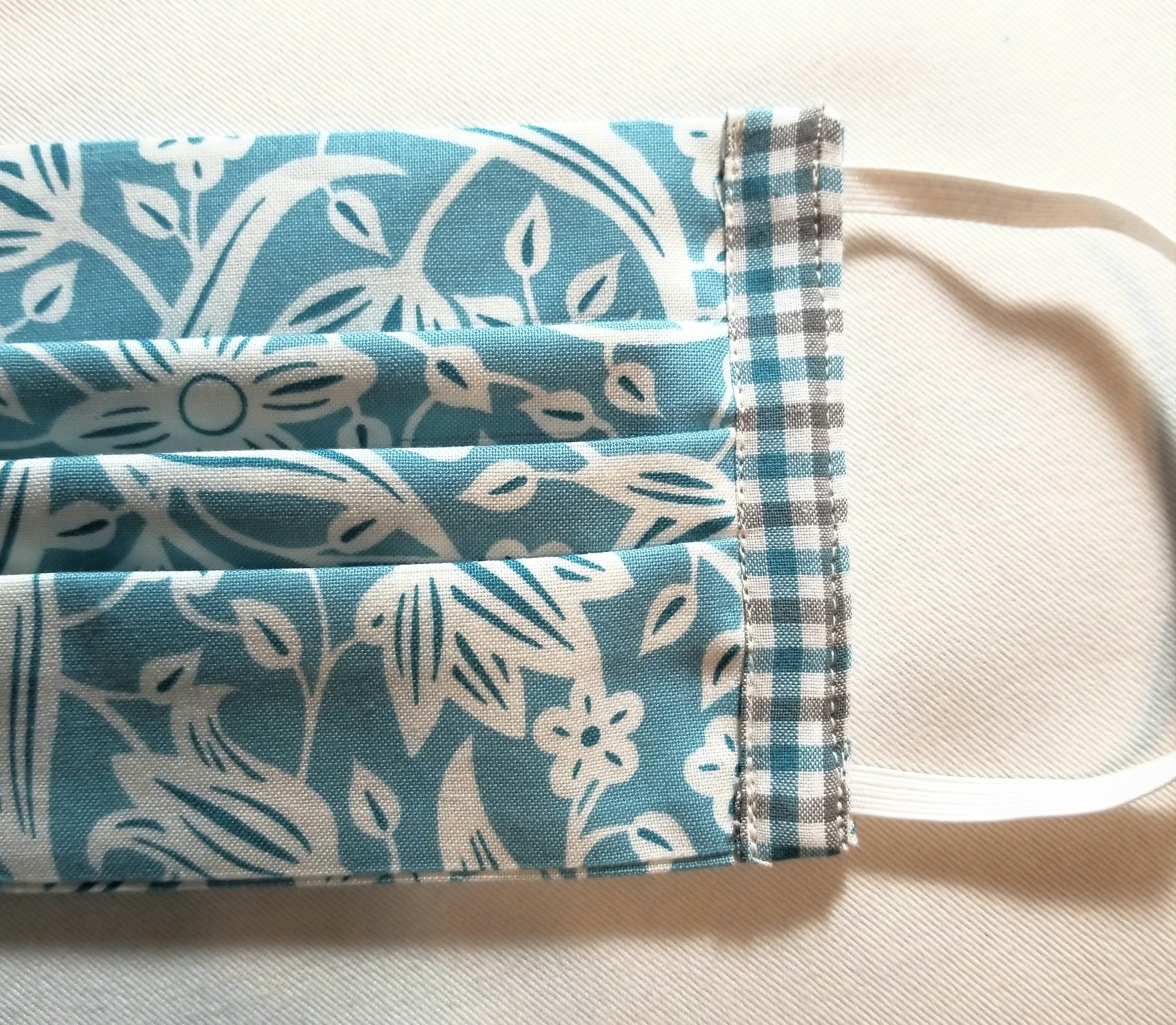
The front of your mask should now resemble the above picture.
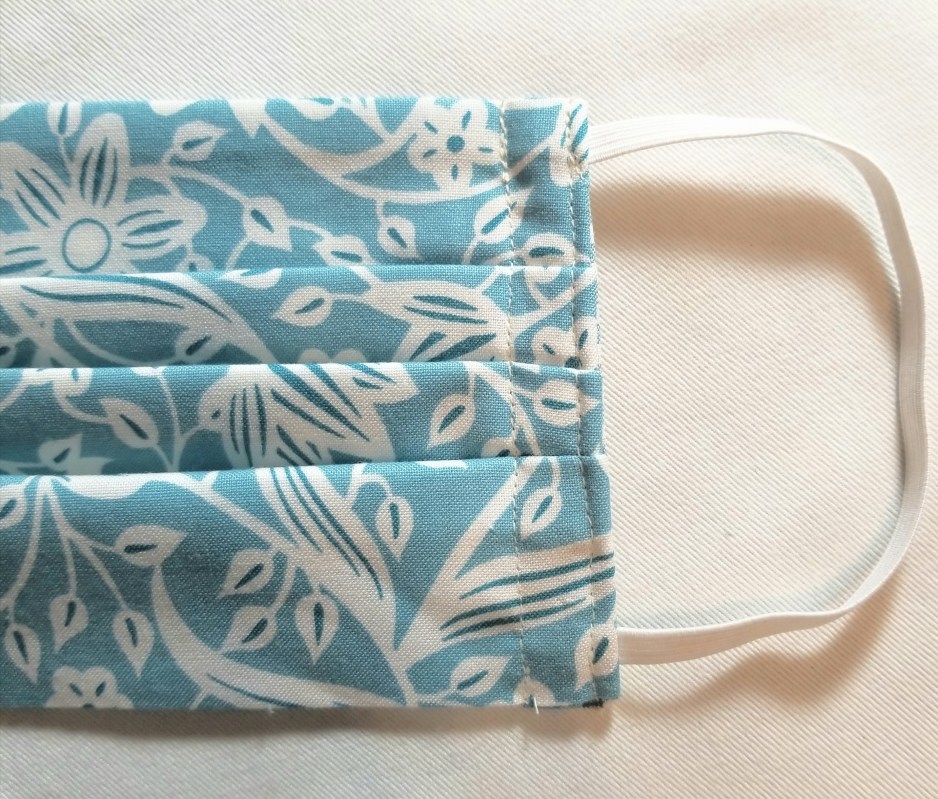
The back of your mask should look like this. Following the previous steps, attach the remaining accent fabric piece to the other end of the mask.
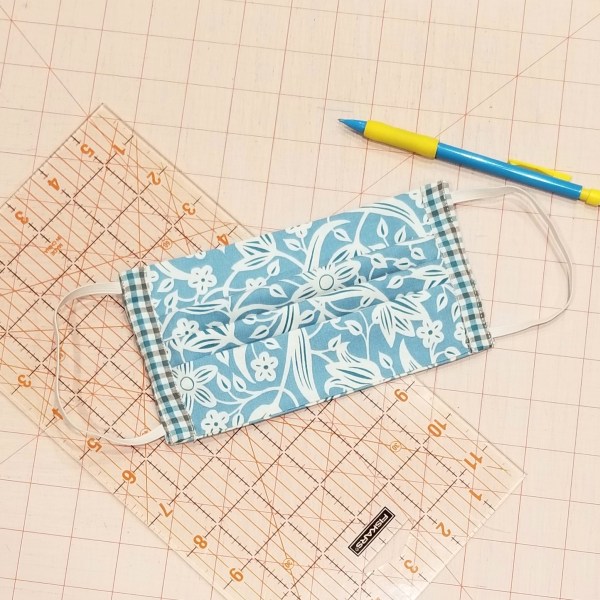
You should now have a reusable, washable mask that measures approximately 4″ x 7″ (unopened).
It took a few hours to put this free tutorial together for you. For this reason, I am greatly appreciative for any mentions that you can give me if you should use this tutorial. If you post a picture on social media, you can use the hashtag: #buttoncountermask. Feel free to share this page, and please tag me in your pictures so that I can see your beautiful creations. Last, I appreciate constructive criticism, so if you notice something that doesn’t look right, or does not make sense, bring it to my attention. I am happy to clarify any steps where you may have questions.
Enjoy!
P.S. Obviously, the elastic length can be adjusted to your facial measurements.
EDIT (March 24 2020): Because this tutorial has recently been used on a large scale, I will be adding a few things here as frequently asked and answered questions, suggestions, and reminders.
- This tutorial was happily shared by me over a year ago. This is not a new tutorial created in light of the current virus pandemic. I am not in charge, nor affiliated with any organization or entity requesting masks to be made. There are multiple organizations that are using this tutorial for their requests. If you have any question regarding what their requirements are, you really, really, really need to ask them. Please understand that I cannot and will not tell you what you should use, or how you should make your mask different from my tutorial.
- Keep in mind also that there are multiple entities that are using this tutorial for their requests. One entity may have completely different requests regarding features than another entity. (for example one organization is requesting a 4 layer mask, while another is fine with the two layer, as their thoughts are that they can be doubled up or used as a cover or liner to another kind of mask.) So, there is no correct or incorrect mask. Who are you making your mask for? Those are the people to whom you direct your questions.
- CHILD OR BABY MASK: After much thought, I have decided that it is in my best interest to NOT supply a mask tutorial for anyone other than an adult. One of my reasons for this is that I feel that a mask could pose as a choking hazard, and I do not want to have any part of that scenario. My suggestion is that you really should ask each individual child’s doctor or provider what their guidelines are, and go from there.
- I will not be held responsible for any mask misuse or malfunction.
- ELASTIC OR TIES? The main reason why my tutorial uses elastic is so I don’t have to tie it behind my head and mess up my hair. That’s it. So, if you are making the tutorial, and you don’t like the elastic, or if the person who you are making your mask for, requests ties; by all means put ties in yours. My pattern is very easily adapted to your preferences. There are organizations specifically asking for elastic, and some that are asking for ties only.
- ELASTIC LENGTH: I have read that a few of you recommend longer elastic; however, mine ended up being slightly loose. Therefore, I will not alter my pattern. I have stated in the tutorial that elastic length will need to vary due to the fact that human heads are not uniform (Thank goodness).
- I don’t have a PDF or printable version of my tutorial. If I decide to do that, I will; but it will be in my own time. I have received many hateful comments (that I deleted) demanding that I provide this. I need to remind those few sour apples that I am under zero obligation to do so. If my absolutely free visual tutorial isn’t to your liking, I invite you to go find one that makes you happy. If you are a person who often finds themselves using the words ”I need you to…”, you might fall into this category.
- I am completely honored that many of you are using my tutorial, or even certain aspects of it to help people in need. Even if you are using a completely different tutorial or pattern and just stopped by to check this one out, I applaud you for being a maker during this time. I cannot express enough how happy it makes me feel to see so many humans getting together to do something for the greater good. Please continue being that human. Those are the best ones.
I am signing off now to take care of my family, who needs me now more than ever. Thank you all for your kindness and understanding. God Bless.


Thank you!
I am a police officer in LA, they issued us one mask, that apparently is good for one use. So since I also sew (stress reliever) I thought I would give this a try. I love it and even though it is not in pdf I can follow this much better than another that I tried. Thank you so much! My co-workers thank you. I will be leaving soon to go to Oregon where my daughter and I will make more for her office. Thank you again.
Thank you for your very informative tutorial. I can relate to allergies. Mine aren’t as bad as yours, no longer in Texas 😩. You didn’t mention that the fabric has to be 100% cotton. Guess that needs to be checked out with where the masks go. Again, thank you. Blessings to you and yours.🙏
Excellent tutorial! I appreciate the exact directions and was able to make four masks tonight to send to my parents who need to travel during COVID19. If to protect some and keep them from touching their faces at the rest stops, all worth it! Plus it gave me SOMETHING helpful to do! I’ll be teaching my daughter who is home for school now, as this is such a great skill to have in a pinch, for fun, or for projects like helping make masks for citizens and health care workers!!! Thanks for your time putting your craft into words!!!
I just watched your tutorial. It s great. I’m not a real good sewer but I can understand your pictures and great explanations. Thank you
Thank you so much for the time and effort you put into creating this tutorial — I know it will help many people in the medical field and those taking care of family and themselves. May God bless you for what you have done in an effort to assist those in this crisis.
Thank you for your tutorial. It is quite simple to follow and if someone really needs a pattern to follow for this, perhaps they shouldn’t be trusted with a sewing machine? I think it is quite lovely an you’ve done a wonderful job explaining it.
I think you’ve done a wonderful job explaining your tutorial. I can’t see that a pattern is needed. I am going to try this, and if I can make it, then it will pass the “easy” test! Lol! Thank you so much for providing it for us. It is certain to be a lifesaver in this day and time, literally.
An absolutely excellent tutorial Thank you very much for offering it to us all
I am a nurse… well retired, but a surgical nurse at that. I am SO SORRY that there are people out there who complain about this lovely, simple, and FAST pattern that you have provided. That hurts my heart. I apologize for that. Your tutorial is excellent and it is appreciated. Thank you for it. JBRN
My very sincere thanks. Good news. I have inherited a sewing machine. Bad news. I have also inherited two left hands. Good news. These instructions are so clear, even I should be able to sew a mask. Grateful in Toronto.
Great tutorial. Thanks you for sharing this with us. It is very useful. ❤️
Thanks for this. I have only made a few, but I put the pattern on my Facebook page.
Thank you! Very easy to follow!
Stay well!
Thanks so much for this perfect tutorial; your unselfish sharing of this pattern and method will probably save lives. I’m making as many of these as I have fabric for, and people keep requesting them from me. It’s one way I can contribute without leaving the house. God Bless.
Thanks so much for providing this tutorial! Ignore the haters.
Thank you for taking the time to write this tutorial. I know how to sew and your instructions were spot on. I’ll be using your tutorial to make my masks. I like the finished look of the mask.
Ignore the haters. What they don’t get is that what they put out there will come back to them!
This should be renamed “How to take something simple and make it difficult”
Thank you! I plan to me a number of these!
Thank you so much for publishing this. I like the way you did your elastic. The instructions are clear and easy to follow Thank you for sharing your ideas and time.
Peace
Thank you so much for this tutorial. My father asked me to make him a mask, and this design will work well. Much appreciated!
Awesome Pattern do you have recommended dimensions for a child size mask?
Just finished my first one. I only had 1″ elastic, so I used my rotary cutter to cut the lengths into 1/4″ strips. Worked well, I hope it doesn’t ravel. I’m going to fiddle with the measurements to fit a child. If anyone else has already done so, please share. Thanks so much for the clear directions, it went together very easily.
Thank you for your tutorial, we have looked a lot for patterns and instructions that make sense and work well, yours is and does. Thank you very much and keep up the great work.
Thank you for caring enough to share a wonderful step by step instructions to help other allergy sufferers. Thanks for sharing! You are appreciated💗
You have done an excellent job with this. Thank you so much for sharing. In these trying times I will be making some for my family’s personal use.
A retired Home Economics teacher who taught for 35 years.
I just finished my first mask. Now that I have gone thru the easy-to-follow instructions once, the next masks should go much more quickly! Thank you for taking the time to post this tutorial, it is greatly appreciated.
Hi!
Here’s a link to a .pdf of this tutorial.
It’s 16 MB and 17 pages, but that’s down from 35 pages, so… I hope you find it helpful. Enjoy. And be well.
❤️❤️❤️
https://28777.biz/Button-Counter-Face-Mask-pdf-file
Thank you! You tutorial with excellent pictures and simple instructions is wonderful! With much Gratitude for your effort to share this with anyone who would like to make a mask. Very nicely done.
I have learned from you not only how to make a mask but also beautiful sewing techniques. Thank you so much for this article!!!!!
I just made my first mask and I must say I’m quite proud of myself but, alas, it does not look as clean and neat as yours. I did not switch my presser foot at the stage where you add the accent piece. Do you think that is the reason? That part was a struggle.
great instructions! Thank you for your details. This mask is much better than the one with the seam in the middle of the masks without pleats. It makes it easier to breathe. I have to use a slightly longer piece of elastic for my husband’s big head. Thanks again and stay safe.
THANK YOU for your amazing face mask tutorial. It was exactly what I had been searching for. Please ignore the not-so-nice people – we are GRATEFUL for you sharing your insight! (I’m sure many of us will be visiting your site again in 9 months for some tutorials on cute baby items!) Thank you again!
Thank you so much for taking the time sharing your pattern, tutorial, and great advice. I plan to make these for my family. ❣️
Dianna
Amen to Raven Fenmore!! You are a treasure for sharing this & I for one as well as many others appreciate you immensely…
I’m really struggling with the last steps, encasing the raw edges. Is it like quilt binding, or am I doing something wrong?
Thank you so much for this detailed tutorial!!! After watching your instructions I immediately thought “Hey I can do this!”
Thanks for your detailed instructions. Some of the other tutorials are not as well done. THANKS! I hope you and your family are well.
Thanks so much sharing this, and for your update notes 😉
It’s so beautiful and well made.
I found this pattern and tutorial very informative. I am anxious to try this. I am a novice at sewing but I think I can do this per your instructions.
Thank you!
Thank you for sharing your tutorial. I will be making masks for my granddaughter, great niece, and dear friend who work in the nursing home and are required to wear these type of masks and they must be laundered every night. I’ll make them some spares. Thanks again.
Thank you, thank you! I am finishing my first mask and will be making enough for the dialysis center that my daughter goes to three times a week. You will never know how many lives will be saved because you were kind enough to share your pattern and tutorial.
Thank you so much for sharing your pattern with us during these terrible days of COVID19. Your pictures and directions were easy to follow. I made two masks so far for my daughter who works in the ER at UNC’s mental health part. Due to low PPE’s for their unit; this is a blessing until more supplies come in. No problem running this on my IPad, had it sitting right by my sewing machine. Take care and stay safe🤗
Fabulous instructions!
Today is April 3, 2020 and I just found your pattern. Thank you for your time and your effort. Thank you for the excellent instructions. Virtual hugs and good thoughts to you and your family. And… booo-ya!! Way to go!!! Great job on dealing with the sour apples. (you are soooo much nicer than I would be!!!!)
Thank you for taking the time to provide this!
Thank you for keeping this up. I love seeing the cheerful mask, and the easy to understand instructions that you wrote in more relaxed times. Leaving this tutorial online for us all is very kind. Thank you.
Love your tutorial! It‘s easy to understand, because you‘re made it so well. Many thanks.
Thank you so very much for this easy to follow tutorial on how to construct a cloth face mask. I will be making several of them for family and friends, and for the homeless folks that I see on the street corners when I have to venture out to the grocery store.
We’ve all got to stick together and help each other… I feel you’ve given us all a blessing with your directions for this item. Thank you for your time!
Stay home, stay safe, and wash your hands!
P.S. – Don’t let the negative remarks get you down. 😉
Thank you so much for this mask tutorial. I need both written and visual information when learning something new and your tutorial is the perfect match. Thank you for taking the time
to post this in the manner you chose. So much appreciated!