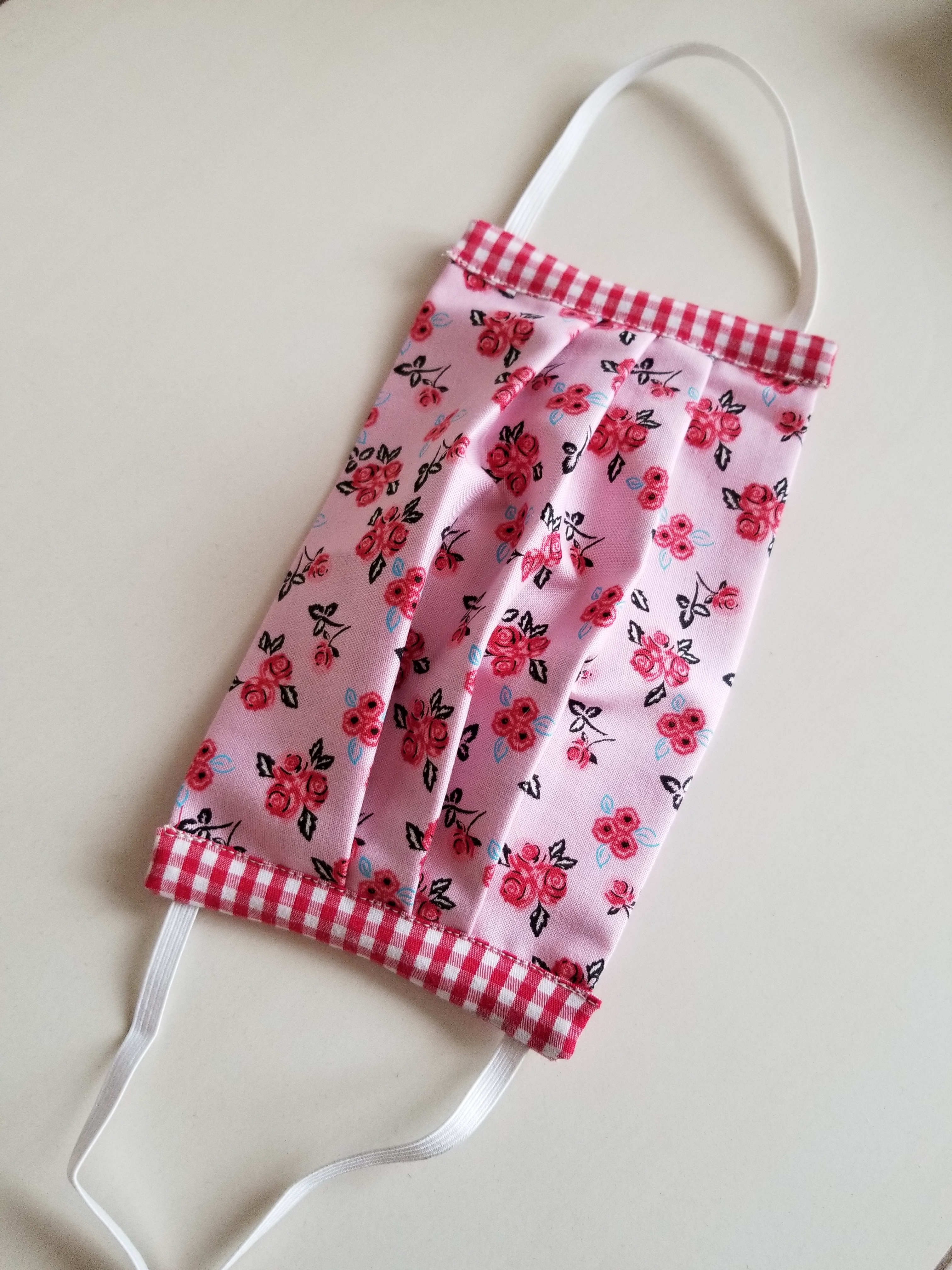
My allergies have been incredible this year, and by that I mean that they have been worse than they have ever been. (Please, please, please do not suggest medical advice here. Much appreciated.) I see an allergy specialist who gives me 2 shots, 2-3 times a week to help with my symptoms. They have helped a lot; however, Juniper Ash (Cedar Fever!) here in Austin is 6 times worse than average this year, and boy oh boy, do I feel it. She suggested that I wear a face mask when I go outside to help reduce the amount of pollen that is going into my lungs and sinuses. After going to a few different stores to purchase some, I found that many other Austinites had already bought them out. No worries, right? I know how to sew. I will just make one. When I finished, I had many requests for a tutorial, so here you go:
Materials needed:
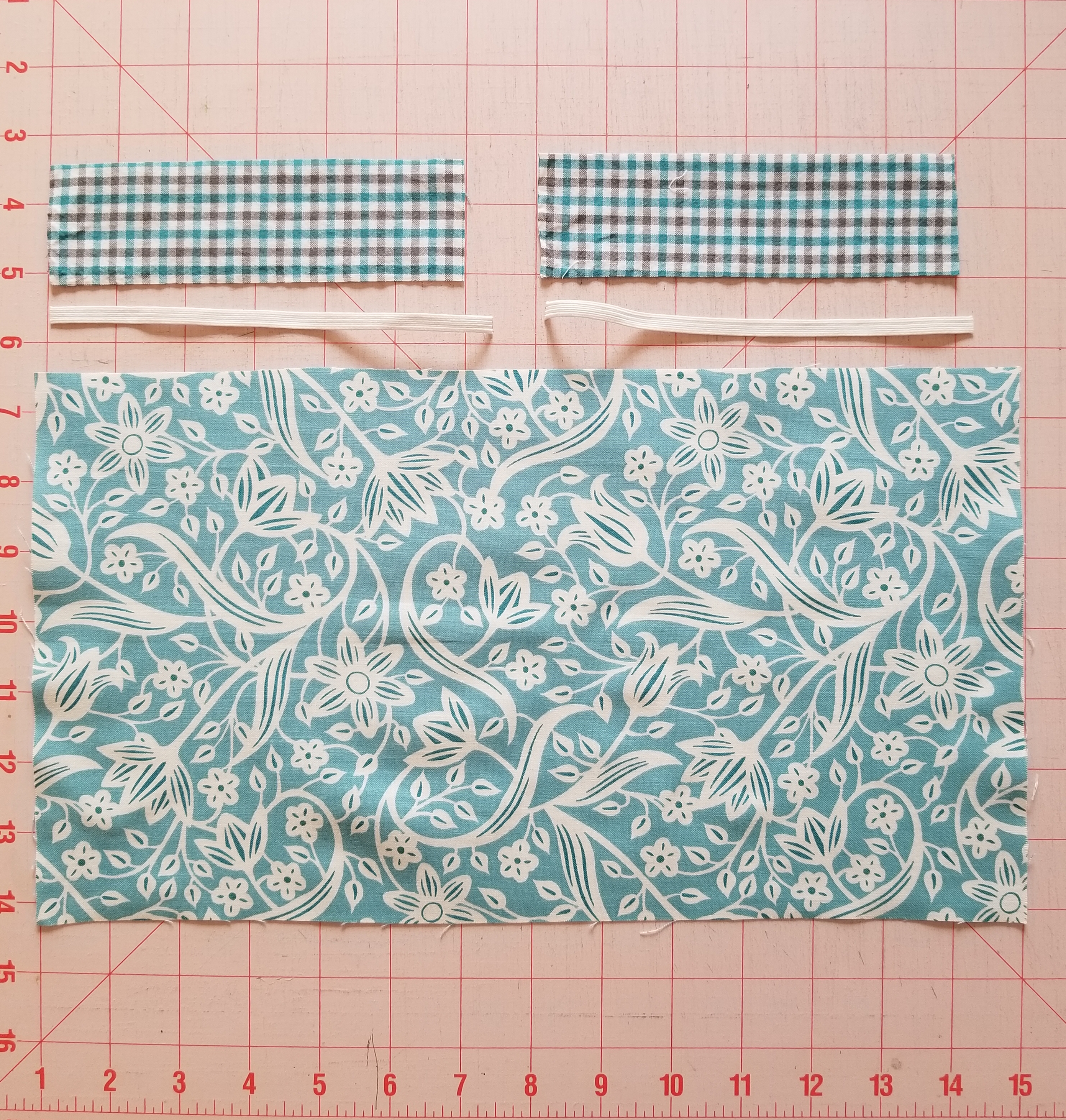
- 1 piece of fabric measuring 8” x 14”. Until you get familiar with this tutorial, I would suggest a non-directional print. One that has a scattered image printed on the surface such as the one shown.
- 2 strips of fabric measuring 1.75” (1 3/4”) x 6”. This will be the accent edge piece. It can be the same fabric as the main piece or a small-scale print or solid.
- Two pieces of 1/4” width elastic. These will be about 6 1/2” long.
- Ruler
- Fabric marking tool.
- Pins
- Scissors
- Sewing machine, threaded.
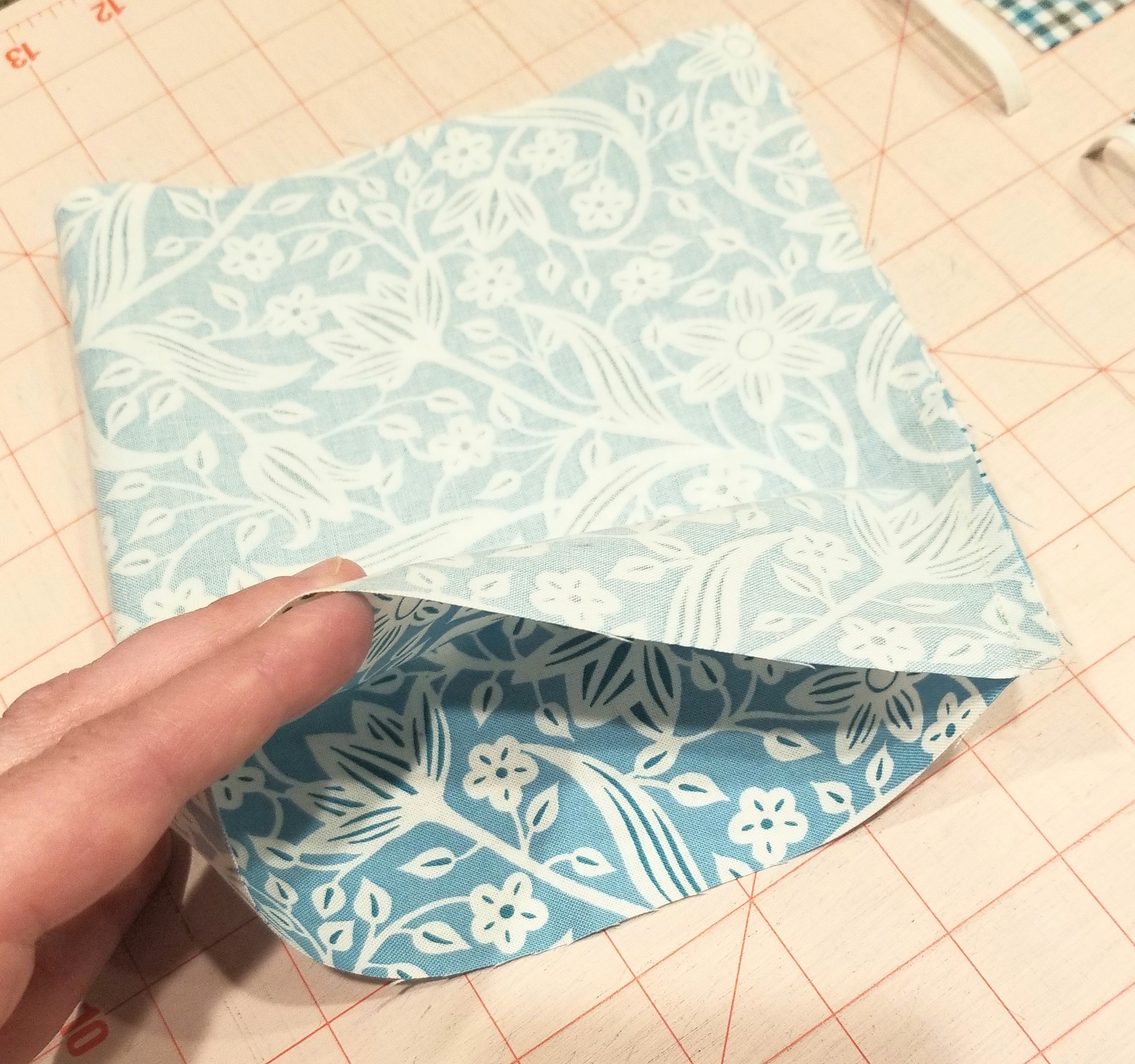
Fold the main piece of fabric in half, right sides together. Sew along the 8 inch width edge, using a 1/4 inch seam allowance.
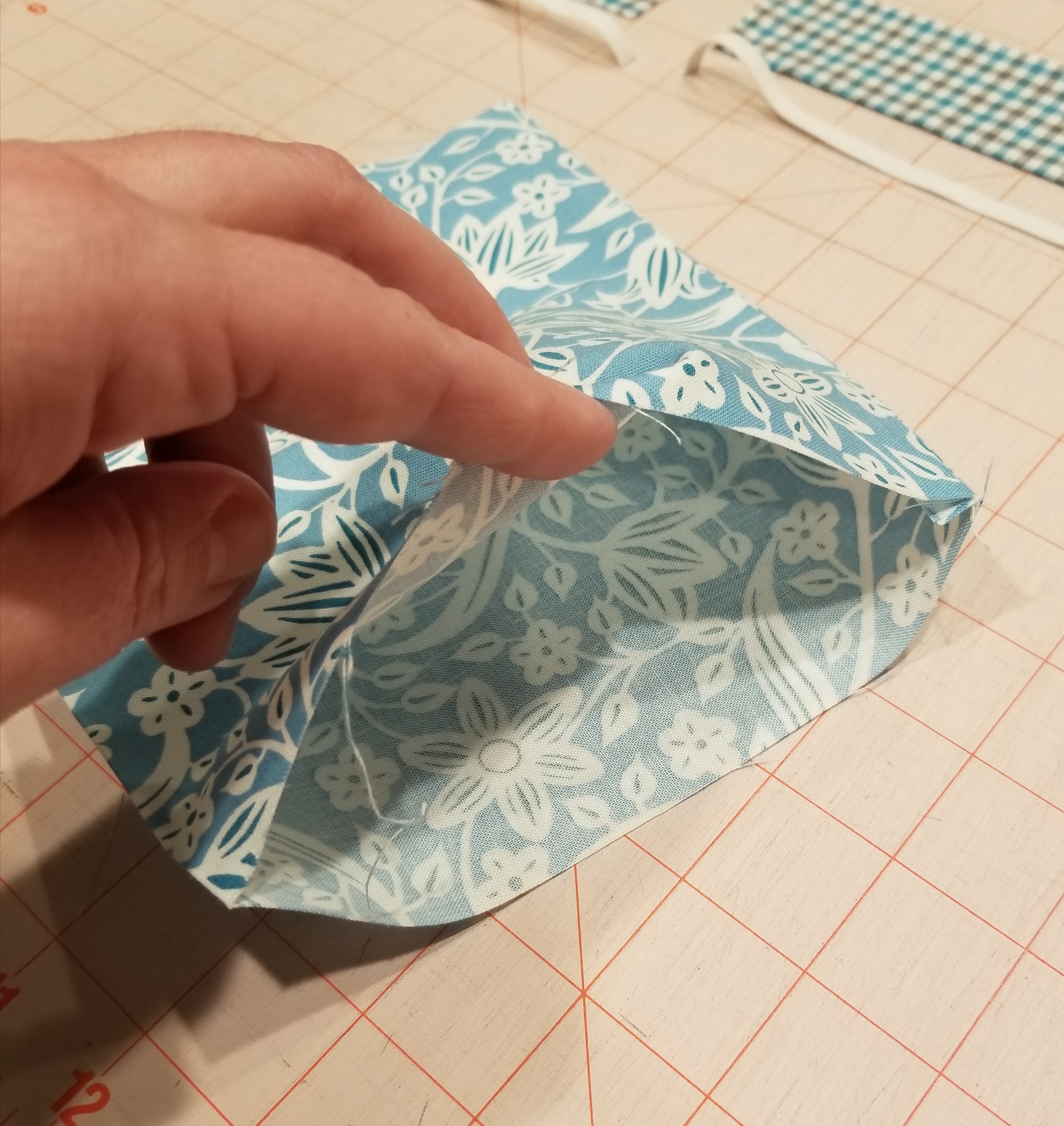
Turn this tube shape inside out, so that the right side of the fabric is now on the outside. Press this flat, keeping the seam to one end of the flattened tube.
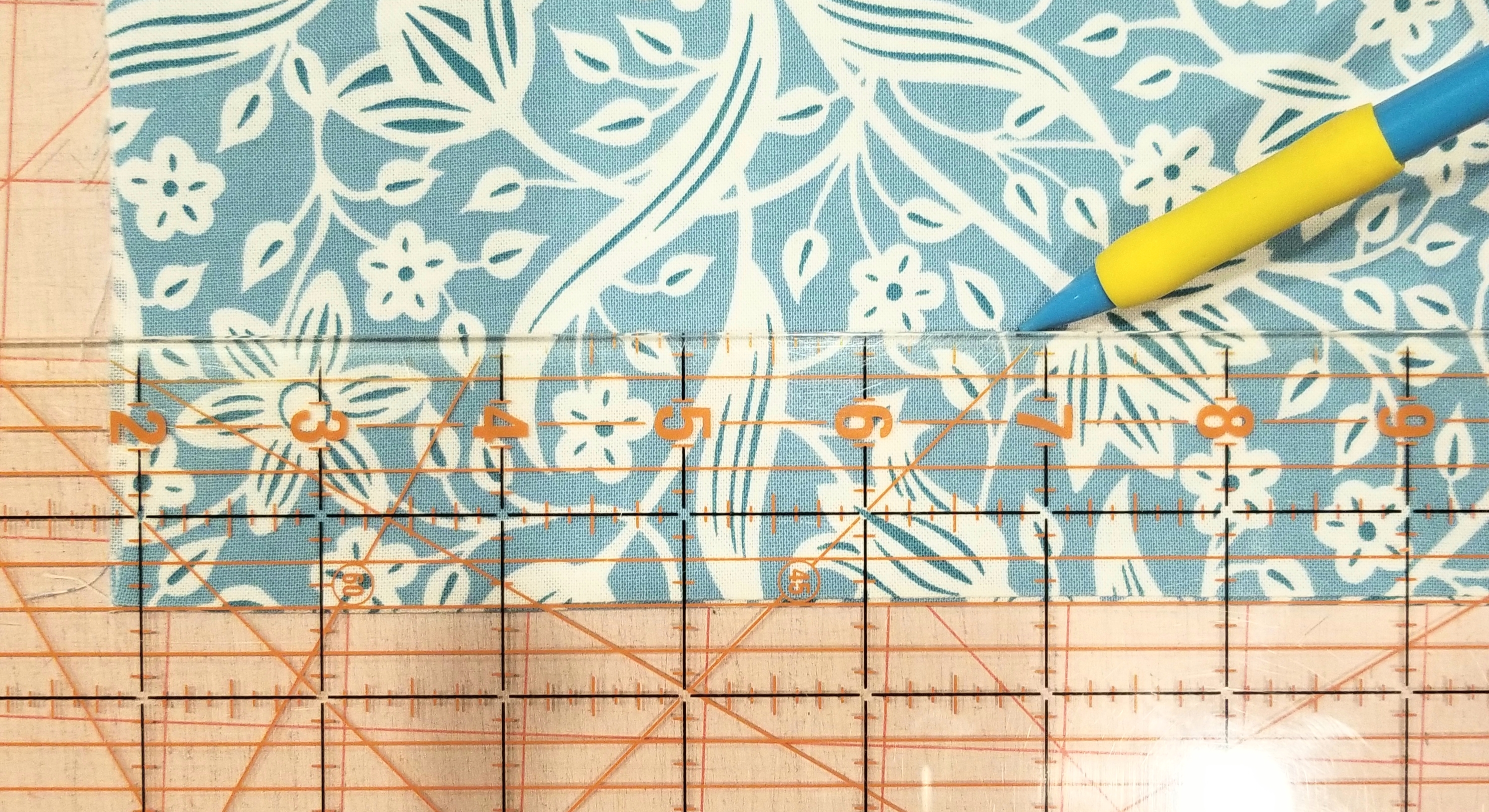
Place the tube of fabric so that the raw edges are on each side and the seam edge is at the bottom. Using a ruler, measure and mark a line 1 1/2 inches from the bottom edge. Make another line 1 inch above this line, or 2 1/2 inches from the seam edge. Don’t use a pencil as you see in the picture, use a fabric pen, or fabric chalk. I used a pencil for illustration purposes.
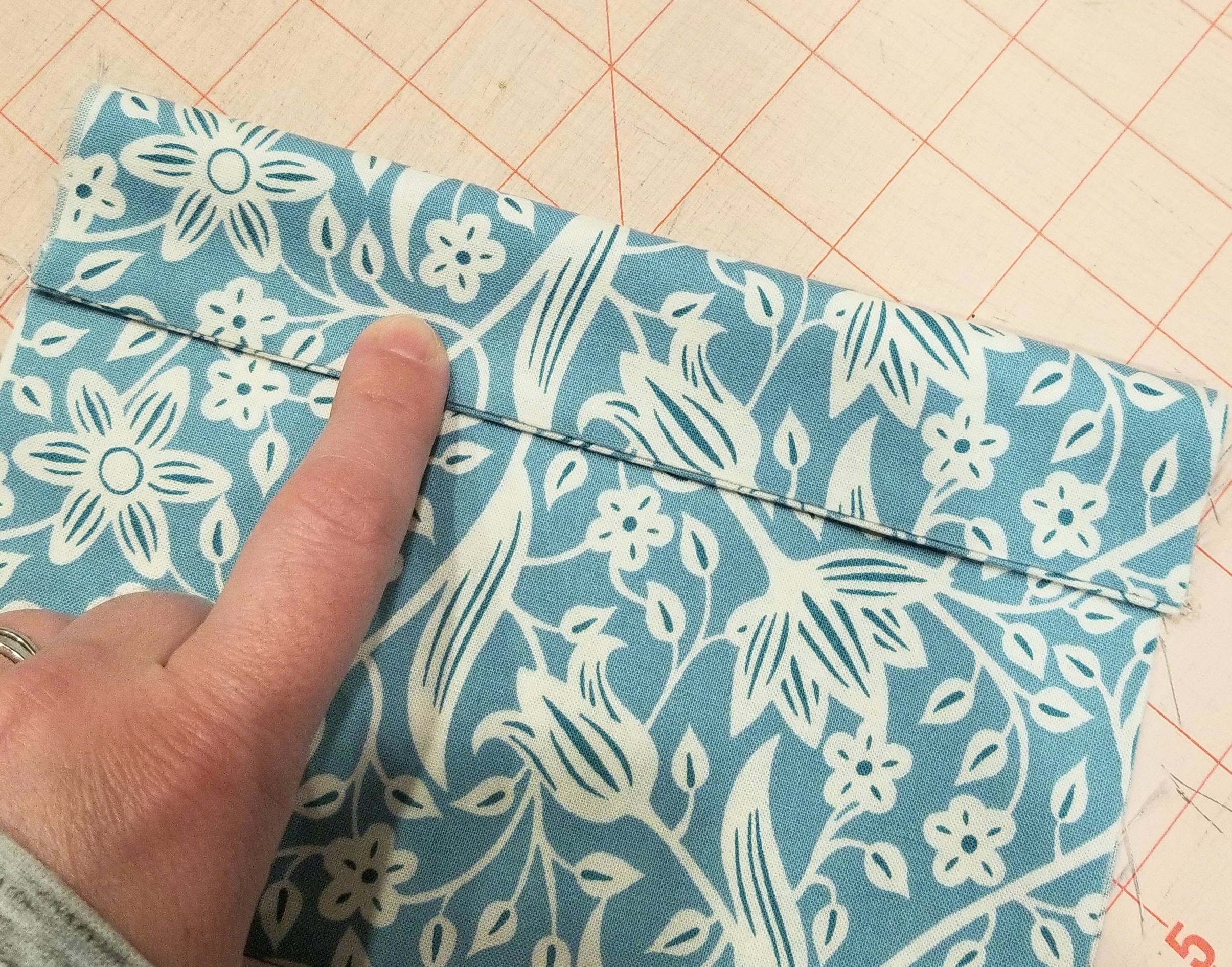
Fold the seam edge up (or down in this picture, as I turned it upside down…sorry) making the crease on the first line that you just marked. You should have 1 1/2 inch edge here.
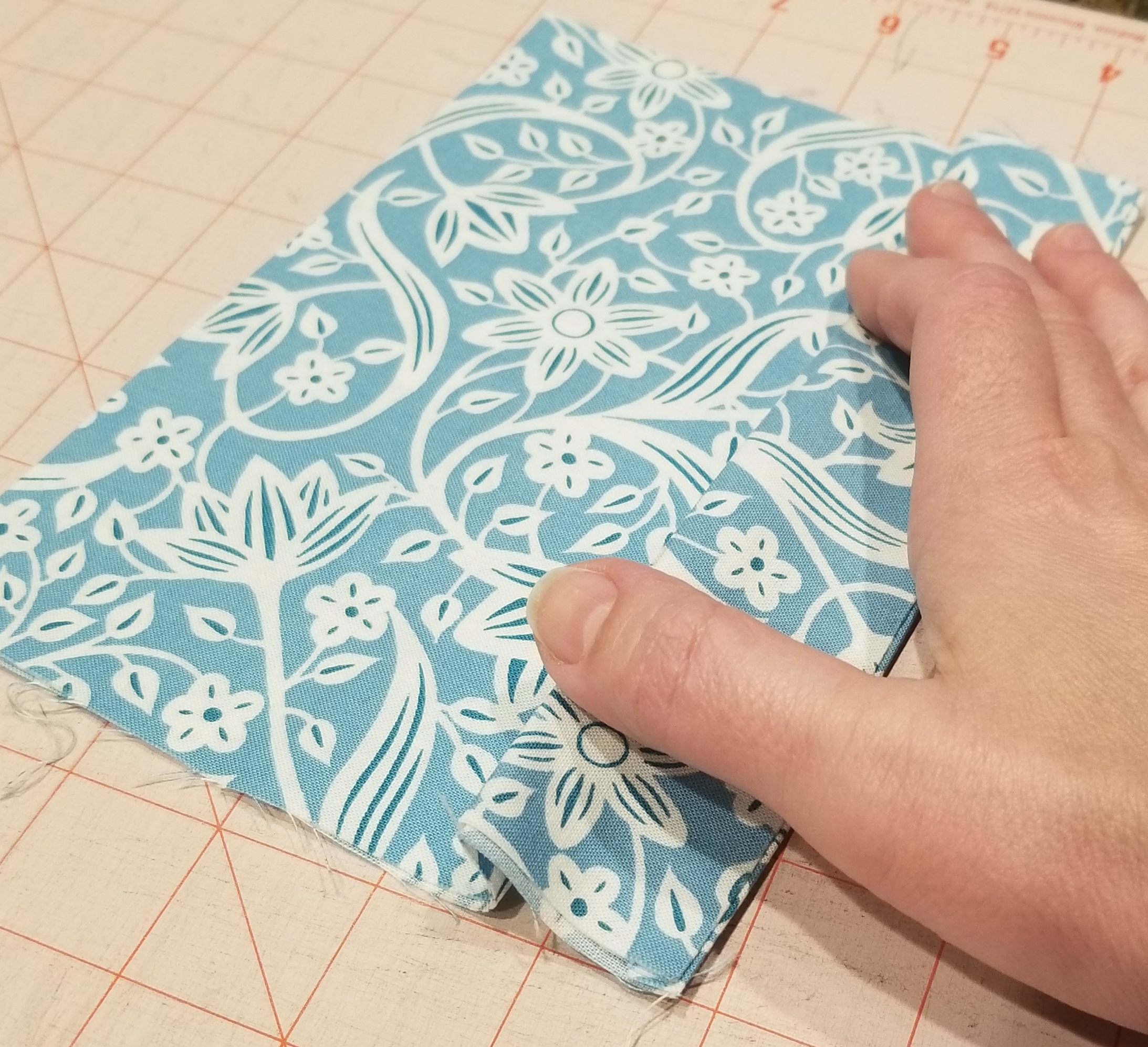
Flip the tube piece over. Match the crease edge to the second line that you made earlier. Press. The pleat that you just created will be 1/2 inch deep. Pin the pleat down on each raw edge end.
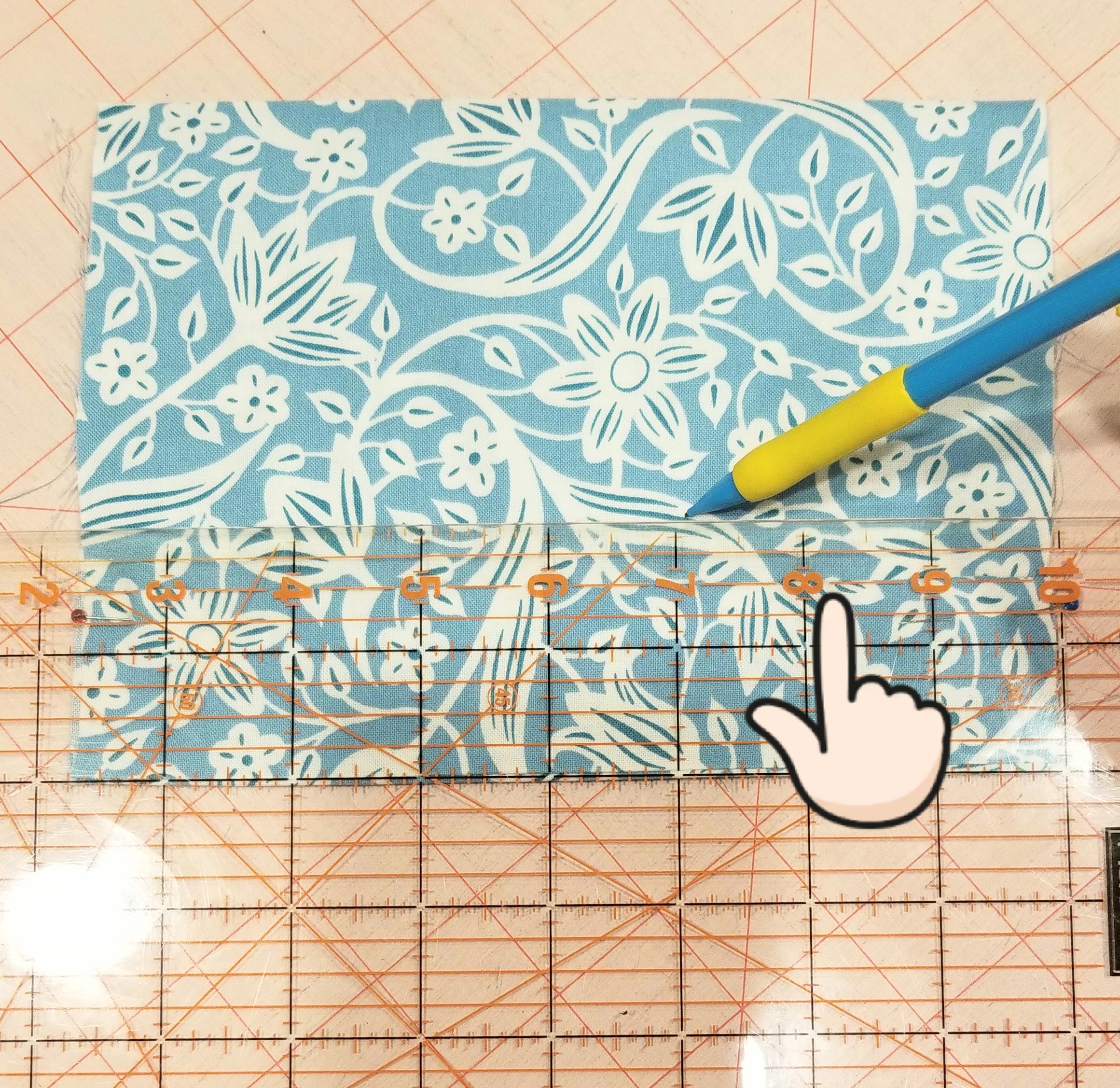
Now you will mark the lines for the second pleat. Mark a line measuring 1/2” from the top crease of the last pleat, (or 2″ from the bottom seam edge). It was difficult to see the top of the crease in this picture, so look at the finger indicator above.
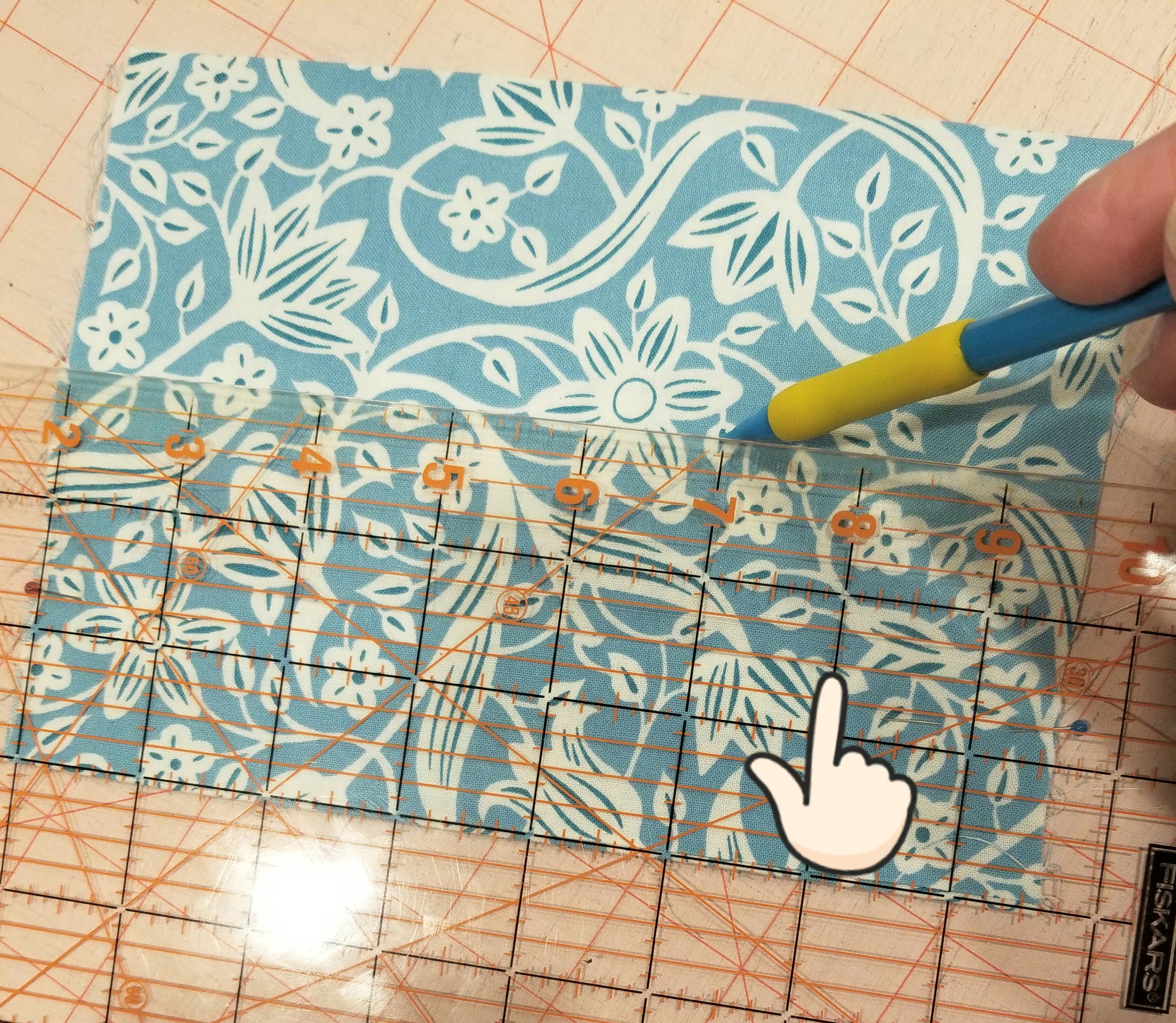
Now mark another line one inch above the last line that you made (or 3 inches above the seam edge). Using these lines as your guide, repeat the steps that you followed to make the first pleat.
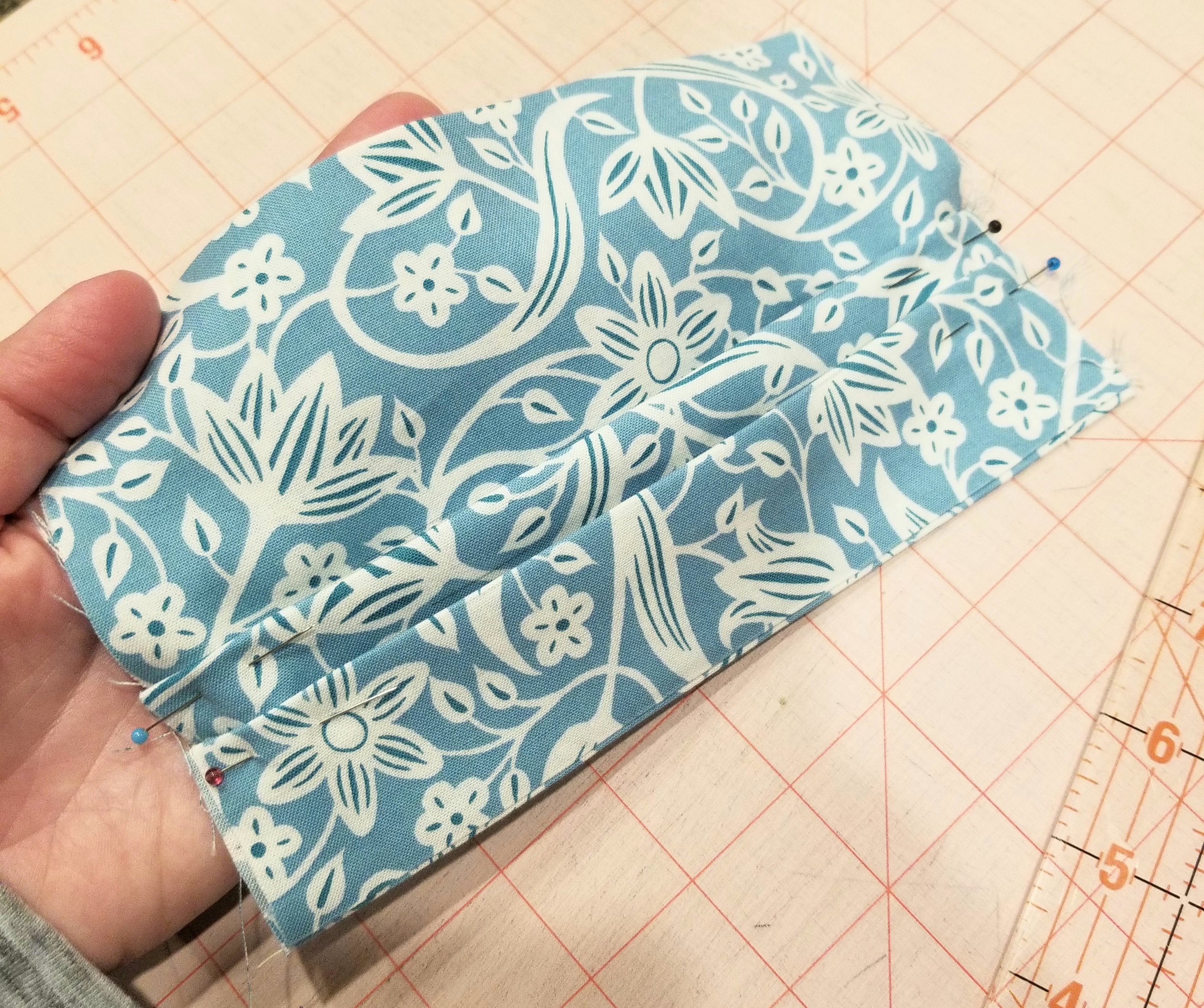
You should now have two pleats, each one being 1/2 inch deep. Repeat the steps you used to make the second pleat, so that you end up with three pleats total. Press.
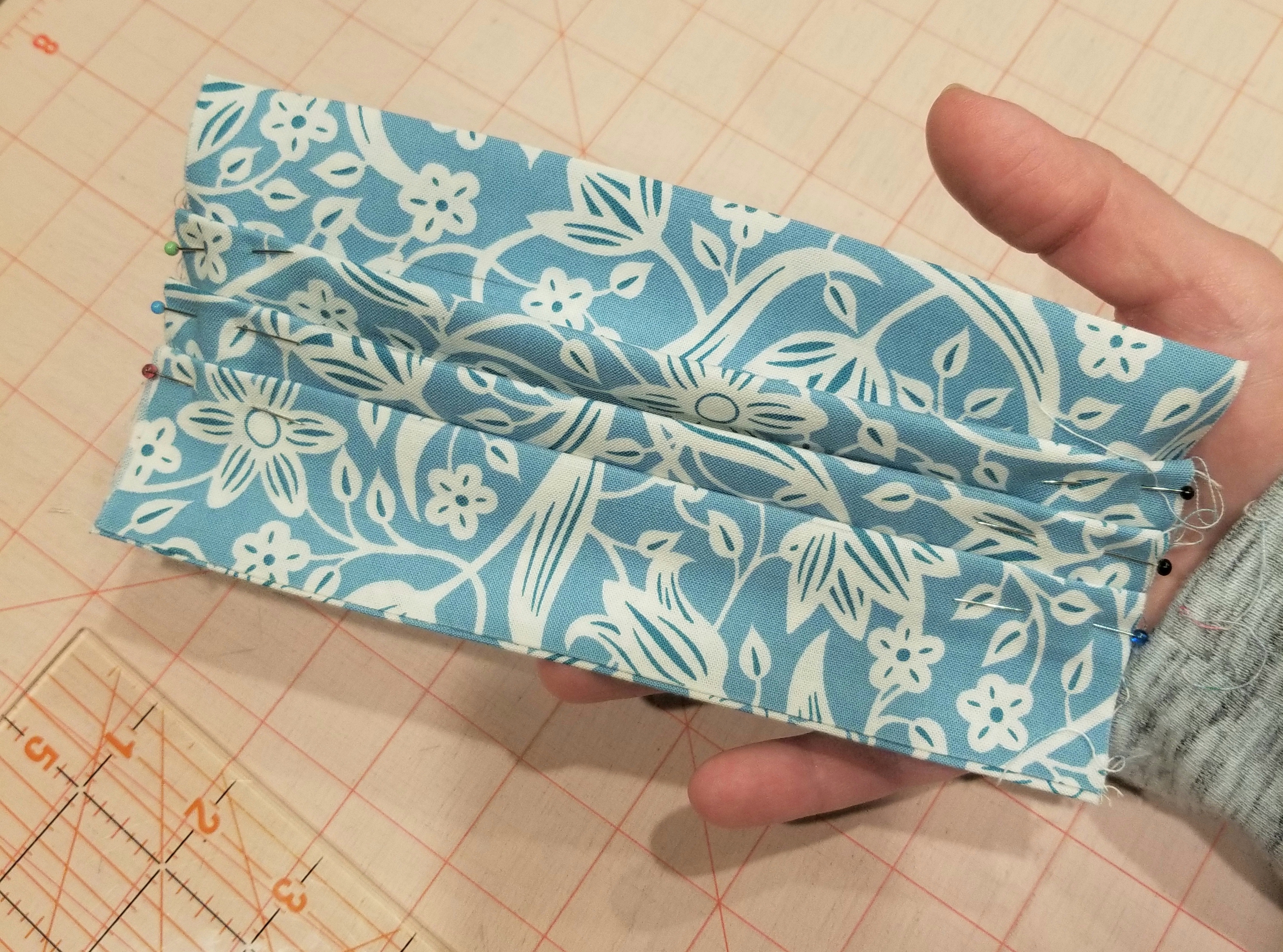
This is what your main piece should look like at this point.
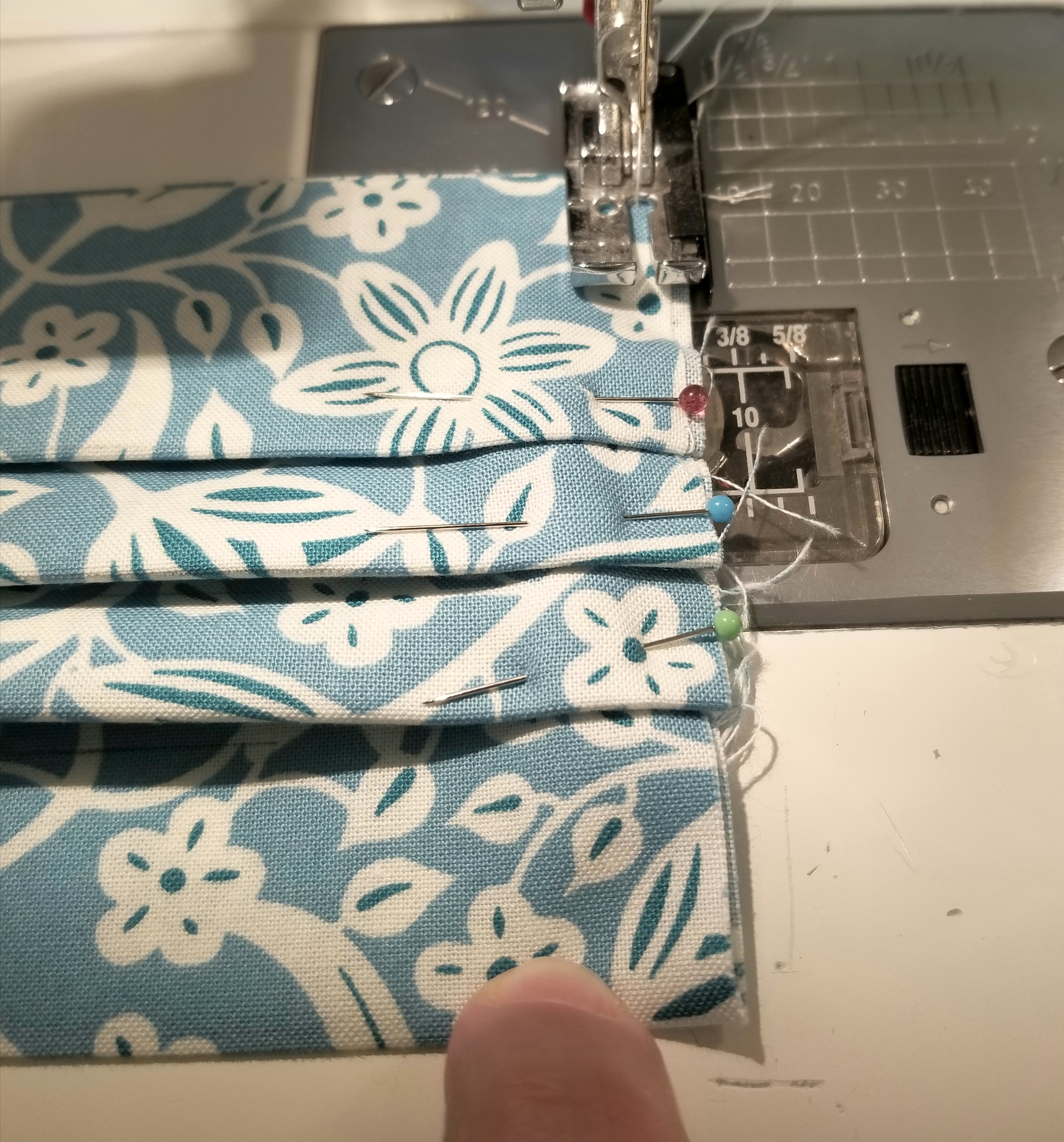
Using a 1/8” seam allowance, baste stitch the raw edges.
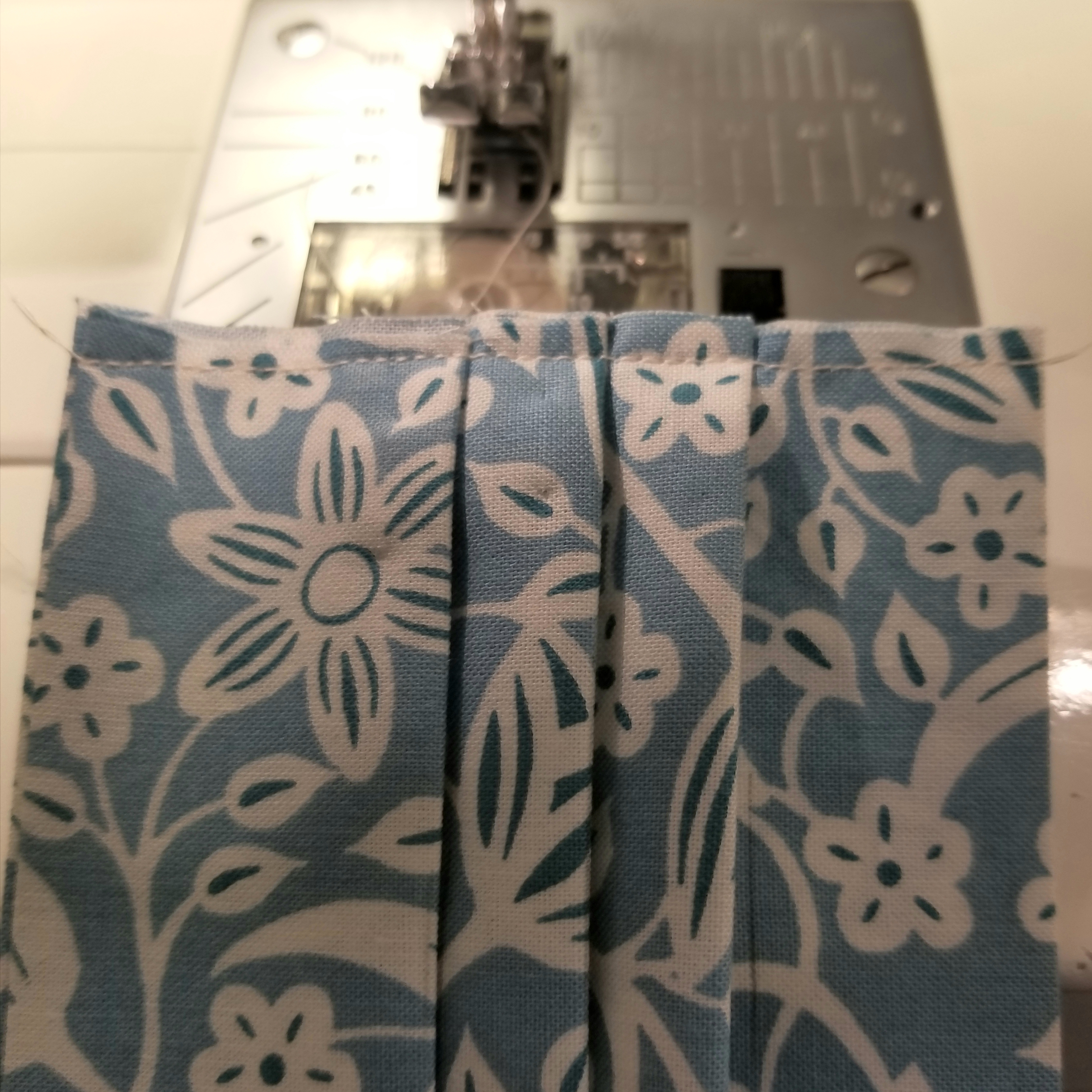
Repeat this step so that both raw edges are basted as shown in the picture above.
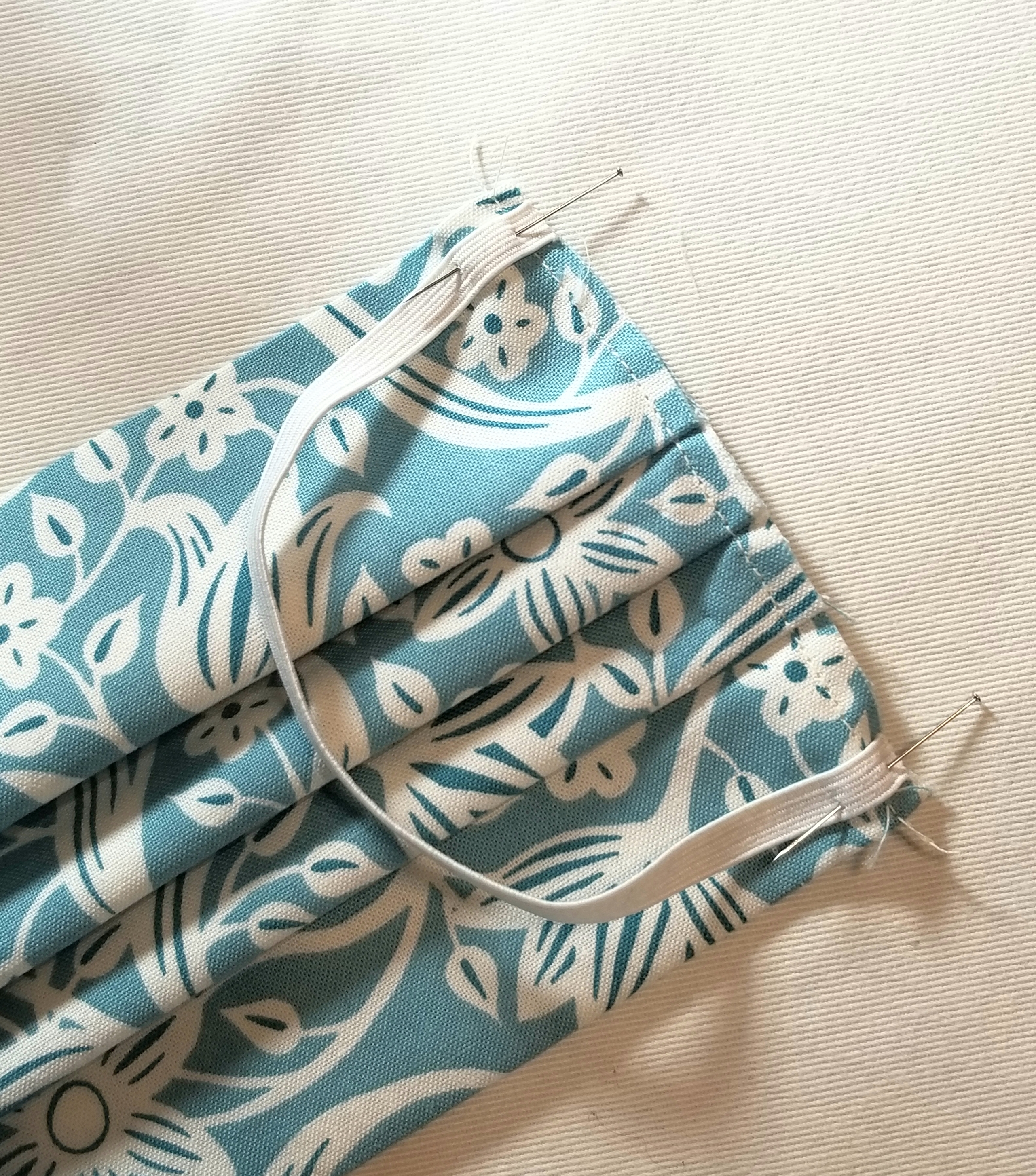
Pin one elastic piece to the raw edge, making sure not to twist it before baste stitching it to the edge at both ends. I placed mine 1/8” from the top and bottom edge of the main pleated piece. Baste elastic in place 1/8” inch from raw edge. Repeat, to attach remaining elastic piece to the other raw edge.
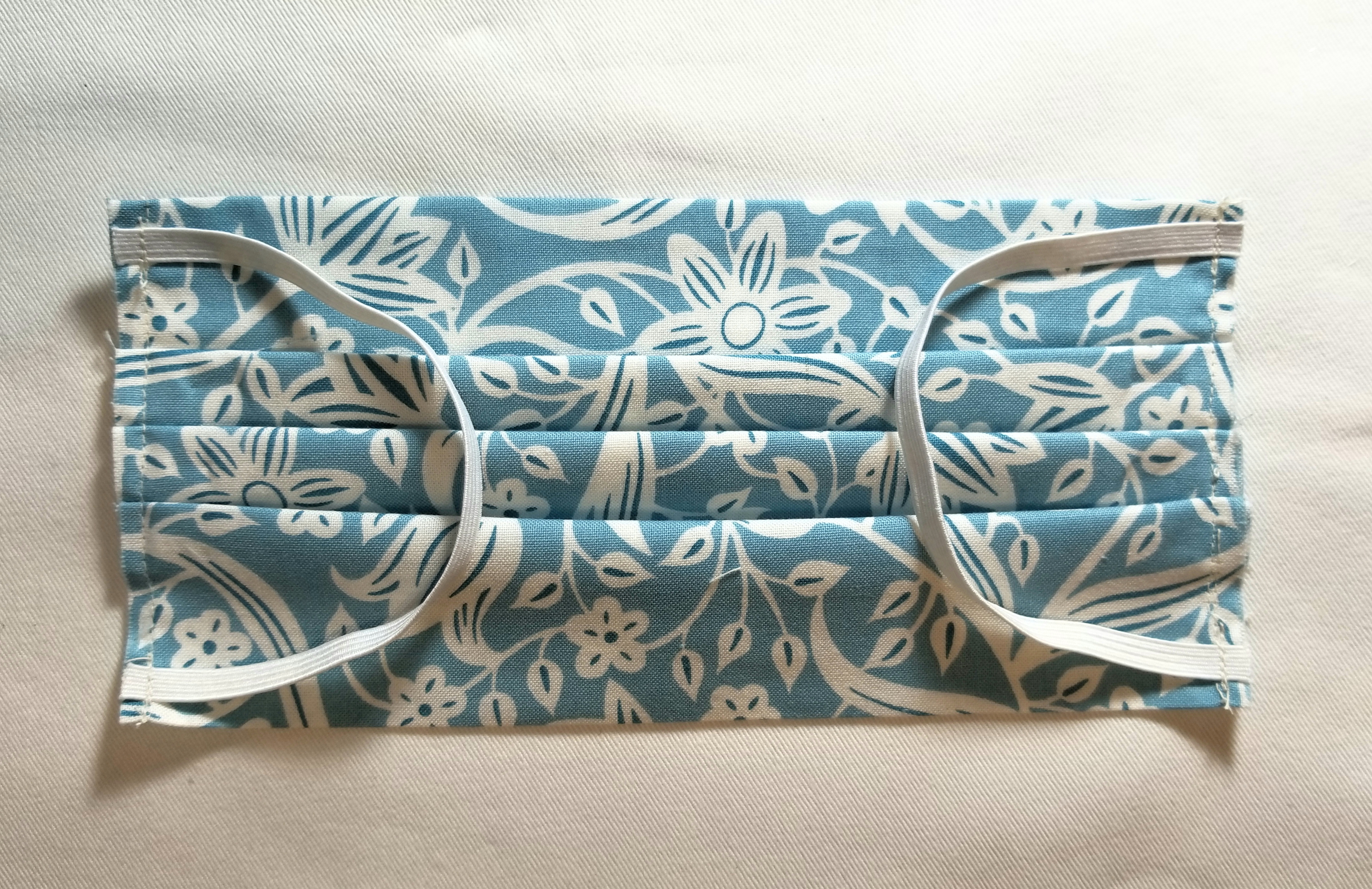
Your pleated piece should now resemble the picture above.
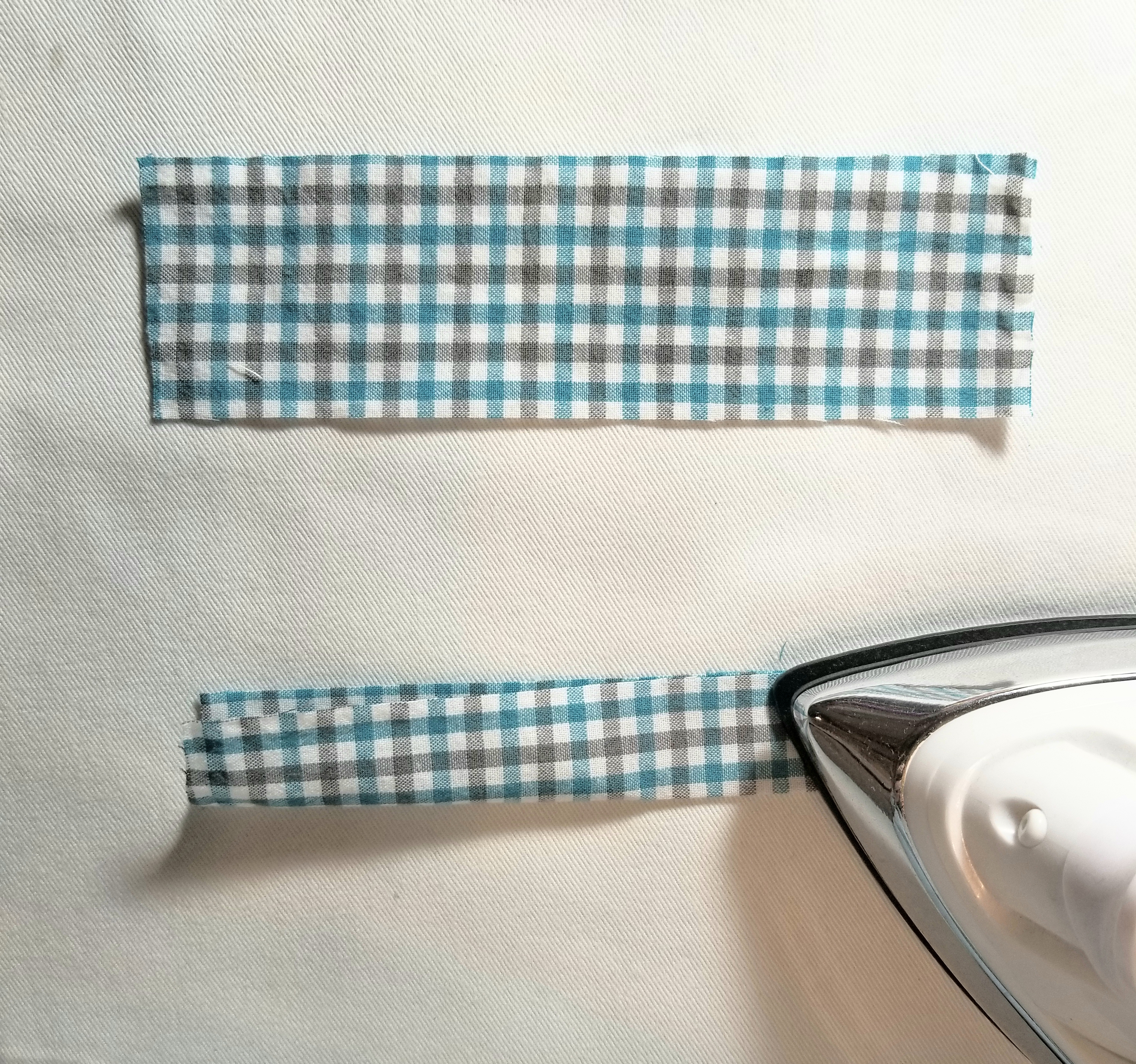
Fold each accent strip of fabric lengthwise in half, matching raw edges, as shown in the picture above. Press.
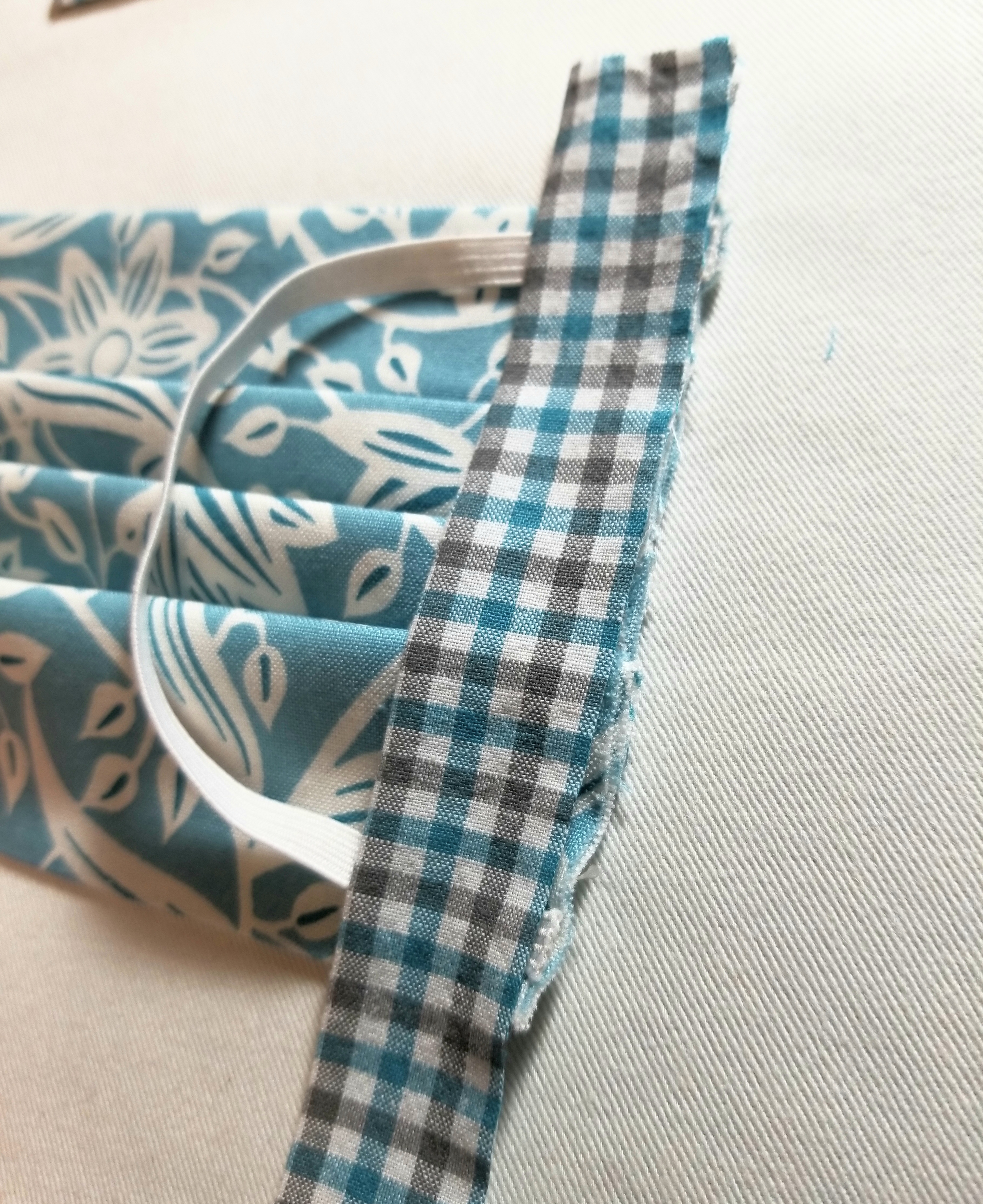
Place the strip on top of the elastic. Make sure the raw edge is facing outward, and the creased edge is facing the main body of the pleated piece. It will be a little longer on the top and bottom and that is okay, as we are going to fold some of that to the back.
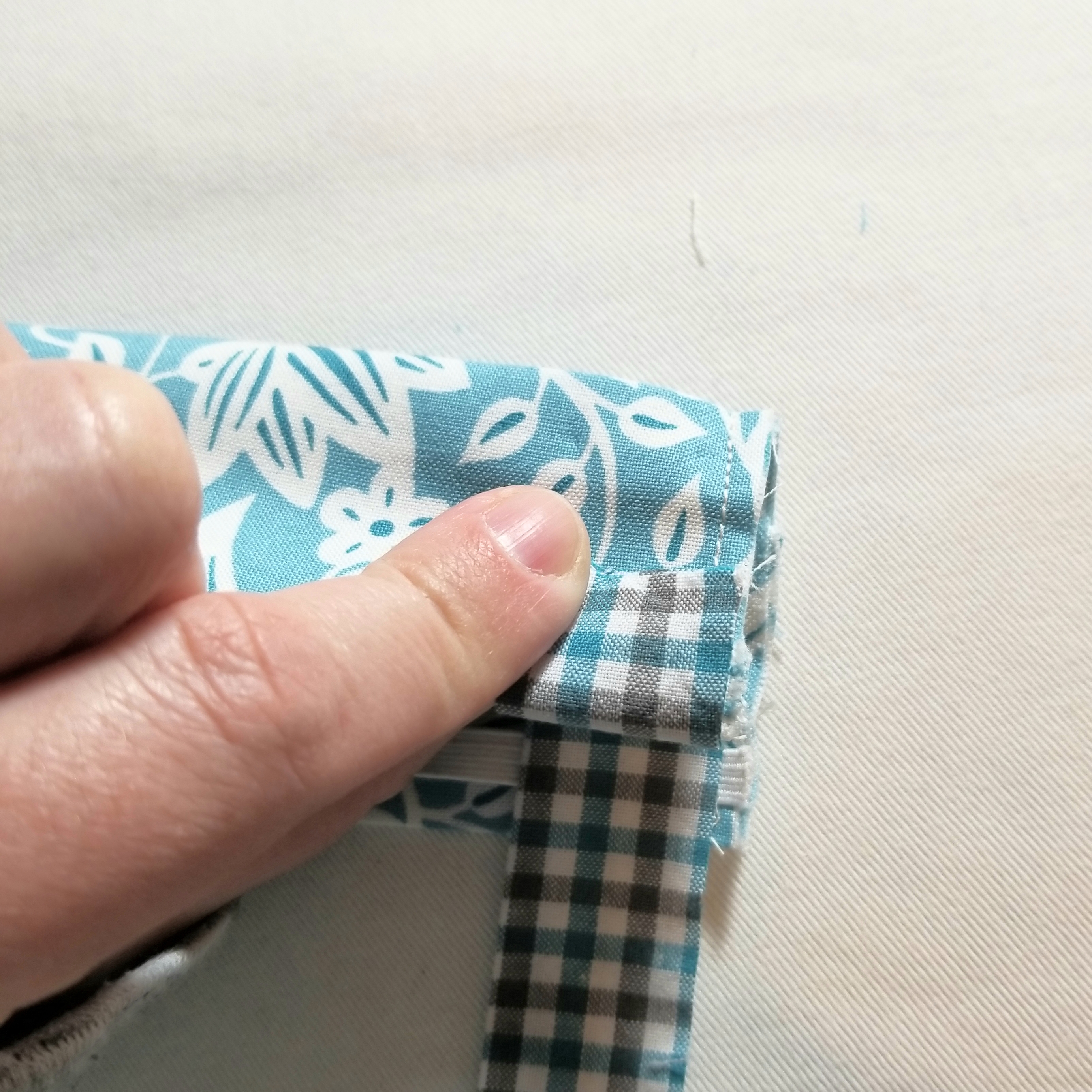
Tuck about 1/2” of the top edge to the back as shown in the picture above.
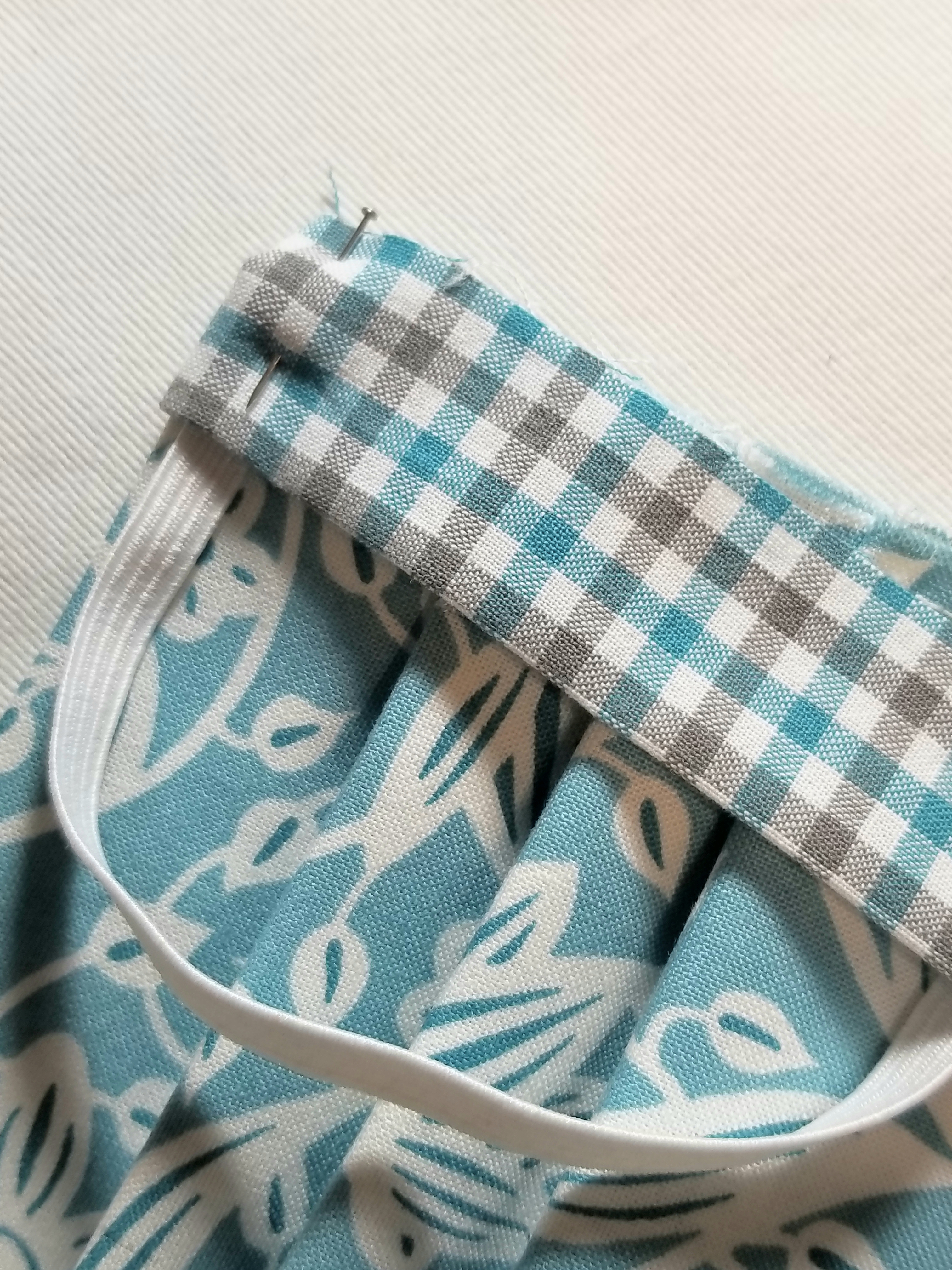
Pin all layers in place.
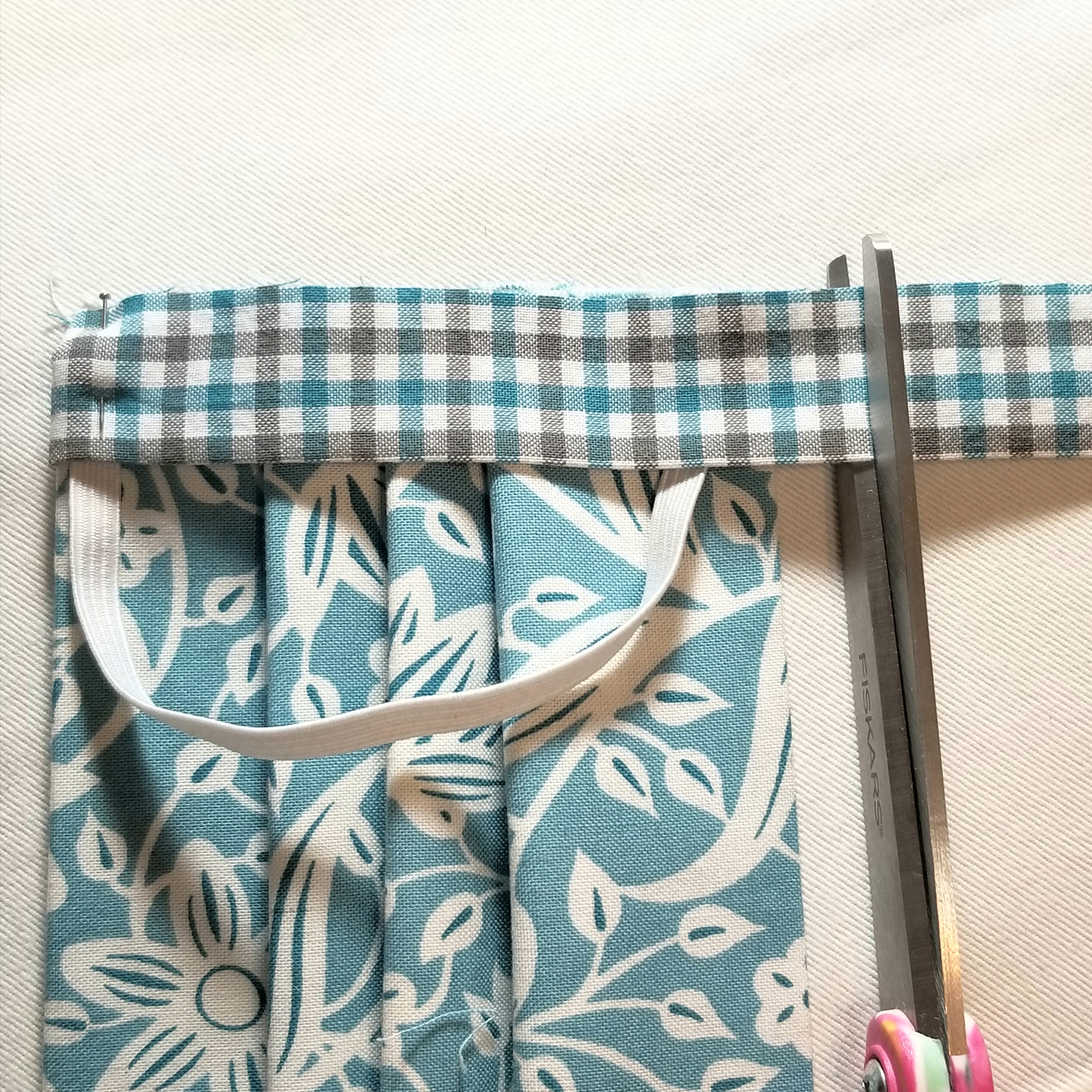
Trim the other end of the accent strip, so that it is about 1/2” longer than the bottom edge of the main pleated piece.
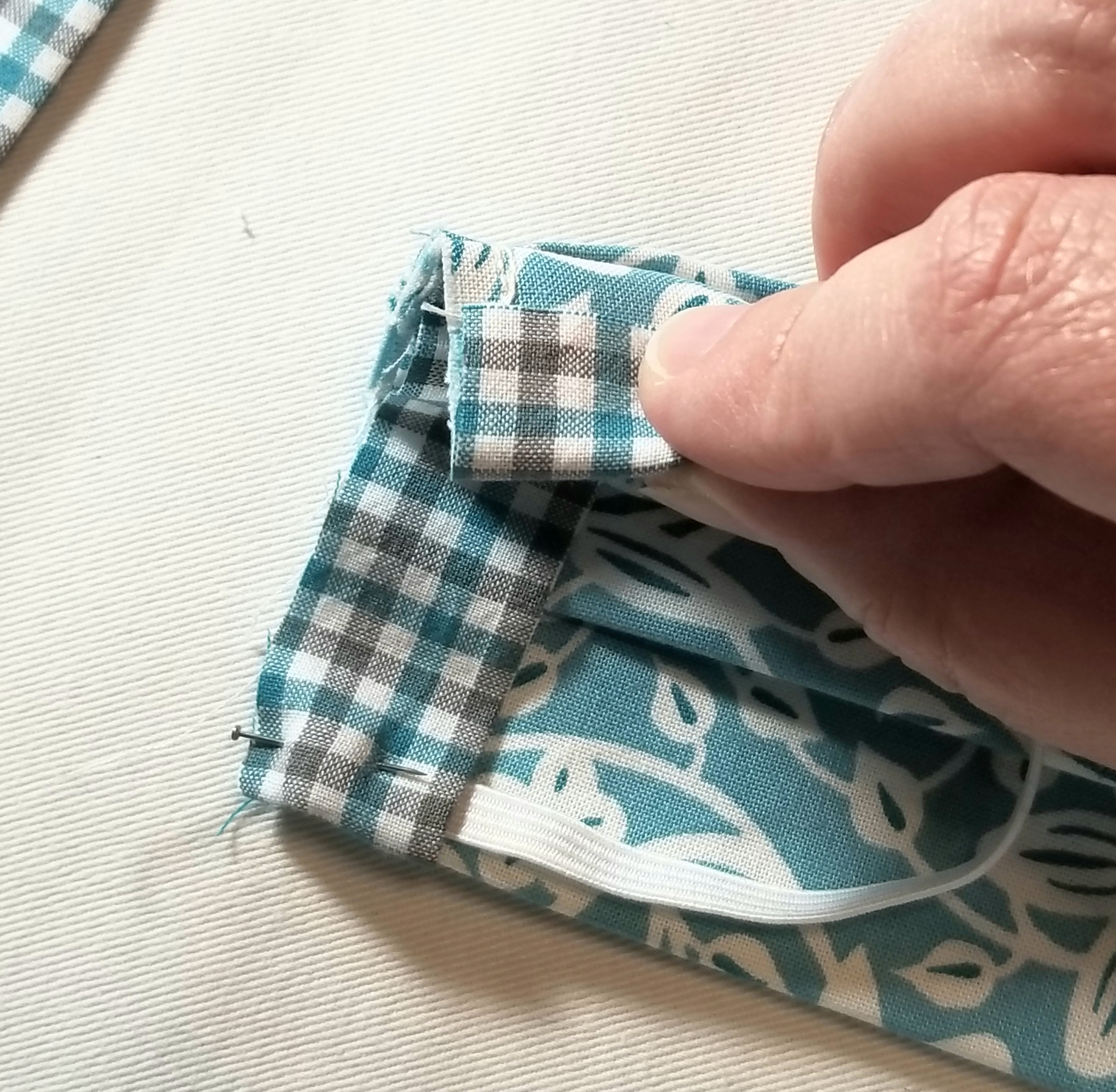
Fold the bottom edge of the accent fabric strip to the back, just as you did with the top edge.
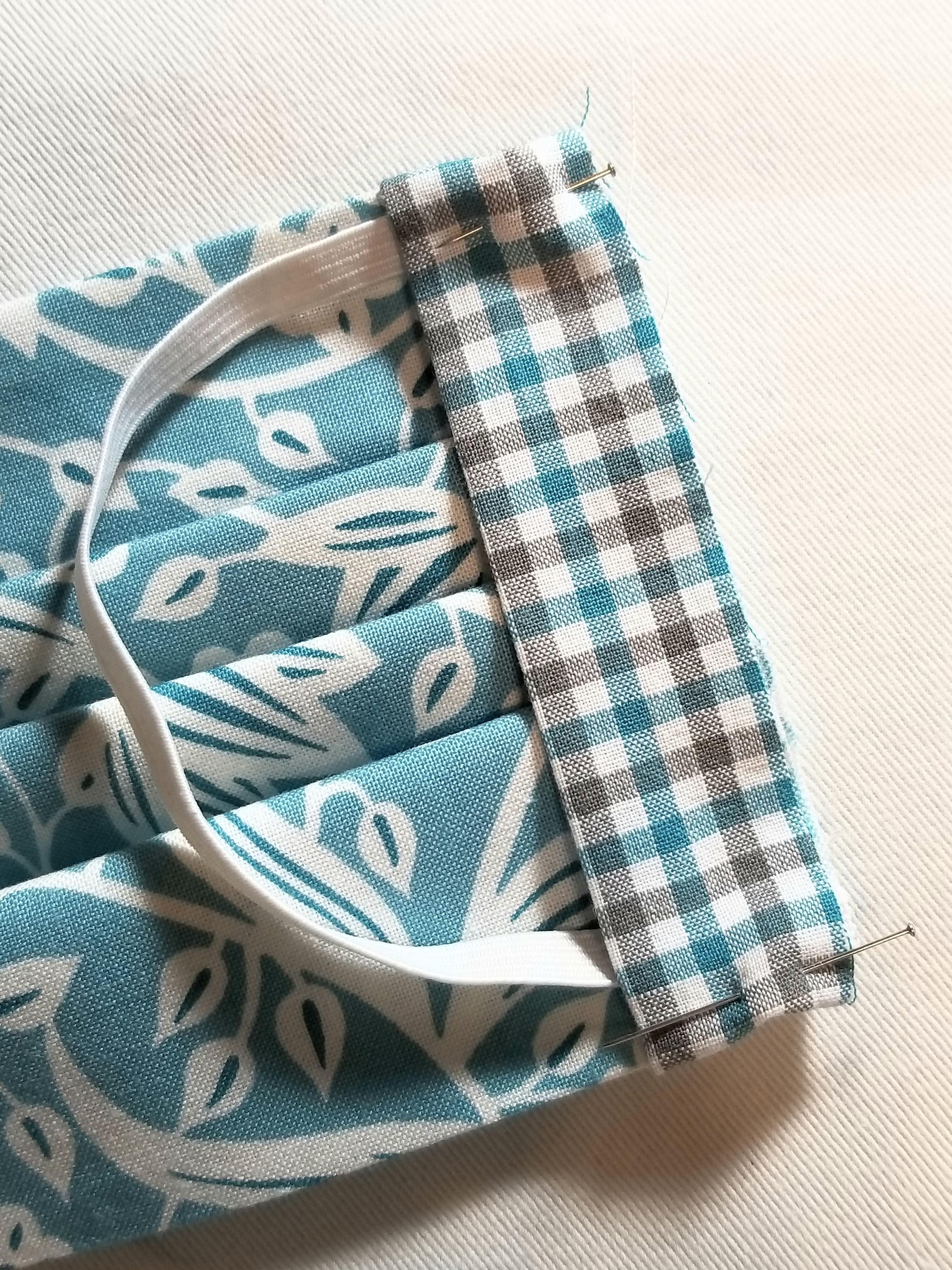
Pin both ends in place.
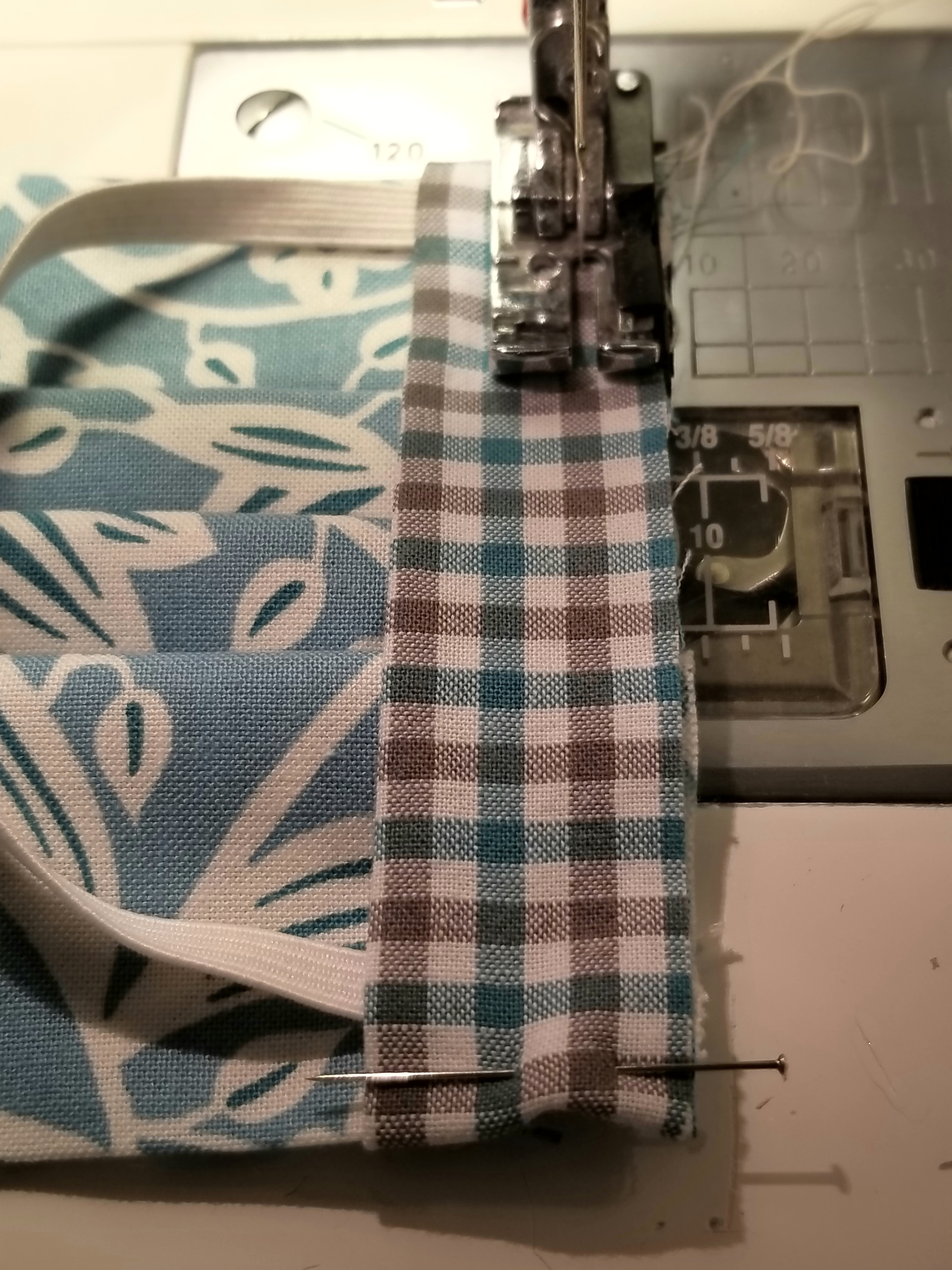
Using a 1/4 inch seam allowance, stitch the length of the entire edge, making sure to back stitch at the beginning and end.
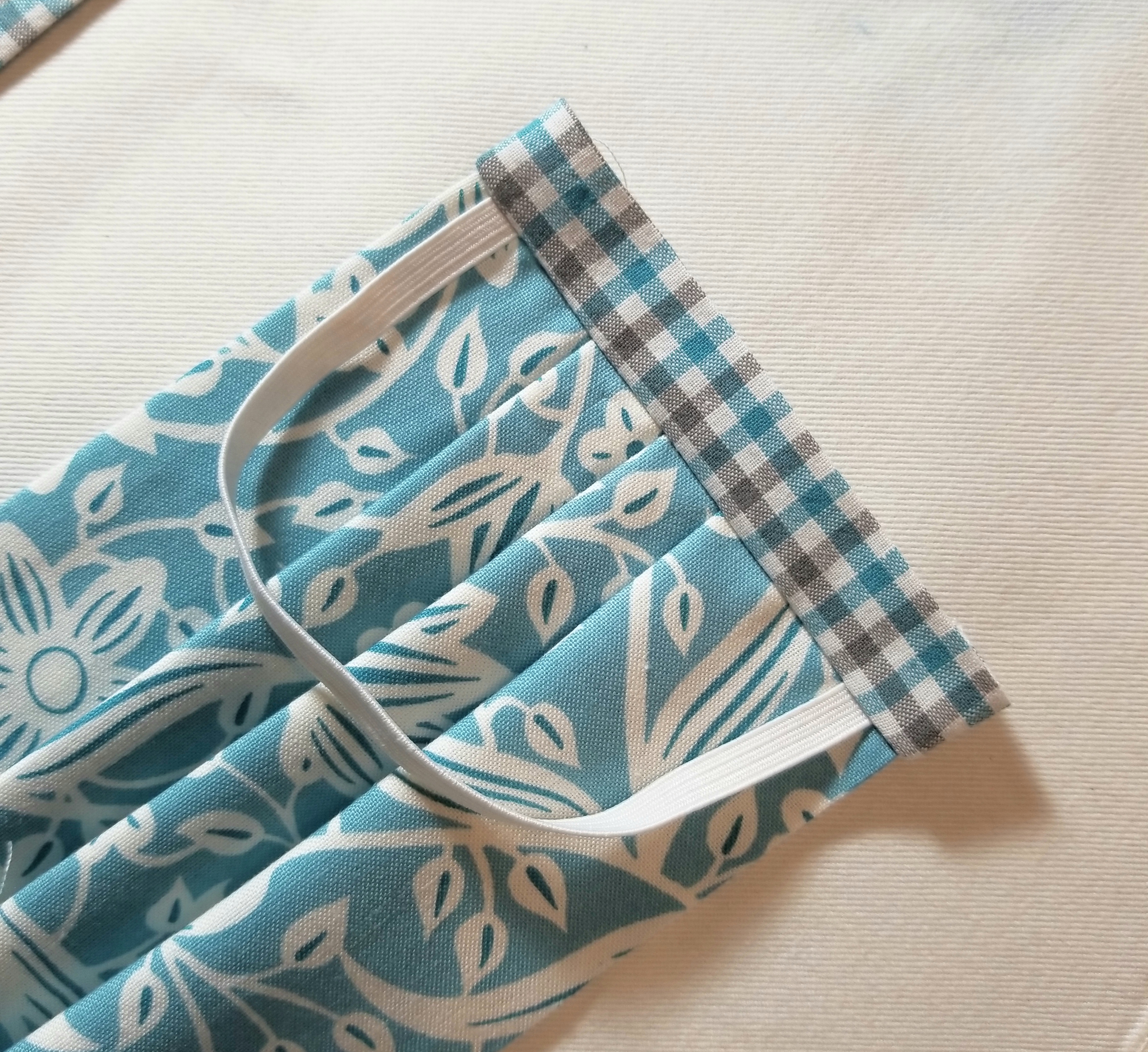
Open the the accent fabric strip seam by flipping it outward away from the main pleated piece, then press.
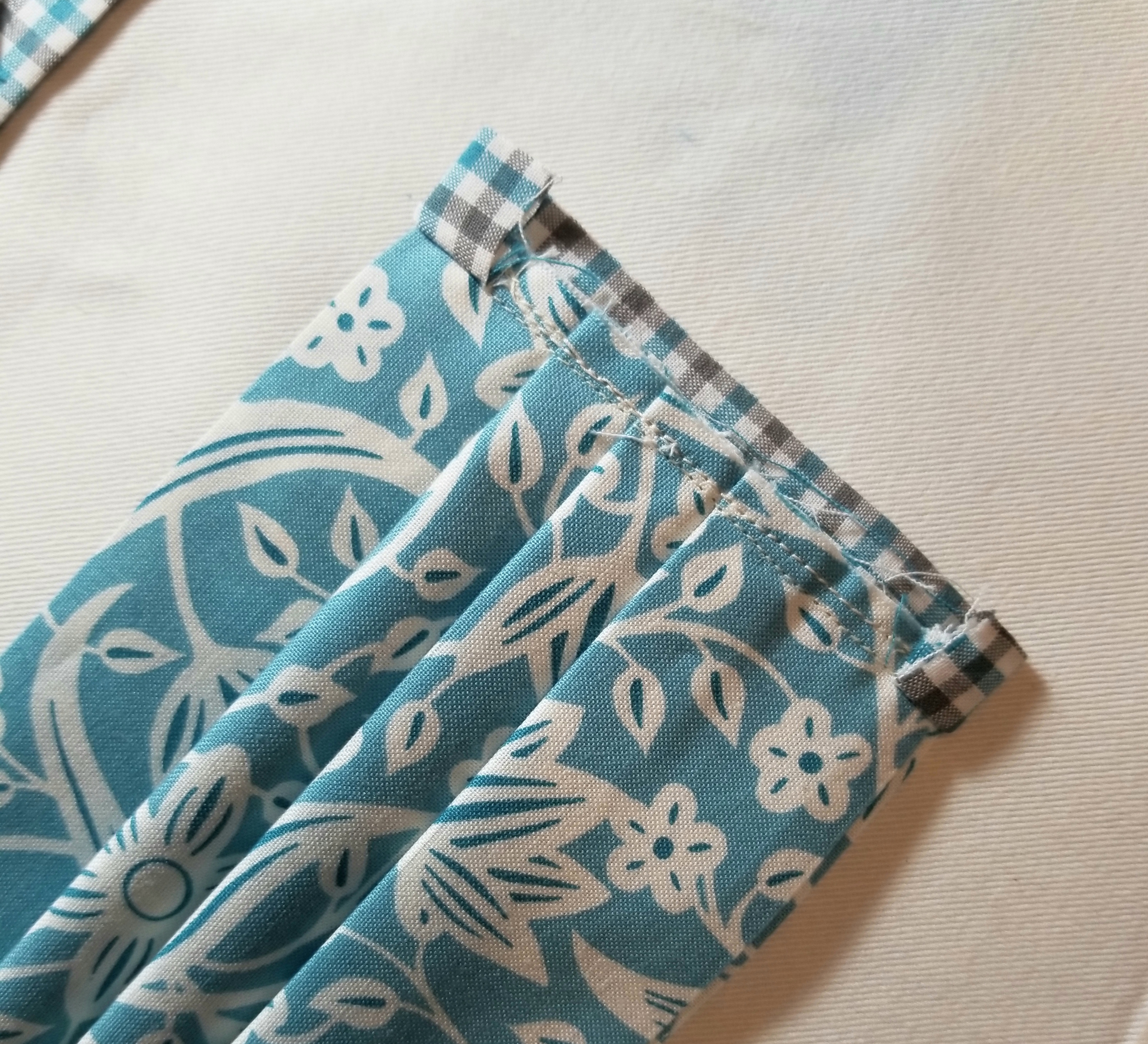
This is what the mask should look like if you flip it over.
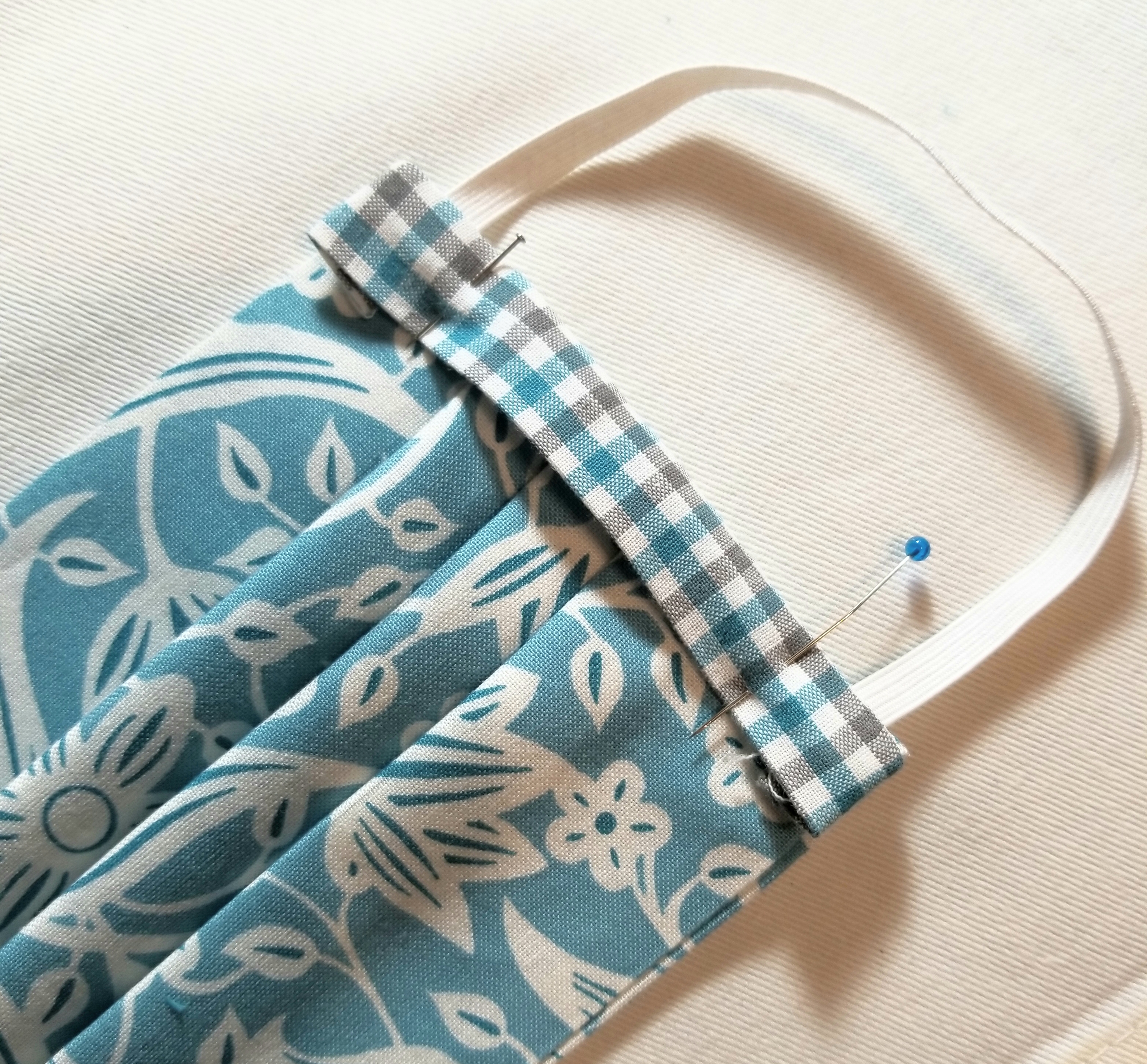
fold the ENTIRE accent piece down toward the main pleated piece, encasing the raw seam. You will now see the accent piece on this side, but not at all on the flip side. Press. Pin edge down.
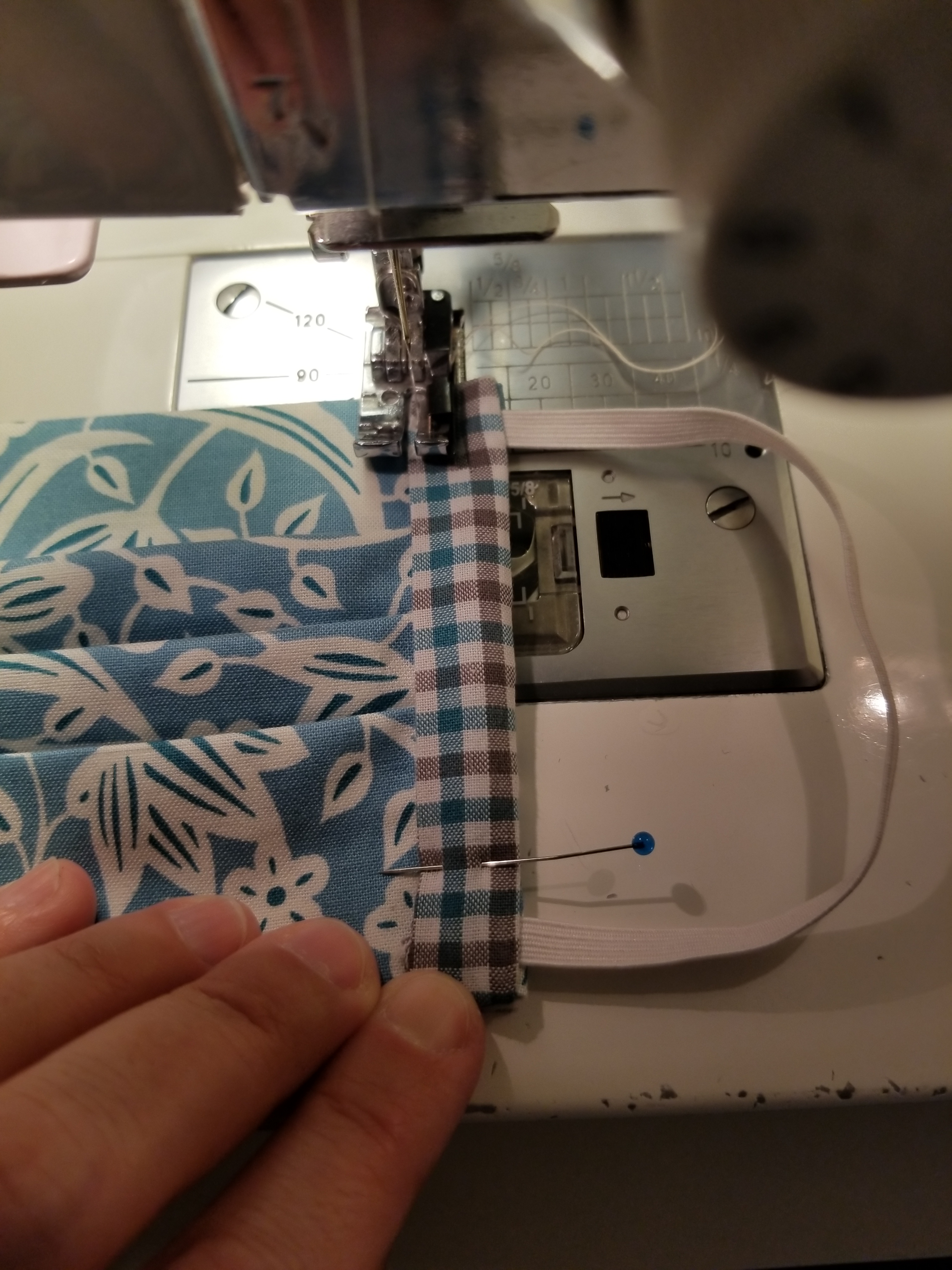
If you are a good sewist, you will change out your presser foot to a straight stitch foot. If you are lazy, like me, you will keep that 1/4″ presser foot on your machine and struggle your way through this next step. 😀 Stitch this accent strip down to the main body of the mask, sewing along the edge, making sure to back stitch at the beginning and end.
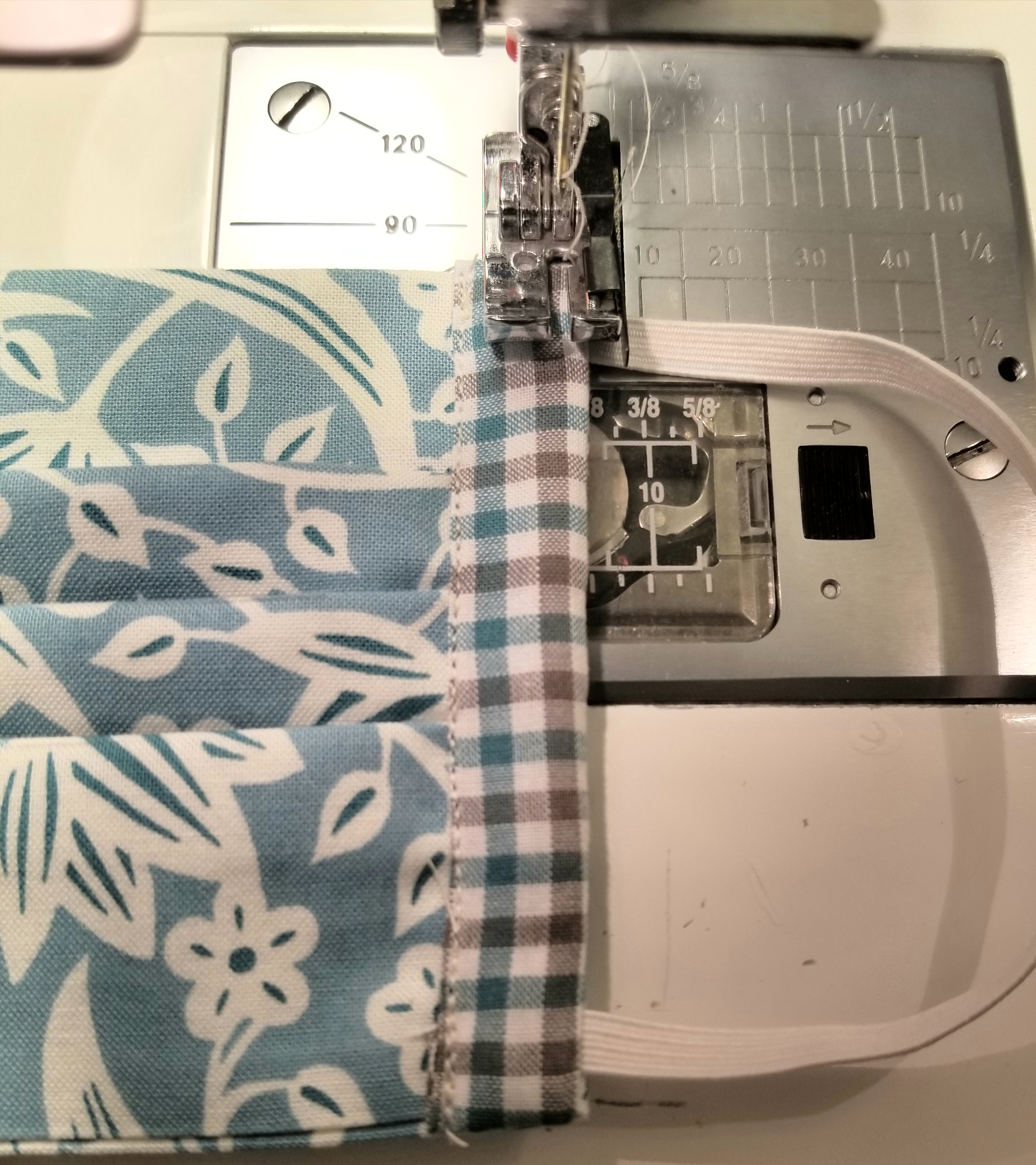
This step isn’t necessary. It just gives it a nice finished look, and helps to give that elastic a little extra stability. Stitch down the edge of the mask close to the elastic side.
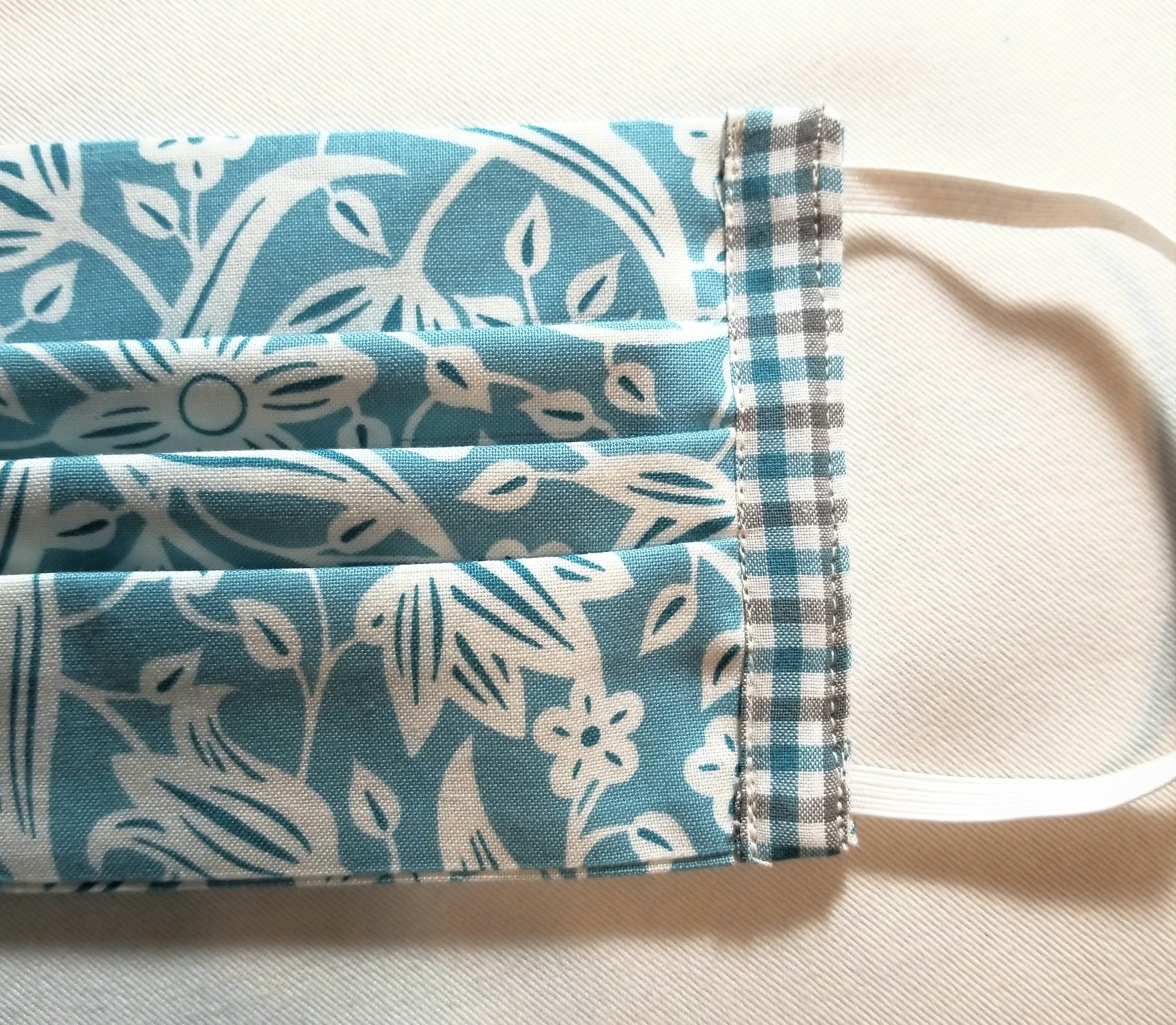
The front of your mask should now resemble the above picture.
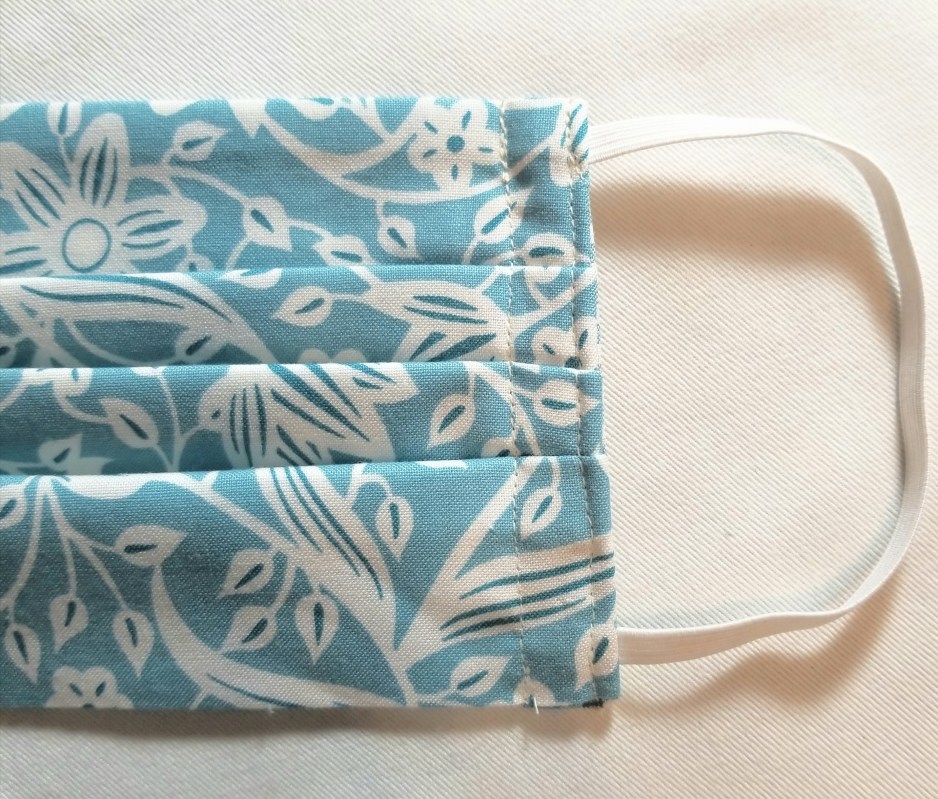
The back of your mask should look like this. Following the previous steps, attach the remaining accent fabric piece to the other end of the mask.
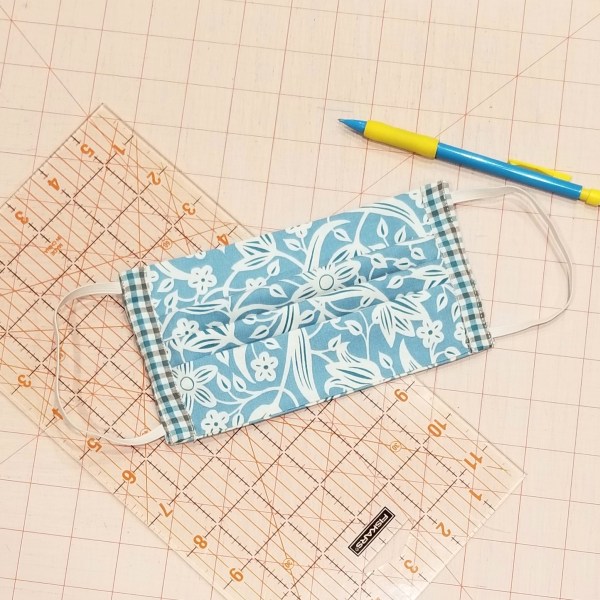
You should now have a reusable, washable mask that measures approximately 4″ x 7″ (unopened).
It took a few hours to put this free tutorial together for you. For this reason, I am greatly appreciative for any mentions that you can give me if you should use this tutorial. If you post a picture on social media, you can use the hashtag: #buttoncountermask. Feel free to share this page, and please tag me in your pictures so that I can see your beautiful creations. Last, I appreciate constructive criticism, so if you notice something that doesn’t look right, or does not make sense, bring it to my attention. I am happy to clarify any steps where you may have questions.
Enjoy!
P.S. Obviously, the elastic length can be adjusted to your facial measurements.
EDIT (March 24 2020): Because this tutorial has recently been used on a large scale, I will be adding a few things here as frequently asked and answered questions, suggestions, and reminders.
- This tutorial was happily shared by me over a year ago. This is not a new tutorial created in light of the current virus pandemic. I am not in charge, nor affiliated with any organization or entity requesting masks to be made. There are multiple organizations that are using this tutorial for their requests. If you have any question regarding what their requirements are, you really, really, really need to ask them. Please understand that I cannot and will not tell you what you should use, or how you should make your mask different from my tutorial.
- Keep in mind also that there are multiple entities that are using this tutorial for their requests. One entity may have completely different requests regarding features than another entity. (for example one organization is requesting a 4 layer mask, while another is fine with the two layer, as their thoughts are that they can be doubled up or used as a cover or liner to another kind of mask.) So, there is no correct or incorrect mask. Who are you making your mask for? Those are the people to whom you direct your questions.
- CHILD OR BABY MASK: After much thought, I have decided that it is in my best interest to NOT supply a mask tutorial for anyone other than an adult. One of my reasons for this is that I feel that a mask could pose as a choking hazard, and I do not want to have any part of that scenario. My suggestion is that you really should ask each individual child’s doctor or provider what their guidelines are, and go from there.
- I will not be held responsible for any mask misuse or malfunction.
- ELASTIC OR TIES? The main reason why my tutorial uses elastic is so I don’t have to tie it behind my head and mess up my hair. That’s it. So, if you are making the tutorial, and you don’t like the elastic, or if the person who you are making your mask for, requests ties; by all means put ties in yours. My pattern is very easily adapted to your preferences. There are organizations specifically asking for elastic, and some that are asking for ties only.
- ELASTIC LENGTH: I have read that a few of you recommend longer elastic; however, mine ended up being slightly loose. Therefore, I will not alter my pattern. I have stated in the tutorial that elastic length will need to vary due to the fact that human heads are not uniform (Thank goodness).
- I don’t have a PDF or printable version of my tutorial. If I decide to do that, I will; but it will be in my own time. I have received many hateful comments (that I deleted) demanding that I provide this. I need to remind those few sour apples that I am under zero obligation to do so. If my absolutely free visual tutorial isn’t to your liking, I invite you to go find one that makes you happy. If you are a person who often finds themselves using the words ”I need you to…”, you might fall into this category.
- I am completely honored that many of you are using my tutorial, or even certain aspects of it to help people in need. Even if you are using a completely different tutorial or pattern and just stopped by to check this one out, I applaud you for being a maker during this time. I cannot express enough how happy it makes me feel to see so many humans getting together to do something for the greater good. Please continue being that human. Those are the best ones.
I am signing off now to take care of my family, who needs me now more than ever. Thank you all for your kindness and understanding. God Bless.


Your math does not add up
Randy, please let me know which part doesn’t add up, so I can hopefully clarify. Thank you for your feedback.
There is something seriously wrong with this pattern . I have tried it several times and the edge piece application when turned does not work at all. Please don’t tell me I don’t know how to sew- I have been sewing Vogue designer patterns since I was in high school. Have made two wedding gowns , costumes for plays.
Julia, I promise that there is nothing wrong with the pattern, but maybe there is some miscommunication in understanding on both of our parts. I really think that you are trying to take the edge piece and fold it around to the other side. What you are really supposed to do is, once you sew that accent strip down to the mask, open it completely. Press it open. then fold the entire accent strip to the other side. This means that you will only see the accent strips on one side of the mask, not both sides (front and back). Good luck, I hope this extra information helps you out.
Thank you for an easy to follow tutorial. My best wishes to you and your family.
Thank you, Sonia. It really has been a crazy couple of weeks, and will continue to be crazy, but we are going to be stronger for it, right? Best wishes to your family as well.
thank you so much. finally a pattern i can go by and it’s perfect. again thank you dear
Mary, Thank you for your feedback. It makes me happy to know that this worked out well for you.
thank you for this tutorial I learn the option of how to shorten the elastic. Our pattern is similar only I used 3 separate pieces of fabrics a nice printed for outside face, inner not as nice, and white one next to mouth. I put a tack for the nose . My elastic go around the piping at the sides. I find yours more economical on elastics.
Thank you, Mercedita. you are right about elastic needing to be economical in use. I have been known to reuse elastic or any stretchy, knit material to finish these. Happy sewing.
hmm, good ideas
I got a pair of sandals in the mail, they were tied together with thin black elastic, which I reused for my mask! lol
Annie,
Oh, good idea. Now I am never going to throw those away. ha, ha. Reduce, reuse, recycle. Am I right? Happy sewing.
Thank you for your awesome tutorial!
You’re so very welcome!
Pingback: Plague, But Make It Fashion | Lorrie Kim
Thank you so much for providing free access to your pattern, and very detailed instructions and pictures. I found this very easy to follow and the end product is great quality. The accent strips on the sides are such a nice finishing touch. Thank you!
Mary, thank you so much! The accent strip was a way for me to remember which side is facing out in the event that I took off the mask. I am so glad to hear that you were able to make a nice, finished mask.
I really appreciated your instructions!!!! I can hardly wait to begin.
I hope you were able to tackle this with success. Thank you.
I’m new to using a sewing machine. I’m having a hard time with getting close to the edge of the fabric without it slipping off. Any suggestions on how to keep my fabric centered?
Bobbie, one thing you can do, if your machine has this feature, is to move the needle position over a little bit so that it naturally sews a little to the right, closer to the edge of the fabric (or left if your trying to scootch over that way) When you change the needle position, just make sure that your presser foot accommodates that (might need a zig-zag presser foot). But really if it slips off, just cuss a little, back stitch, and go at it again. Perfection is for losers. 🙂
Thank you for this mask tutorial. I tried making a mask with a different one but it took a week to make the first mask and two days for the second one. And I still haven’t made one for myself or my 83 year old mother!. I read through all your directions and I’m pretty sure I can finish more than one in a single day. Right now I’ve got requests from 10 friends and/or family members. With your tutorial I think I’ll be able to do it. Thank you so much for sharing this
Oh my, I hope you are able to get them made a bit faster with this tutorial. It should be pretty easy. I have been telling people that the first one goes slower, but you get faster once you get the hang of it. Try to batch your work (cut ten pieces, sew ten pieces, press ten pieces, etc.) Good luck.
I like your style for get them you are a blessing remember when you are doing good there are those that tried to throw . you under the bus crew is the same ones that tried to kill Christ .keep on stepping you owe them nothing Christ already paveed the way blessing to your family
I wanted to thank you for such an amazing pattern, will help me out when dusting and gardening. Truly appreciate all the time and effort you took to sharing a great pattern. Thank you! Marie, Alberta, Canad
Thank you, Marie. I too use mine for cleaning (especially the oven or shower, yuck) and I also use my mask when using potting soil to avoid Legionnaires’ disease. Having asthma means being extra careful. Happy sewing!
So true for asthmatics! At least now, we are not the only ones wearing them,
Thank you – I have looked at several patterns to make masks for our Food Pantry guests and this is by far the easiest one since I want to make several.
I am so glad that you can use this. I wish I had a photo comment section to see all of the amazing masks that people such as yourself have made. Good luck!
I have made about 7 of these. As soon as I get an order of fabric and elastic I’ll make more. Easy and they fit well.
I made about 10 of them today using ties. It takes longer, but I was able to use up fabric scraps that way. Elastic has been a little scarce, right?
Try Amazon for your elastic. They have 1/8” roll. Have no elastic try hair/ponytail holders. The size is just about right and you can get a card of about 20 from Dollar Tree.
By the way, I added firm stabilizer between the 2 layers.
Thank you for this tutorial, looks like I can do this. Am going to do this in the am.
Stay well
Hello Monica, thank you so much for provding this tutorial! I’ve made several masks for my family and friends and have recommended your guide to my students across the globe. We really appreciate it, and your masks are being made in the UK, Spain, Germany and Russia right now!
Suzanne, wow! Such great news that so many of your friends and family are able to use this. It’s good to know that my sharing is appreciated by you all. Happy sewing.
Pingback: DIY Fabric Mask – Countless Blessings
Pingback: 25 Sewing Patterns for Face Masks to Keep Your Family Safe - Elma Craft
Hi, thank you so much for sharing your tutorial and your tips. I was wondering what dimensions you would recommend for a larger size? (eg men size?)
Caroline, for a larger mask I would try making the cutting dimensions 9” x 14” instead of 8” x 14”. You will continue to follow all of the directions exactly. If this turns out to be a bit too big, then cutting the piece 8 1/2” x 14” is the answer. You can likely get away with checking the width of the fabric piece by having this person hold both sides up to check for coverage, before you make the pleating steps, to save you time and effort. Thank you for your question. Good luck.
Just wanted to give Thanks to you for such an easy format to follow! Im an art teacher who dabbles in everything and not really a sewist by trade….you make this so much simpler….many thanks…..using for food delivery, supply runs for dropping off to students, an run arounds…my mom, sister and I are all making them for family and friends! You rock!
Kim, Thank you for your wonderful feedback. This is so awesome that you were able to introduce this to your mom and your sister. Thank you for being essential. You are greatly appreciated. Stay safe.
Thank you sooo much for this tutorial. With Covid-19 requirement of wearing masks I needed something quick and some thing my kiddos would wear. They picked out fabric from my scraps for themselves, me and Daddy. The smallest one I took off an inch or so due to my youngest’s small size. Instead of elastic I used the elastic straps I’d saved from buying shoes at store. Tried to post photo but failed.
Janel, this is excellent feedback. I hope that some of my readers here can use your information for their own needs. Thank you for visiting me.
Thank you so much for making this tutorial! I’m the only one in my family who can sew and I want to contribute while I have time between college online classes. Quick question: do you pin the pleats down through all the fabric or just pin the pleats themselves? Just wanna make sure I’m doing this correctly. Thanks!
Camille, I pin the pleats down through all layers. My pins are glass head, so I can iron right over them, but if yours are not, you can just iron over all the parts except those pin heads. Now for full disclosure: I have made so dang many of these babies, that I don’t even use pins. I just press each pleat and jog over to my sewing machine. I am so glad that you are taking this on. Great job, and thank you very much.
Hi-thank you for posting. What kind of material did you use? It looks nice and thick.
I used regular ol’ quilter’s cotton. It is a medium weight woven cotton that is used in many projects, but most commonly, quilts. It is slightly heavier than a shirting fabric, but with a slightly looser weave than that. I personally chose cotton, because it can withstand higher temperatures for cleaning and drying, and synthetic material harbors bacteria more readily. This was a personal preference, so I don’t necessarily recommend one fiber over the other for other people. Thank you, Sandy, for stopping by.
Thank you for generous and thoughtful tutorial. I’ve been looking for a written pattern for a while – I need to be able to look at a still picture to figure out what to do next – and yours is perfect. I appreciate the time you spent making it, and I hope you are rewarded by learning how much you have contributed to the goodness of the world. Thanks again.
Jan, Your words are so kind and so much appreciated. Thank you for them. It makes my day. I am also glad to hear that my pictures are helpful. When I made the tutorial, I thought ‘Oh, my…this is a bit long, but thorough.’ Then I decided to go with my gut, and that was ‘Thorough is always best’. Have a great week ahead.
Thank you for this tutorial and especially the photos! There are many versions of the pleated face mask out there but your tutorial seems to encompass the best ideas in an easy to understand way. I’ll add a metal nose piece and maybe a pocket, but your tutorial removed any doubts I had about the basic construction. Thanks!
Nancy, so great to hear! Yes, back when I made the tutorial, I had a hard time finding anything that I could use to make my own, so I just looked at a cheap disposable one, then worked out the measurements. Now you pretty much have to wade through a ton of mask tutorials, patterns, pictures, diagrams, warnings, and contradictions before you even dare to cut your fabric. You are a daring soul. :D. Thank you so much for stopping in. Happy sewing.
Thank you so much! I’ve barely gotten into sewing but have lots of supplies so I’m going to try my hand at this! These directions are PERFECT for me!!!
Lisa, you can do this. You really can. Go slow the first time, then blaze through the next 20. ha, ha. I am so happy that you are here. Thank you for visiting.
Im going to be one of those people that says, ” you need to”… Followed by, give yourself a huge hug from me thanking you for everything you are doing and continue to do. And to the others…
Don’t let the door but ya,where the good Lord split ya!
Terri, that is some pretty darn good advice. :D. I might try making pot holder tutorials next…something a bit less controversial. lol! Thank you so much.
Is it normal that I kind of struggled with the last step (not including your finished edge), where I fold the fabric over and see through lots of layers? My stitching wasn’t great and I had some trouble getting it to stay in a nice line. I took off the 1/4 inch presser and used a straight one, but I’m new to this and wasn’t sure if I had done something wrong toward the end.
Jessica, It’s completely normal, especially if you are somewhat new to sewing, which is absolutely fantastic, by the way! Sewing through multiple layers brings out the best of cuss words in my honest opinion. Also, you will notice that it is easier for either older (heavier, durable) sewing machines, or newer ones that are not entry level, to sew through multiple layers easier. Do not let this discourage you, but if you do have an entry level sewing machine, try testing out a good used one that is older (I’m talking…you can find good old singers from the fifties and sixties that are next to nothing cost wise), or try out a mid priced or used Juki or Janome, just to see the difference in ease of use. I am not affiliated with any sewing machine company, so my feedback here is not biased. I hope this is helpful information. Keep sewing girl, and don’t worry about those ‘nice lines’. They will come.
Thank you so much ❤️
Thank you for taking your time away from your family to create such a wonderfully made tutorial. This is a lovely mask and tutorial. I am using it to help make mask for a local church to give out to its congregation when they resume services in May. This is the perfect patern to be able to produce several very quickly. Thank you again.
Adrienne, thank you for your kind feedback. I hope you enjoy making this; so that you are able to put it to good use for your congregation. Just know that these are not covid-19 level N-95 masks, so you will know to use them with some caution. Just putting that out there for your protection. They certainly are better than not wearing one at all. Good luck to you.
Thank you so much for putting the time in to make this tutorial and answer all of the questions. I will be using your pattern for my next round of masks. Your easy to follow pictures are a blessing!
Susan, thank you very much. I hope that you are able to tweak the pattern to accommodate making multiple masks at once. Good luck, and don’t forget to take breaks.
In searching for a mask style for no medical people, I like yours the best. Have been home mostly and have used a scarf when grocery shopping. It will get warm soon and I will need a mask. And I agree, I can not stand tying stuff in my hair.
Clara, Yes, I really prefer the elastic, personally. It is just so much easier to take off once I am finished using it, and much easier to put on when I am in a hurry. I do keep a few of them in rotation, switching them out as often as possible, and tossing the used ones in the wash right away. I mostly need mine for allergies and cleaning, but I am not going to pass up using them in today’s circumstances, even if they aren’t a high level of protection. I am so glad that you find this one comfortable. Thank you for trying it out.
Thank you so much! I really appreciate your thoughtful instructions and photos. : )
Elizabeth, You are welcome. I hope my tutorials in the future are as well liked. Sew on!
I LOVE this tutorial with pictures! I’m sure it helps many of those unfamiliar with sewing. It was easy to follow. I think I’ll go make one, as the pleated one I made left a lot to be desired. I had trouble with thickness and my machine made messy stitches at both ends when sewing over elastic. I think when I go back to SD (we’re in AZ) and can use my Viking sewing machine with movable needle position, it should go much better… Thank you SO much and pay no attention to those who take time only to criticize you.
Bonnie, I just love hearing about new sewers being able to tackle a project with ease instead of anxiety. I hope that you were able to make one of these, somewhat easily. I have a good plenty family from SD. It is a beautiful place that holds my native roots. Thank you for visiting my humble blog. Take care.
Waow..I really love this…
Thanks so very much ma’am
God bless you too
Rahmah, You are welcome, and good blessings in return.
Thank you so much for explaining the pleats. I have been making masks, and my pleats only look like tiny folds on the side of the mask….it’s been driving me crazy. Thanks for such an easy tutorial to follow – and best to you and your family!!! (Also, you’ll find that friend one day 🙂 )
Zizi, You are welcome. The pleats make a huge difference in how well a mask fits the face. I hope this turned out to be the case for you. I am glad to hear that it was somewhat easy to follow. Thank you for that feedback…and yes, I think a good friend is around the corner, it can only be a matter of time. 🙂
Thanks for posting this. I’m
Not great with sewing but will give this a go.
If I can make just one on my own I will be happy.
Gail, I am not a racehorse sewist, but more of a Clydesdale. Slow, strong, and steady always has a good finish. Good luck.
Hi Monica,
I’m a nurse working in the midst of this unbelievable pandemic. In my humble opinion, any mask is a helpful mask at this point. I plan to make them for my family, friends, neighbors and for myself. We can wear them while running errands as we begin to go out in public more and more in the near future. The N95 masks we wear at work make it so hard to breathe but I’m so very grateful I am protected at work!
I am not very experienced with sewing but I came across your tutorial and I’m planning to try this one. You made the mask sound so easy and your instructions appear very detailed (which will be a saving grace for me)!
Thank you for sharing your expertise!!! I plan to use the sewing time as a little therapy!!! Something that is creative, useful and has a good outcome no matter what will be a welcome change in my world!
I find it sad that people “demand” things from others they don’t even know. I wonder what kind of lives these people have? I hope they wake up as a result of this pandemic and see that life is too short to be hateful. Being kind sure makes the life we have a little sweeter!!!
Thank you again for your tutorial!!! Take care and I pray you and your family stay well!!!
Kim, My sister is a nurse as well, and has the same thoughts. A mask is always better than not. I think that there is way too much overthinking of things to the point that we over educate our common sense, and by doing so, end up completely confused about what the right decision or answer should be. Good ol’ gut instinct is usually right.
I hope that you had good luck with this. Thank you very much.
I am so glad that this tutorial is beneficial to you and your family/friends. It makes me feel good to know that this has been helpful during this time (or any).
Thank you so much! Very easy, simple and friendly user pattern and instructions. Pictures were of great help!
Lourdes. You are ever so welcome!
Thank you so much for this tutorial. I added a pocket and copper wire to mine but your pattern got me going. So far I’ve donated 150 to essential workers and I’m still going. I love your pattern because it withstands many washings. It may be a bit more work than the simpler patterns out there but these last abuse.
Jenny, 150! that is amazing! I am sure you don’t need my humble pattern any longer, as you can probably do this with your eyes closed. 😀 Thank you for your kind feedback.
This is a wonderfully detailed, comprehensive, and easy to follow tutorial. I did find that my fat head required different measurements for the material. I started with 15″ x 9 1/2″ and used a 2 inch piece for each side bar. But this is a wonderful and well appreciated guide for making masks for this very weird time in which we live. Thank you very much for taking the time to create and post it.
Deborah, I am quite sure that your head is beautiful and just the right size. One of my favorite things about this mask pattern, is that it is so easily adaptable, by any range of sewers, be they seasoned, or novice. I am glad that you were able to make this one comfortable with some minor adjustments. Thank you for your comment. Happy sewing!
i am a novice sewer… and this part right here is throwing me off i cant seem to get the pleats correct please help
Flip the tube piece over. Match the crease edge to the second line that you made earlier. Press. The pleat that you just created will be 1/2 inch deep. Pin the pleat down on each raw edge end.
Victoria, Were you able to figure out how to get these pleats done? If you think of it like a paper fan, it might make sense. First you press a fold into the mask, then you take that crease that you just made by folding it, then place that crease on the second line. Press it down. Now, you have a pleat. One pleat, and it will be 1/2 inch deep from that first crease you made to the second one you made when you pressed it the second time. From here, you basically repeat this by following the measurements that I provided in the tutorial.
I have tried many times to print this tutorial out so I can refer to it as I am sewing but I can’t get it to print. Is it me our have you prevented this option?
Karen, I have not prevented this from occurring on your end, but I have not provided a PDF. That may be provided on future tutorials, but you shouldn’t have any problem printing anything on your end, as I don’t have control of that.
Pingback: 7 Easy To Make DIY Face Mask Patterns - Saving & Simplicity
Thank you for the pattern. Easy to follow directions
Jane, You are welcome. Thank you for trying this out. I wish you success with it. Enjoy.
Thank you so very much for your detailed pattern! My husband has a wood shop & saw-dust is constantly everywhere! This will help in the shop & with the pollens!!
Bless you & be well,
Perri & Joe
Perri, Oh yes, I have used mine while sanding shelves. It was much better than when I wasn’t wearing one at all. I hope he gets good use of the ones that you make for him. Thank you for your comment.
Thanks so much for this detailed guide. Works well and quite straightforward to produce masks which can be as quirky as the fabric available. So sorry to hear that you have had abuse, so inappropriate.
Carol, Thank you very much. I also found that even different qualities of woven cotton behaved differently with this pattern. I have yet to use it for other fabric types, but might try one eventually with t-shirt knit, just to see how it feels. Take care.
Pingback: Tea Packaging and DIY Face Masks - The Tea House | Loose Leaf Tea Specialists
Thank you for the tutorial but I do have one question. When pinning the elastic are you suppose to pin it to the right side of the mask or pin to wrong side. I’m having a difficult time figuring that part out. I guess the whole side bands are a little confusing to me.
Robin, it really doesn’t matter, because the mask is reversible, so there isn’t a wrong or right side, per se; however, when your mask is complete, your accent fabric will show on one side, and not at all on the flip side.
God’s Richest Blessings to You and your family Monica!
I just wanted to check in on you and see how you and your beautiful family are doing.
The last time I was on your blog, the comments were becoming very heated and unkind.
Your heart has been on my heart and I have been praying for the Lord to Bless you with His Peace & Strength during this time.
Thank you for your service and support to all of us trying to protect our loved ones.
God Bless. ❤
Hi Monica,
Thank you for the instructions and pictures of your mask! I am extremely visual and the pictures really helped when reading the instructions. I have made a few masks using another pattern that includes pipe cleaners in the fold area to crimp the mask a little around the nose. I wear glasses and this helps keep the mask tight. With your pattern, when would you insert the pipe cleaner? I’m thinking when I baste down the pleats, insert the pipe cleaner at the fold so the basting holds the pipe cleaner in place? Any suggestions?
Thanks again for your time to make this pattern available! Stay safe.
Noel, Thank you so much for your feedback. My tutorial doesn’t have a sheath to hold a wire of any kind. There are comments that were made about adapting the pattern to accommodate one, but I am leaving that up to you all to decide. I leave my pattern simple, so that you all can adapt it to your own needs and specifications. Good luck.